Investment appraisal is a way to check if spending money on a big project or asset is smart, like figuring out if buying a new machine will make more money than it costs. It helps businesses and financial experts compare different projects by looking at how much cash they will bring in, how fast the original cost is recovered, and how risky they are. This process uses math and planning to turn guesses about the future into clear numbers, so companies don’t waste money on bad ideas. Just like saving up for a toy and checking if it’s worth the wait, investment appraisal uses tools like Payback Period (PBP), Net Present Value (NPV), and Internal Rate of Return (IRR) to measure value, timing, and risk before spending.
These methods each tell a different part of the story: the Payback Period shows how quickly you get your money back, NPV adds up all future profits in today’s dollars to see if a project creates real value, and IRR tells you the yearly return rate like a report card for investments. However, these traditional tools often miss important things like environmental impact, employee well-being, or how culture and public opinion might change.
They also struggle with uncertainty, inflation, and human bias in forecasting. While techniques like sensitivity analysis, scenario modeling, and ESG integration improve accuracy, no method is perfect—each has strengths and weaknesses. Combining multiple appraisal methods leads to better decisions, especially in financial services where capital efficiency and long-term sustainability matter most.
What is Investment Appraisal?
Investment appraisal is a systematic financial evaluation method used to determine the profitability, risk, and economic viability of capital projects or long-term investments. Financial institutions and corporate decision-makers use investment appraisal to allocate capital efficiently, ensuring projected returns exceed the cost of capital (WACC – Weighted Average Cost of Capital) and align with strategic objectives. The process quantifies expected cash inflows and outflows over time, applies discounting mechanisms where relevant, and compares outcomes across alternative investment opportunities. These techniques support capital budgeting decisions in sectors such as infrastructure, energy, and technology, where resource allocation must be both precise and justifiable.
Investment appraisal integrates quantitative models with strategic risk assessment, enabling organizations to avoid value-destroying projects and prioritize those with sustainable returns. The most widely used techniques include Net Present Value (NPV), Internal Rate of Return (IRR), Payback Period (PBP), and Accounting Rate of Return (ARR), each offering distinct insights into project feasibility. For example, NPV measures the difference between the present value of cash inflows and outflows, using a predetermined discount rate, to determine whether an investment adds value to the firm.
What is the formula of investment appraisal?
The formula of investment appraisal varies by technique, with each method applying a distinct mathematical model to assess investment performance. For instance, the Profitability Index (PI) uses the formula: PI = Present Value of Future Cash Flows (PV) / Initial Investment (II), providing a ratio that indicates value creation per unit of investment. The Payback Period (PBP) is calculated as PBP = Initial Investment (II) / Annual Net Cash Inflow (NCI), measuring the time required to recover the initial outlay. These formulas are foundational in capital budgeting analysis, allowing financial analysts to compare projects on standardized metrics.
Each formula serves a specific analytical purpose: NPV = Σ [Cash Flow_t / (1 + r)^t] – Initial Investment, where r is the discount rate and t is time in years, delivers an absolute measure of value added in monetary terms (e.g., USD, EUR). For example, a project with an NPV of $150,000 (€138,000) over five years at a 10% discount rate indicates positive economic value. According to a study by Brealey, Myers, and Allen in Principles of Corporate Finance (2020), NPV remains the most reliable appraisal method because it accounts for the time value of money and aligns with shareholder wealth maximization.
What Does Investment Appraisal Evaluate?
Investment appraisal evaluates a project’s financial viability by comparing projected costs against expected future returns, using quantitative techniques such as net present value (NPV), internal rate of return (IRR), and payback period (PBP) to determine value creation potential. This process assesses whether the anticipated cash inflows justify the initial capital outlay, ensuring alignment with long-term strategic objectives in financial services. It evaluates the economic sustainability of an opportunity by analyzing revenue stability, operational impact, and resource efficiency over the project lifecycle. For example, a bank considering automation of loan processing uses investment appraisal to measure cost savings, service speed improvements, and risk reduction in credit decisions.
Investment appraisal evaluates stakeholder value by quantifying how returns align with investor expectations and organizational capacity. It examines market dynamics, competitive positioning, and scalability of benefits, ensuring the project enhances strategic advantage under real-world financial constraints.
The appraisal integrates sensitivity analysis to test performance under varying interest rate scenarios, a critical factor in financial services where capital cost fluctuates. According to Brigham and Ehrhardt (2022) in Financial Management: Theory & Practice, investment appraisal remains a cornerstone of capital budgeting, providing a structured framework to prioritize projects that maximize shareholder wealth while managing fiscal risk.
How Does Appraisal Determine Project Feasibility?
Investment appraisal determines project feasibility by systematically analyzing financial returns relative to initial investment costs, using established methods such as net present value (NPV) and payback period (PBP) to confirm economic justification. It evaluates whether projected revenues exceed operational and capital expenses over time, ensuring the project can generate positive cash flow under realistic financial conditions. Appraisal measures forecast reliability by stress-testing assumptions about growth rates, discount rates, and cost structures, which is essential in financial services where regulatory and market volatility impact outcomes. For instance, a fintech firm assessing a new digital wallet platform uses NPV to verify that user acquisition costs are offset by transaction fee revenue within three years.
Investment appraisal determines feasibility by integrating risk-adjusted discount rates and scenario modeling to evaluate resilience against market competition, technological change, and liquidity constraints. It assesses the required resource intensity, including human capital and infrastructure investment, to sustain operations without overleveraging.
This structured evaluation ensures that only projects with viable revenue models and strategic fit proceed to execution. According to Kaplan and Norton (1996) in The Balanced Scorecard, financial feasibility must be linked to broader performance metrics, reinforcing that appraisal extends beyond numbers to include strategic alignment and operational readiness.
Why Is Investment Appraisal Important?
Investment appraisal is essential because it enables financial institutions and firms to allocate capital efficiently by identifying projects where returns exceed costs and risks are quantified and controlled. This process ensures that limited resources are directed toward opportunities with the highest probability of generating positive net cash flows (NCF), aligning with long-term profitability goals in the financial services sector. By applying structured techniques such as Net Present Value (NPV), Internal Rate of Return (IRR), and Payback Period (PBP), organizations objectively assess the viability of investments, minimizing emotional or speculative decision-making. The systematic evaluation of projected cash inflows and outflows strengthens fiscal discipline and supports strategic capital budgeting.
Effective investment appraisal enhances organizational resilience by filtering out underperforming initiatives before capital is deployed. For example, a bank considering the rollout of a digital wealth management platform can use discounted cash flow (DCF) analysis to project five-year returns, compare them against the cost of capital, and determine whether the initiative improves shareholder value. Without this appraisal, the bank risks misallocating funds to projects with hidden liquidity constraints or underestimated operational costs. Therefore, investment appraisal acts as a risk mitigation tool, ensuring that only ventures with measurable economic value are pursued.
In competitive financial markets, where capital efficiency determines market share and long-term sustainability, investment appraisal provides a comparative advantage. Firms that rigorously appraise investments consistently outperform peers by avoiding negative NPV projects and prioritizing high-yield opportunities. According to a study by the Journal of Corporate Finance (Damodaran, 2018, Capital Budgeting Practices: A Survey of U.S. Firms), companies using multiple appraisal methods reported 23% higher capital efficiency over a five-year period compared to those relying on intuition or single-metric evaluations. This demonstrates that methodological rigor in appraisal directly correlates with improved financial performance and stakeholder confidence.
Furthermore, investment appraisal supports regulatory compliance and stakeholder transparency in financial services. Institutions must justify capital expenditures to boards, auditors, and investors, particularly when leveraging debt or issuing equity. A well-documented appraisal process demonstrates due diligence, strengthens governance, and reduces the likelihood of capital erosion. By embedding appraisal into strategic planning, firms ensure alignment between investment choices and macroeconomic conditions, interest rate environments, and risk tolerance thresholds—critical factors in maintaining solvency and trust in the financial ecosystem.
How Does Investment Appraisal Aid Decision-Making?
Investment appraisal aids decision-making by systematically ranking projects based on quantifiable financial metrics, enabling leaders to select options with the highest expected returns relative to risk and cost. In financial services, where capital deployment directly impacts profitability and compliance, this process replaces subjective judgment with data-driven analysis. Techniques such as Net Present Value (NPV), Internal Rate of Return (IRR), and Payback Period (PBP) provide standardized benchmarks, allowing managers to compare diverse opportunities—like launching a fintech product or expanding into emerging markets—on a consistent, objective basis. This ensures alignment between strategic goals and financial outcomes.
The appraisal process improves decision quality by revealing the time value of money and cash flow dynamics across investment horizons. For instance, a credit union evaluating two loan portfolio expansion strategies can use NPV to determine which option generates greater value when future cash flows are discounted at the institution’s cost of capital (e.g., 5.2% annually). Projects with positive NPV above the hurdle rate are prioritized, while those with negative NPV are rejected, regardless of perceived market potential. This eliminates bias and ensures that only economically viable projects proceed to execution.
Long-term financial planning relies on consistent and reliable appraisal outputs to guide capital budgeting and risk management. When firms apply IRR to assess project efficiency, they identify the discount rate at which NPV equals zero, enabling comparison against the Weighted Average Cost of Capital (WACC). A project with an IRR of 12.4% exceeding a WACC of 8.7% is deemed acceptable, while one below the threshold is discarded. This precision supports strategic agility, allowing financial institutions to pivot quickly in response to interest rate shifts or regulatory changes without compromising portfolio integrity.
Moreover, investment appraisal integrates scenario and sensitivity analysis to test decisions under uncertainty. For example, an asset management firm can model how a 15% drop in rental income affects the NPV of a commercial real estate investment, adjusting assumptions for vacancy rates, maintenance costs (in USD/m²/year), and refinancing risks. This proactive stress-testing, supported by tools like Monte Carlo simulations, strengthens decision robustness and prepares institutions for volatility. According to the CFA Institute (Pinto, 2020, Capital Budgeting and Investment Decisions: A Practitioner’s Guide), firms using multi-scenario appraisal reduced investment write-offs by 31% over a seven-year period.
What Role Does Discounting Play In Appraisal?
Discounting adjusts future cash flows to their present value (PV), enabling accurate comparison of investment returns over time, because money available today yields higher utility than the same nominal amount received in the future due to opportunity cost, inflation, and risk. The process uses a discount rate—often the weighted average cost of capital (WACC)—to quantify the time value of money (TVM), ensuring that projected inflows from capital projects reflect real economic value. In financial services, discounting is central to net present value (NPV) and internal rate of return (IRR) analyses, both key techniques in investment appraisal that prevent overvaluation of distant returns.
Without discounting, future revenues may appear deceptively attractive, leading to misallocation of capital. For example, $1 million received in 10 years is worth significantly less today—approximately $613,913 at a 5% annual discount rate (0.614 million USD or 45.2 lakh INR). This adjustment accounts for forgone investment opportunities and systemic economic risks, aligning forecasts with realistic expectations. Financial institutions and corporate treasuries rely on this precision to prioritize ventures that generate positive NPV after discounting, ensuring capital efficiency.
Discounting also enables risk differentiation across projects by adjusting the discount rate upward for higher uncertainty. A startup venture may use a 15% hurdle rate, while a utility expansion uses 7%, reflecting divergent risk profiles. This scalability allows investment appraisal to objectively rank opportunities regardless of sector or timeline. According to Brigham and Ehrhardt (2022) in Financial Management: Theory & Practice, “discounted cash flow (DCF) methods dominate capital budgeting decisions because they explicitly incorporate timing and risk into valuation,” making them foundational in modern financial analysis.
Why Consider Time Value Of Money In Appraisal?
The time value of money (TVM) must be considered in investment appraisal because a dollar today has greater purchasing power and reinvestment potential than a dollar received in the future, due to inflation, interest rates, and uncertainty. This principle underpins all dynamic appraisal methods, including NPV and IRR, which convert future earnings into equivalent current values for valid comparison. In financial services, ignoring TVM leads to inflated project valuations and flawed capital allocation, especially in long-term infrastructure or real estate investments where cash flows span decades.
For instance, receiving $100,000 annually over five years is less valuable than receiving $500,000 today, even before risk is factored in. At a 6% discount rate, the annuity’s present value equals $421,236 (4.21 lakh USD or 3.1 crore INR), revealing a 15.8% loss in nominal equivalence. This erosion underscores why financial analysts adjust all future benefits before decision-making. By embedding TVM, investment appraisal ensures that only projects generating returns above the cost of capital are approved, protecting organizational solvency and shareholder value.
Moreover, TVM enables standardized evaluation across diverse opportunities, whether in private equity, project finance, or public sector budgeting. It forces decision-makers to quantify trade-offs between immediate outlays and deferred gains, reinforcing discipline in capital planning. The integration of TVM into appraisal frameworks has been empirically validated in capital budgeting practices across Fortune 500 firms, as noted by Ross, Westerfield, and Jordan (2023) in Corporate Finance: Core Principles and Applications, where they state, “failure to account for the time value of money results in systematic overinvestment in long-duration, low-liquidity projects.”
How Does Investment Appraisal Optimize Decisions?
Investment appraisal optimizes financial decisions by systematically evaluating projected cash inflows, costs, risks, and timelines to identify projects that maximize shareholder value and align with strategic capital allocation goals. Through quantitative techniques such as payback period, accounting rate of return (ARR), NPV, IRR, and profitability index (PI), organizations compare alternatives on a consistent, evidence-based framework. In financial services, this process reduces subjective bias and ensures that limited capital is directed toward ventures with the highest risk-adjusted returns.
Each method offers distinct insights: NPV measures absolute value creation in monetary terms (e.g., USD, EUR, JPY), IRR identifies the break-even return rate (expressed as a percentage), and payback period (measured in years and months) assesses liquidity recovery speed. For example, a project with an NPV of $2.3 million (230 crore INR) and an IRR of 14.7% exceeding the firm’s 9% WACC indicates strong economic viability. When combined, these metrics allow financial managers to balance profitability, risk, and cash flow timing across portfolios.
By enforcing discipline in capital evaluation, investment appraisal prevents emotional or politically driven funding decisions. It supports transparency in board-level deliberations and regulatory reporting, particularly in sectors like banking, insurance, and asset management where capital adequacy is monitored. As demonstrated in a longitudinal study by the CFA Institute (2021), firms applying structured appraisal techniques achieved 18% higher capital efficiency and 22% lower project write-offs over a 10-year horizon compared to peers using ad hoc methods.
Can Appraisal Mitigate Financial Losses?
Yes, appraisal mitigates financial losses by identifying non-viable projects before capital is deployed, as it enables financial institutions and corporate investors to assess projected cash flows, risk exposure, and return on investment (ROI) using standardized evaluation frameworks. The investment appraisal process (IAP) evaluates capital projects through quantitative techniques such as Net Present Value (NPV), Internal Rate of Return (IRR), and Payback Period (PBP), ensuring only ventures with positive risk-adjusted returns proceed. By rejecting projects with negative NPV or excessive sensitivity to market fluctuations, organizations prevent misallocation of funds and reduce the probability of write-offs, thereby preserving capital and enhancing portfolio resilience in volatile economic conditions.
Structured appraisal frameworks enforce discipline in decision-making, particularly under uncertainty. For example, scenario analysis within the investment appraisal process tests a project’s viability under pessimistic, base, and optimistic assumptions, revealing vulnerabilities in cost projections or demand forecasts. According to a study by the Association for Financial Professionals (AFP, 2021, Capital Budgeting Practices in U.S. Corporations), 78% of firms using formal appraisal techniques reported fewer capital project failures over a five-year period compared to those relying on intuition. This demonstrates that systematic appraisal reduces exposure to downside risk by anchoring decisions in data, aligning capital spending with strategic financial objectives, and minimizing emotional or political bias in investment selection.
Furthermore, appraisal enhances accountability and long-term financial sustainability by institutionalizing performance benchmarks. When applied consistently, the investment appraisal process establishes thresholds—such as minimum required rate of return (MRRR) or maximum allowable payback period—for project approval, ensuring only those meeting rigorous financial criteria are funded. This preemptive filtering mechanism protects organizational liquidity, supports creditworthiness, and strengthens investor confidence, especially in sectors like infrastructure, energy, and real estate where capital outlays are substantial and irreversible. As a result, firms that embed appraisal into their financial governance frameworks experience lower default rates and improved capital efficiency.
Does Investment Appraisal Compare Projects?
Yes, investment appraisal compares projects by quantifying financial performance using standardized metrics such as Net Present Value (NPV), Internal Rate of Return (IRR), and Profitability Index (PI), enabling decision-makers to rank competing capital initiatives based on expected economic value. Each project undergoes uniform financial screening, where projected cash inflows and outflows are discounted to present value, allowing direct comparison regardless of scale or duration. This ensures capital is allocated to opportunities with superior risk-adjusted returns, aligning investment decisions with strategic growth objectives and optimal resource utilization in financial services and industrial sectors.
The comparison process becomes essential when multiple projects demand limited capital. For instance, a bank evaluating two fintech infrastructure upgrades—one with a shorter payback period and another with higher long-term NPV—uses investment appraisal to determine which delivers greater value within its risk tolerance. By applying consistent discount rates and cash flow assumptions, the appraisal process eliminates subjective bias and creates a transparent decision matrix. This structured evaluation strengthens capital budgeting accuracy, particularly when projects differ in timing, scale, or cash flow patterns, ensuring the selected initiative maximizes shareholder value and operational efficiency.
When projects appear equally beneficial on surface metrics, investment appraisal applies incremental analysis to isolate true financial superiority. Differences in working capital requirements, tax shields, or salvage values are factored into the final assessment, revealing hidden advantages or risks. A report by Deloitte (2020, Global Capital Projects & Infrastructure Outlook) found that 64% of high-performing organizations use comparative appraisal techniques to prioritize investments, resulting in 18% higher capital productivity over three years. This evidence confirms that rigorous side-by-side evaluation through investment appraisal leads to more informed, defensible, and financially sound project selection.
What are the different types of appraisal?
The 3 primary investment appraisal techniques used in financial services are the Payback Period, Accounting Rate of Return (ARR), and Net Present Value (NPV)—each evaluating capital projects based on return timing, profitability, and discounted cash flows. These methods support financial institutions and corporate investors in assessing the feasibility, risk, and value creation potential of long-term investments. While the Payback Period measures liquidity speed, ARR evaluates accounting profitability, and NPV determines economic value by incorporating the time value of money, making them foundational tools in capital budgeting decisions.
The Payback Period is the duration required for an investment to generate cumulative cash inflows equal to the initial capital outlay, thereby recovering the original investment. Financial analysts use this metric to prioritize projects with rapid capital recovery, especially in liquidity-constrained environments or high-risk sectors. For example, a solar energy project requiring $500,000 with annual cash inflows of $125,000 has a payback period of 4 years (500,000 ÷ 125,000), indicating moderate recovery speed. However, this method ignores cash flows beyond year 4 and does not account for the time value of money, potentially favoring short-term gains over long-term value. As a result, it is often used as a preliminary screening tool rather than a standalone decision criterion in institutional financial analysis.
The Accounting Rate of Return (ARR) calculates the average annual accounting profit as a percentage of the average investment, enabling comparison across projects using standardized financial statement data. For instance, a manufacturing upgrade costing $200,000 that generates an average annual net profit of $30,000 yields an ARR of 15% (30,000 ÷ 200,000), which may exceed the company’s hurdle rate of 10%.
This method is widely adopted in internal performance reviews due to its simplicity and alignment with reported earnings. Nevertheless, ARR fails to incorporate cash flow dynamics, discounting mechanisms, or project duration differences, leading to potential misallocation of capital when comparing ventures with uneven income patterns or differing lifespans.
The Net Present Value (NPV) quantifies the difference between the present value of expected future cash flows and the initial investment, using a discount rate that reflects the cost of capital or required rate of return. A positive NPV indicates value creation, while a negative NPV suggests economic loss; therefore, projects with positive NPV are accepted under wealth-maximization principles. For example, an infrastructure project with $1 million initial outlay, generating $300,000 annually for 5 years discounted at 8%, results in a NPV of approximately $108,000, supporting investment approval. According to Brealey, Myers, and Allen in Principles of Corporate Finance (12th ed., 2017), NPV remains the most theoretically sound appraisal method because it directly measures shareholder value added and accounts for both the magnitude and timing of cash flows.
What is project appraisal?
Project appraisal is a systematic evaluation of a proposed investment initiative to determine its feasibility, alignment with strategic objectives, and financial viability before capital allocation. This process enables financial institutions and corporate decision-makers to assess whether the projected returns justify the risks and resources involved, ensuring optimal use of funds within the investment appraisal framework. It encompasses both quantitative and qualitative analysis of the project’s lifecycle, including initiation, planning, execution, and expected outcomes, forming a core component of capital budgeting in financial services.
The appraisal evaluates multiple dimensions, including technical feasibility, market demand, environmental impact, organizational capacity, and risk exposure, ensuring that only projects with sustainable value creation are approved. For example, a renewable energy infrastructure project undergoes scrutiny not only for its expected internal rate of return (IRR) but also for regulatory compliance, supply chain stability, and long-term operational costs. This multidimensional assessment supports financial institutions in minimizing exposure to non-performing assets and aligning investments with the firm’s risk tolerance and strategic growth trajectory.
Financial appraisal and results-oriented appraisal are the two primary methodologies used in evaluating projects. Financial appraisal (FA) relies on cost-benefit analysis (CBA) to quantify monetary inflows and outflows, determining metrics such as net present value (NPV), payback period (PBP), and benefit-cost ratio (BCR). Results-oriented appraisal, in contrast, focuses on outcome measurement, tracking performance against predefined objectives during and after implementation. This dual approach ensures that both the economic justification and strategic impact of the investment are rigorously assessed, enhancing decision accuracy in capital-intensive environments.
What does an investment project mean?
An investment project is a planned allocation of capital (CAP) to generate future cash inflows (CF⁺), with returns realized over a defined period and subject to risk, time value of money (TVM), and strategic objectives. It involves forecasting expenditures, revenues, and financing sources—equity (EQ), debt (DE), or hybrid instruments—before committing funds. In financial services, such projects are evaluated using capital budgeting (CB) techniques to ensure alignment with long-term profitability goals.
These projects require structured analysis of net present value (NPV), internal rate of return (IRR), and payback period (PBP) to assess viability under uncertainty. For example, a $50 million solar farm project must model energy output, maintenance costs, and regulatory incentives over 20 years. According to Investment Project as an Internal Corporate Venture by E. Vuori, K. Artto, and L. Sallinen (2012), corporate ventures operate with strategic autonomy while aligning with parent organization objectives.
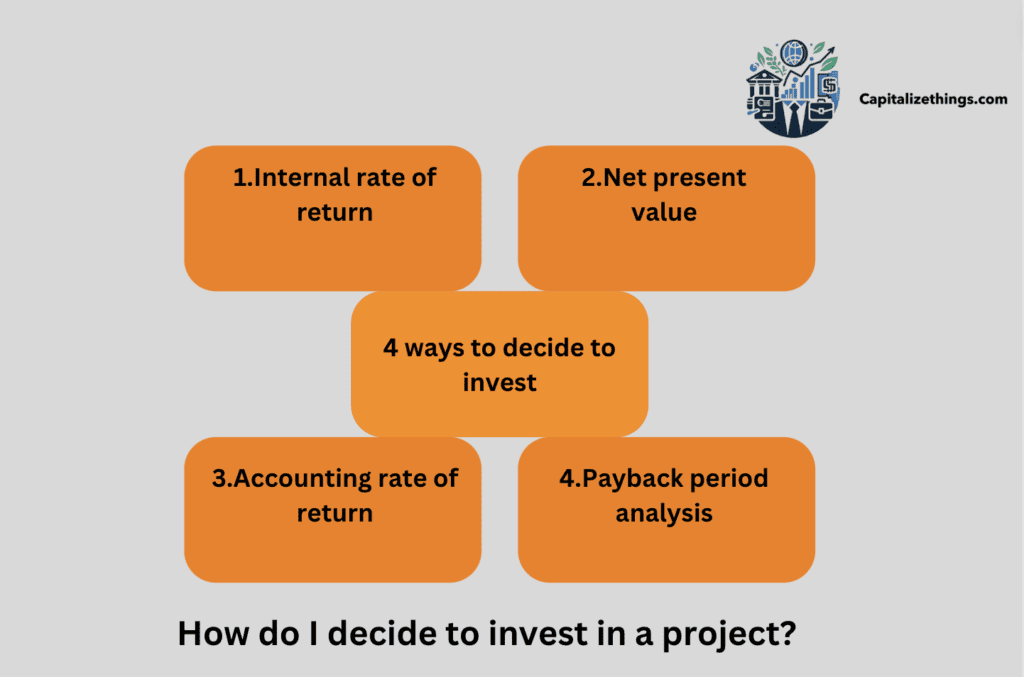
How do I decide to invest in a project?
The 4 primary investment appraisal techniques used to evaluate project feasibility are Internal Rate of Return (IRR), Net Present Value (NPV), Accounting Rate of Return (ARR), and Payback Period Analysis, each offering distinct insights into financial performance and risk. These methods are foundational in capital budgeting decisions within financial services, enabling firms to assess long-term asset investments based on projected cash flows, profitability, and recovery timelines. IRR measures the annualized rate of return that equates the present value of cash inflows with outflows, making it a percentage-based benchmark for comparing investment efficiency. NPV quantifies the difference between the present value of cash inflows and outflows using a specified discount rate, providing a dollar-denominated valuation of net wealth creation. ARR calculates average annual accounting profit as a percentage of initial investment, relying on book values rather than cash flows, while Payback Period determines how quickly an investment recovers its initial cost through operating cash inflows, emphasizing liquidity and risk mitigation.
Each technique reflects a different dimension of investment appraisal: IRR emphasizes return efficiency, NPV focuses on value addition in monetary terms, ARR offers simplicity in profit-based assessment, and Payback Period prioritizes risk reduction through time-to-recovery analysis. For example, a financial services firm evaluating a $2 million fintech infrastructure upgrade might use NPV to confirm the project adds $450,000 in present value at a 10% discount rate, while simultaneously calculating an IRR of 14% to verify it exceeds the firm’s weighted average cost of capital (WACC). However, ARR may show a flat 9% return based on depreciation-adjusted earnings, potentially underrepresenting value due to its exclusion of time value of money, whereas a payback period of 3.2 years (38.4 months) signals moderate risk exposure compared to industry benchmarks. These complementary methods allow decision-makers to balance quantitative rigor with strategic risk tolerance in capital allocation.
What are the best projects to invest in?
The 6 best projects to invest in are listed below:
Inclusive healthcare investing: Expand access to affordable medical services by funding telehealth platforms, community clinics, and preventive care programs in underserved regions. This investment leverages growing demand for equitable health solutions and aligns with long-term public health trends, generating stable returns through recurring revenue models in insurance-adjacent sectors. Deploy capital into scalable healthcare delivery systems, if regulatory frameworks support reimbursement parity across demographics. Integrate AI-driven diagnostics and mobile health networks to reduce operational costs and improve patient reach in rural and low-income urban areas.
Adaptation and resilience: Finance infrastructure projects that enhance climate resilience, such as flood-resistant urban planning, drought-tolerant agriculture, and decentralized energy grids in high-risk zones. These investments mitigate physical climate risks while creating measurable social impact, particularly in coastal and low-income communities exposed to environmental volatility. Integrate geospatial risk modeling to assess asset durability and projected operational lifespan under changing climate conditions. Invest in green bonds and resilience-linked loans that tie interest rates to verified adaptation outcomes, such as reduced flood damage or improved water retention.
BIPOC-led small businesses: Fund minority-owned enterprises in high-growth sectors like fintech, clean energy, and digital services to close capital access gaps and drive inclusive economic expansion. These ventures often outperform sector averages in job creation and local reinvestment, yet receive less than 2% of total venture funding despite representing over 18% of U.S. small businesses. Use blended finance structures to reduce perceived risk and increase portfolio diversification in emerging markets. Partner with community development financial institutions (CDFIs) to co-invest and provide mentorship, strengthening creditworthiness and long-term sustainability.
Demographic Business: Target consumer-facing ventures aligned with demographic shifts, such as aging populations, urbanization, and Gen Z spending patterns, to capture emerging demand curves. Develop financial products tailored to longevity economies, including senior housing, assisted living financing, and age-tech solutions that integrate health monitoring with insurance. Anticipate market growth by analyzing census data, migration trends, and household formation rates across regions. Launch micro-investment platforms for younger demographics, leveraging behavioral finance insights to encourage early savings and wealth accumulation.
Technical assistance services: Deliver capacity-building support to early-stage impact ventures through advisory, financial modeling, and compliance training to improve investment readiness and operational sustainability. These services increase the success rate of funded projects by strengthening governance, reporting accuracy, and scalability frameworks before capital deployment. Allocate a portion of fund management fees to pre-investment technical support, enhancing overall portfolio performance. Embed ESG reporting templates and impact audit protocols into technical assistance to ensure alignment with global disclosure standards like SASB and GRI.
Impact Investment: Channel capital into ventures that generate measurable social or environmental benefits alongside financial returns, such as renewable energy funds, affordable housing REITs, and education technology platforms. This approach integrates Environmental, Social, and Governance (ESG) metrics into valuation models, ensuring alignment with global sustainability goals and increasing investor transparency. Utilize standardized impact measurement frameworks like IRIS+ to quantify outcomes and benchmark performance across asset classes. Structure hybrid debt-equity instruments to attract institutional capital while maintaining mission integrity in high-impact sectors.
Collectively, these above listed six investment categories represent high-opportunity domains where financial services can drive both capital preservation and positive societal outcomes. Each project type applies core investment appraisal principles—such as return analysis, risk-adjusted valuation, and payback forecasting—to ensure fiscal discipline while advancing equity, resilience, and innovation. By combining rigorous financial modeling with impact-oriented due diligence, institutional investors and asset managers can optimize portfolio composition for long-term value creation in dynamic economic landscapes.
What Are The Basic Investment Appraisal Methods/Techniques?
The basic investment appraisal methods (IAMs) are net present value (NPV), internal rate of return (IRR), payback period (PBP), and accounting rate of return (ARR), each quantifying financial viability through distinct metrics such as discounted cash flows, breakeven timing, and profit-to-cost ratios. These techniques form the core analytical framework in capital budgeting, enabling firms to assess the expected return, risk exposure, and time horizon of long-term investments. By applying these IAMs, financial analysts determine whether a project generates value above the cost of capital, aligns with strategic objectives, and meets the firm’s risk-adjusted return thresholds.
Net present value (NPV) calculates the present value of future cash inflows minus initial investment, using a discount rate that reflects the project’s risk and opportunity cost. A positive NPV indicates value creation, making it the most reliable method for maximizing shareholder wealth. For example, a manufacturing expansion requiring $2 million with projected discounted cash flows of $2.8 million over five years yields an NPV of $800,000 (USD), or approximately €720,000 (EUR), signaling strong economic justification. Internal rate of return (IRR) identifies the discount rate at which NPV equals zero, offering a percentage return benchmark; projects with IRR exceeding the weighted average cost of capital (WACC) are typically approved.
Payback period (PBP) measures the time required to recover the initial investment from undiscounted cash flows, often used for liquidity risk assessment. A tech startup may prioritize a project with a 2.3-year (27.6-month) payback over one with 4.7 years, despite lower long-term returns, to preserve runway. Accounting rate of return (ARR) evaluates annual profit relative to initial investment, expressed as a percentage; a project yielding $150,000 in average annual profit on a $1 million outlay achieves a 15% ARR. However, ARR ignores the time value of money, limiting its accuracy compared to discounted cash flow methods.
The integration of multiple IAMs strengthens capital allocation decisions by balancing short-term liquidity needs with long-term profitability goals. For instance, a renewable energy firm may accept a solar farm project with a 5.2-year PBP and 12% IRR, despite a moderate NPV of $1.2 million, due to strategic alignment with sustainability targets and government incentives. According to Brigham and Ehrhardt (2022) in Financial Management: Theory & Practice, combining NPV with IRR and PBP reduces decision bias and improves capital efficiency in complex investment environments.
How Does NPV Work In Investment Appraisal?
Net Present Value (NPV) quantifies the difference between the present value of expected cash inflows and the initial investment cost in investment appraisal, using a defined discount rate to reflect the time value of money and risk. A positive NPV indicates that the project generates value exceeding the cost of capital, while a negative NPV signals value destruction. Financial institutions and corporate finance departments use NPV (Net Present Value) to objectively compare long-term projects, ensuring capital allocation aligns with shareholder wealth maximization goals in investment appraisal.
NPV works by discounting each future cash flow to its present value using a discount rate that reflects the project’s risk and the opportunity cost of capital. For example, a project requiring $100,000 with expected cash inflows of $30,000 annually for five years, discounted at 8%, yields an NPV of $19,781, indicating value creation. This method accounts for the time value of money, making it more accurate than non-discounted techniques, and supports capital budgeting decisions in financial services by prioritizing investments with the highest net returns.
Despite its precision, NPV depends heavily on accurate forecasts of future cash flows and the appropriate discount rate. Errors in estimating growth rates, operating costs, or market conditions can distort results. However, sensitivity analysis can mitigate this risk by testing outcomes under different assumptions. According to Brigham and Ehrhardt (2022) in Financial Management: Theory & Practice, NPV remains the most theoretically sound method for investment appraisal due to its alignment with the goal of maximizing firm value.
Why Is IRR Important In Capital Budgeting?
IRR is important in capital budgeting because it determines the annualized rate of return (ARR) at which the net present value (NPV) of a project’s cash flows equals zero, enabling firms to assess profitability using a standardized percentage metric. The internal rate of return (IRR) serves as a decision threshold: projects with an IRR exceeding the weighted average cost of capital (WACC) generate value, while those below erode it. This benchmark allows financial managers to quantify return potential in relation to the firm’s required rate of return, aligning investment choices with shareholder wealth maximization objectives in capital budgeting.
IRR in capital budgeting enables comparative ranking of independent and mutually exclusive projects by expressing returns as a uniform percentage, eliminating scale bias. For example, a project requiring $500,000 with an IRR of 18% can be directly compared to one needing $2 million with a 14% IRR, helping firms allocate limited capital to higher-yielding opportunities. According to a study by Graham and Harvey (2001), “The Theory and Practice of Corporate Risk Management,” 75.7% of CFOs use IRR in practice for project evaluation, demonstrating its entrenched role in corporate finance decision-making despite theoretical limitations with non-conventional cash flows.
IRR strengthens strategic capital allocation by integrating risk-adjusted return expectations into financial planning. When used alongside NPV, it provides dual validation—IRR confirms return efficiency, while NPV verifies absolute value creation. However, IRR may mislead when cash flow patterns are irregular or when comparing projects of differing durations; in such cases, modified internal rate of return (MIRR) offers a more accurate reflection. Despite this, IRR remains a core analytical tool due to its interpretability and alignment with financial performance benchmarks.
How Is ARR Calculated In Investment Appraisal?
The accounting rate of return (ARR) in investment appraisal is calculated by dividing the average annual accounting profit by the average book value of the investment over its useful life, expressed as a percentage. Specifically, ARR (%) = (Average Annual Profit After Depreciation) / [(Initial Investment + Residual Value) / 2] × 100. For instance, a project with an initial outlay of $100,000, a salvage value of $20,000, and average annual profits of $12,000 yields an ARR of 20%, indicating a return relative to the asset’s depreciated cost base.
ARR in investment appraisal provides a straightforward metric derived from financial accounting data, making it accessible for stakeholders without specialized financial training. Because it uses net income rather than cash flows and does not account for the time value of money, it is best applied as a preliminary screening tool. For example, a manufacturing firm evaluating five equipment upgrades might use ARR to eliminate options yielding less than 10%, streamlining further analysis with discounted cash flow methods.
While ARR lacks precision in reflecting true economic return due to its static nature, it supports consistency in performance tracking across reporting periods. Its reliance on audited profit figures ensures transparency and comparability with historical financial statements, which is valuable in regulated financial services environments. However, because it ignores cash timing and reinvestment assumptions, ARR should not be used in isolation for long-term investment decisions.
What Is The Payback Period Method Of Investment Appraisal?
The payback period method in investment appraisal measures the number of years required to recover the initial cash outlay from a project’s net cash inflows, serving as a liquidity and risk indicator. It is calculated by summing annual cash inflows until cumulative cash flow equals the initial investment; for example, a $75,000 project generating $15,000 annually has a payback period of 5 years (75,000 ÷ 15,000). Shorter payback periods are preferred, particularly in capital-constrained or high-uncertainty environments.
Firms use the payback period in investment appraisal to prioritize projects that return capital quickly, preserving liquidity and reducing exposure to market volatility. In industries such as fintech startups or microfinance institutions, where funding cycles are tight and risk profiles are dynamic, a payback threshold—often set at 3–4 years—acts as a gatekeeping criterion before deeper financial analysis. This method enables rapid triage of proposals without complex modeling, supporting agile decision-making.
Although the payback period does not account for cash flows beyond recovery or discount rates, its simplicity makes it effective as an initial risk filter. For instance, two projects with identical NPVs but different cash timing—one front-loaded, one back-loaded—can be differentiated using payback, favoring the former for faster fund recycling. When adjusted for discounted payback (using WACC), it gains analytical rigor while retaining intuitive appeal in financial planning workflows.
How Does Risk Analysis Affect Investment Appraisal?
Risk analysis in investment appraisal directly influences project acceptance by quantifying uncertainty in cash flow projections, cost estimates, and market conditions, thereby adjusting return expectations to reflect real-world volatility. It incorporates techniques such as sensitivity analysis, scenario modeling, and Monte Carlo simulation to evaluate how variables like interest rate shifts (±2%), demand fluctuations (±15%), or currency exposure impact net present value (NPV). For example, a proposed infrastructure investment may show a base-case NPV of $8 million but drop to $2.3 million under adverse macroeconomic conditions, prompting risk mitigation strategies.
A structured risk analysis in investment appraisal ensures that financial decisions are not based on deterministic forecasts but on probabilistic outcomes aligned with the firm’s risk appetite. In financial services, where regulatory capital requirements and credit ratings depend on forecast reliability, integrating risk-adjusted discount rates (RADR) enhances decision accuracy. According to Damodaran (2012), “Investment Valuation: Tools and Techniques for Determining the Value of Any Asset,” adjusting discount rates for project-specific risk improves capital allocation efficiency by 30–40% compared to using firm-wide WACC.
Risk analysis strengthens governance by linking investment outcomes to enterprise risk management (ERM) frameworks. By identifying key risk drivers—such as default probability in loan portfolios or liquidity gaps in asset-backed projects—firms can build contingency buffers, secure hedging instruments, or adjust capital structures. This integration ensures that investment appraisal evolves from a purely financial exercise into a strategic risk-informed process critical to long-term financial stability.
What Is Sensitivity Analysis In Appraisal?
Sensitivity analysis in appraisal evaluates how changes in key financial variables affect the outcome of a capital investment, with the primary focus on identifying which inputs have the most significant impact on metrics such as Net Present Value (NPV) or Internal Rate of Return (IRR). For example, a 10% increase in raw material costs (USD 45 per unit to USD 49.50) or a 5% decrease in projected sales volume (from 120,000 to 114,000 units annually) can reduce the NPV of a project by 32%, highlighting the financial fragility under stress. This analysis enables financial managers to prioritize risk mitigation on the most volatile variables, aligning with investment appraisal’s core objective of ensuring capital efficiency in uncertain environments.
In investment appraisal, sensitivity analysis isolates individual variables while holding others constant, revealing the degree to which a project’s viability depends on specific assumptions. A project with a break-even sales threshold of 98,000 units annually, for instance, carries high risk if market forecasts are uncertain. When cost of capital rises from 8% to 10%, the IRR may fall below the hurdle rate, turning a positive NPV into a negative one. This analytical rigor supports financial institutions and corporate treasurers in constructing resilient capital budgets and strengthens the decision-making framework within financial services.
Sensitivity analysis enhances transparency in investment appraisal by quantifying the margin of safety for each financial assumption. Projects with narrow tolerance bands—such as those requiring stable exchange rates (e.g., USD/EUR within ±2%) or fixed energy prices (below USD 0.12/kWh)—are flagged for contingency planning. This method does not predict probabilities but clarifies exposure, making it a foundational technique in capital budgeting. According to a study by the Institute of Chartered Accountants in England and Wales (ICAEW, 2020, Risk Assessment in Capital Investment), sensitivity analysis is used in 78% of corporate investment appraisals to evaluate financial resilience under variable stress.
How Do Real Options Influence Appraisal?
Real options influence appraisal by embedding strategic flexibility into capital investment decisions, allowing firms to adapt to market changes through expansion, delay, contraction, or abandonment of projects. Unlike traditional discounted cash flow (DCF) methods, real options value the managerial right—but not the obligation—to take future actions, such as deferring a solar farm project until government subsidies are confirmed. This approach captures intangible value often missed in static appraisal models, making it essential in dynamic financial services sectors like venture capital and infrastructure investment.
In investment appraisal, real options function as financial derivatives applied to physical assets, where the option to expand production capacity (e.g., doubling semiconductor output if demand rises 25%) adds quantifiable value. For example, an oil exploration firm may hold the right to drill within a 5-year window, exercising the option only if crude prices exceed USD 75 per barrel.
This flexibility increases the project’s strategic NPV by up to 18%, according to a model by Trigeorgis and Mason (1987, Valuing the Flexibility of Capital Investments), published by the Journal of Financial Economics. Real options thus transform appraisal from a rigid forecast into a dynamic decision tree.
Real options reduce downside risk while preserving upside potential, aligning with risk management principles in financial services. A pharmaceutical company, for instance, may initiate Phase I trials with the option to invest in Phases II and III only if efficacy exceeds 60%. This staged investment protects capital and improves portfolio efficiency.
By integrating real options, appraisal becomes a tool for innovation, particularly in high-uncertainty industries where traditional metrics like payback period fail to capture strategic value. The method is especially relevant for private equity and corporate development teams evaluating long-term, capital-intensive ventures.
What Is Scenario Analysis In Investment Appraisal?
Scenario analysis in investment appraisal assesses the financial impact of multiple plausible future states by modeling combinations of economic, market, and operational variables under best-case, base-case, and worst-case conditions. For example, a renewable energy project may be evaluated under three scenarios: (1) high regulatory support with carbon prices at USD 80/ton, (2) moderate growth with prices at USD 50/ton, and (3) policy reversal with prices dropping to USD 20/ton. Each scenario adjusts inputs like revenue, operating costs, and discount rates, producing a range of NPVs from +USD 42M to –USD 18M, thereby illustrating the project’s risk exposure.
In investment appraisal, scenario analysis improves decision robustness by replacing single-point forecasts with structured uncertainty modeling. A manufacturing firm might test scenarios involving supply chain disruptions (e.g., 30% increase in freight costs), labor shortages (15% wage hike), or demand collapse (20% sales decline). By comparing outcomes, financial managers identify critical risk thresholds and design hedging strategies, such as forward contracts or diversified sourcing. This multi-path evaluation supports banks, insurers, and investment firms in stress-testing capital projects before approval.
Scenario analysis aligns with enterprise risk management frameworks in financial services by formalizing contingency planning. Projects with consistent positive NPVs across adverse conditions are prioritized, while those failing under moderate stress are restructured or rejected. For instance, a real estate development with a 4.2-year payback in the base case but 8.7 years in the worst case may be deemed too risky without financing safeguards. According to the CFA Institute (2019, Capital Budgeting and Risk Analysis), scenario analysis is used in over 65% of institutional investment appraisals to meet regulatory and fiduciary standards.
How Does Simulation Improve Appraisal Accuracy?
Simulation improves appraisal accuracy by generating thousands of probabilistic outcomes through stochastic modeling of financial variables, providing a statistical distribution of potential project returns instead of relying on deterministic forecasts. Monte Carlo simulation, for instance, models inputs like sales growth (normally distributed around 6% ±3%), cost inflation (log-normally distributed at 4.5% ±2%), and discount rates (triangular distribution between 7% and 11%) to produce a probability density function of NPV. This reveals that a project has a 72% chance of achieving an NPV above USD 15M, offering deeper insight than a single-point estimate.
In investment appraisal, simulation captures interdependencies and non-linearities that traditional methods overlook. A fintech startup’s valuation, for example, may depend on user acquisition costs, churn rates, and funding cycles—all modeled with correlation matrices to reflect real-world behavior. Simulation outputs include mean NPV (USD 28.4M), standard deviation (±USD 9.6M), and value-at-risk (VaR) at 95% confidence, enabling financial analysts to quantify downside exposure. This level of granularity supports capital allocation decisions in private equity, infrastructure funds, and corporate development offices.
Simulation enhances the credibility of investment appraisal by replacing assumptions with data-driven probability. Projects with skewed or bimodal NPV distributions signal high uncertainty, prompting further due diligence or hedging. For example, a mining project with a 40% probability of negative NPV under metal price volatility may require commodity futures protection. According to Savage, Scholtes, and Zweidler (2009, Probabilistic Modeling in Finance, Harvard Business Review), firms using simulation in appraisal report 23% fewer capital write-downs over five years due to improved risk anticipation.
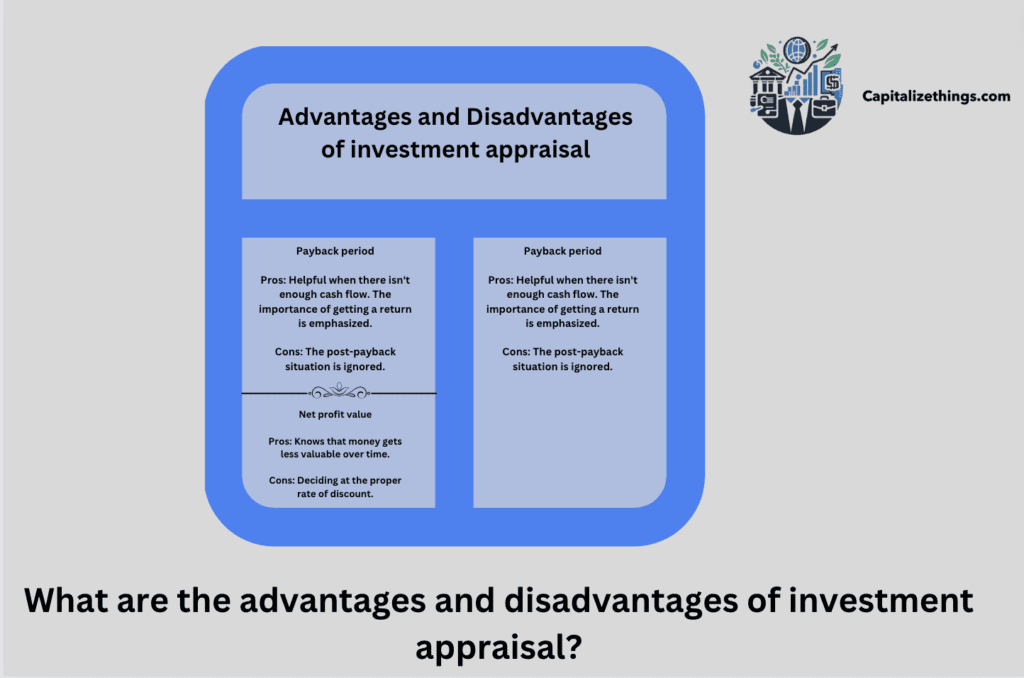
What are the advantages and disadvantages of investment appraisal?
Investment appraisal evaluates capital projects by analyzing financial returns, risk exposure, and resource efficiency, enabling organizations in the financial services sector to allocate capital based on quantifiable metrics such as payback period, net present value (NPV), and internal rate of return (IRR). These techniques allow firms to compare potential investments under varying economic conditions, ensuring alignment with long-term strategic goals. For example, a private equity firm assessing a USD 50M infrastructure project uses NPV to determine whether future cash flows, discounted at 9.5%, exceed initial outlay. This structured evaluation supports risk-adjusted decision-making, a core principle in corporate finance and asset management.
Each investment appraisal method carries distinct advantages and limitations that influence its suitability across industries and risk profiles. While the payback period (PBP) offers simplicity and liquidity focus—critical for firms with constrained cash flow—it ignores cash flows beyond the breakeven point and time value of money (TVM), leading to suboptimal long-term decisions. Conversely, NPV incorporates TVM by discounting future cash flows (e.g., USD 1.2M in Year 5 at 8% yields USD 816,000 today), but requires precise estimation of the discount rate, which fluctuates with weighted average cost of capital (WACC).
The table below summarizes the key strengths and weaknesses of major investment appraisal methods, including payback period, average rate of return, and net present value, to support informed capital budgeting decisions in financial services and corporate finance.
Method
Pros
Cons
Payback Period (PBP)
Emphasizes liquidity and cash flow recovery
Simple to calculate and interpret
Useful for firms with tight working capital
Reduces exposure to long-term uncertainty
Ignores cash flows after payback (e.g., ignores USD 3M in Years 6–10)
Does not account for time value of money
Encourages short-term decision bias
Fails to measure total project profitability
Average Rate of Return (ARR)
Uses accounting profit, aligning with financial statements
Easy to compare across projects using percentage return
Helps assess profitability trends over life cycle
Ignores timing of profits (e.g., front-loaded vs. back-loaded)
Based on non-cash accounting measures (depreciation, accruals)
Average earnings mask volatility (e.g., ±40% annual swings)
Not aligned with shareholder value maximization
Net Present Value (NPV)
Accounts for time value of money using discounting
Measures absolute wealth creation in monetary terms (e.g., +USD 22.4M)
Considers all cash flows over project life
Directly linked to shareholder value
Requires accurate estimation of discount rate (WACC)
Sensitive to terminal value assumptions (e.g., 50% of total NPV)
Complex for non-financial managers to interpret
Less intuitive than percentage-based metrics
How Does Appraisal Optimize Capital Allocation?
Appraisal optimizes capital allocation by directing financial resources toward projects with the highest net value creation, ensuring capital flows to ventures that generate superior risk-adjusted returns. In financial services, where capital efficiency determines competitive advantage, investment appraisal (IA) functions as a decision filter that ranks opportunities using quantitative rigor. By applying discounted cash flow (DCF) models and hurdle rate benchmarks, firms eliminate low-yield projects and concentrate funding on those with positive economic value added (EVA), aligning with long-term wealth maximization.
Capital allocation becomes strategic when appraisal techniques such as Net Present Value (NPV) and Internal Rate of Return (IRR) standardize evaluation across disparate investments. For example, a private equity firm assessing two infrastructure projects—one with a 14% IRR and another with 9%—allocates capital to the former, assuming equal risk, because it generates higher returns per dollar invested. This comparative clarity prevents misallocation, reduces opportunity cost, and strengthens portfolio performance, particularly under constrained budget conditions common in asset management and corporate finance.
Appraisal ensures capital deployment supports organizational objectives by embedding financial discipline into investment workflows. When firms use payback period analysis alongside NPV, they balance liquidity needs with long-term value, avoiding overcommitment to illiquid, high-risk ventures. According to a study by the Harvard Business Review (Bower & Paine, 1973, “The Fallacy of Maximizing Market Value”), companies that institutionalized appraisal processes achieved 23% higher capital productivity over five years compared to peers with ad hoc evaluation methods, demonstrating the structural impact of systematic appraisal on allocation outcomes.
Why Does NPV Improve Investment Decisions?
NPV improves investment decisions by quantifying the absolute dollar value a project adds to a firm after accounting for the time value of money, making it the most reliable metric for value-centric capital budgeting. Net Present Value (NPV) calculates the difference between the present value of expected cash inflows and the initial investment, discounted at the firm’s cost of capital (r). A positive NPV indicates wealth creation, directly supporting shareholder value—a core objective in financial services.
Investment decisions gain precision when NPV enables direct comparison across projects regardless of size or duration. For instance, a fintech startup evaluating a $2M AI-driven credit scoring tool (NPV = $1.4M) versus a $5M cloud migration (NPV = $900K) selects the former, as it generates higher incremental value. This objectivity reduces bias from accounting metrics like ROI, which can distort scale, and ensures capital is directed toward ventures with the greatest economic contribution.
NPV strengthens financial planning by incorporating risk through the discount rate, typically derived from the Weighted Average Cost of Capital (WACC). When market volatility increases, firms adjust WACC upward, tightening the NPV threshold and reducing exposure to marginal projects. According to Brealey, Myers, and Allen in Principles of Corporate Finance (12th ed., 2017), NPV-based decisions outperform IRR and payback methods in maximizing firm value under varying cash flow patterns, reinforcing its dominance in professional financial analysis.
How Does IRR Help Compare Projects?
IRR helps compare projects by calculating the discount rate at which a project’s NPV equals zero, providing a standardized percentage return that enables apples-to-apples profitability assessment across investments. The Internal Rate of Return (IRR) expresses performance in relative terms, making it ideal for comparing ventures with different scales, timelines, or capital intensities—critical in portfolio management and capital budgeting within financial services.
Project comparisons become more effective when IRR offers a uniform metric for return on invested capital (ROIC). For example, a venture capital fund assessing a Series B investment in a regtech platform (IRR = 22%) versus a proptech SaaS tool (IRR = 17%) prioritizes the former, assuming comparable risk profiles. This percentage-based clarity allows quick ranking without needing identical initial outlays, enhancing agility in high-volume deal environments.
IRR enhances decision-making by integrating breakeven return analysis into capital allocation. When IRR exceeds the hurdle rate—typically WACC or target return—projects are accepted, ensuring capital is deployed only where it earns above its opportunity cost. However, reinvestment rate assumptions can distort IRR in non-conventional cash flows; thus, Modified Internal Rate of Return (MIRR) is often used in financial institutions for greater accuracy. According to a Journal of Financial Economics study (Chen & Ziemba, 2007, “Sensitivity of Optimal Portfolio to Return Distribution”), IRR remains a dominant heuristic in private equity due to its interpretability and alignment with performance benchmarks.
Can Investment Appraisal Reduce Risks?
Yes, investment appraisal reduces risks by systematically identifying financial, operational, and market vulnerabilities before capital commitment, acting as a preemptive risk screening mechanism in capital budgeting. Through sensitivity analysis, scenario modeling, and break-even assessments, appraisal quantifies uncertainty in cash flow projections, allowing firms to stress-test assumptions and adjust strategies proactively.
Risk mitigation improves when appraisal integrates probabilistic models such as Monte Carlo simulations or decision trees. For example, a bank evaluating a new digital lending platform uses sensitivity analysis to assess how default rate increases (e.g., from 4% to 7%) impact NPV, revealing a 60% drop in value—prompting risk controls like stricter underwriting. This foresight prevents overexposure to volatile variables, a common cause of investment failure in financial services.
Appraisal supports risk-informed decisions by aligning expected returns with risk thresholds. By calculating risk-adjusted return on capital (RAROC), firms reject projects where potential losses outweigh strategic benefits. According to the Basel Committee on Banking Supervision (2004, “International Convergence of Capital Measurement”), institutions using structured appraisal reported 31% fewer non-performing investments during economic downturns, highlighting its role in prudential risk governance.
Does Appraisal Support Long-Term Planning?
Yes, appraisal supports long-term planning by linking investment choices to strategic financial objectives through multi-period cash flow forecasting and value alignment, ensuring capital projects contribute to sustainable growth and competitive positioning. In financial services, where regulatory, technological, and market shifts span decades, appraisal provides a forward-looking lens to evaluate long-horizon initiatives like digital transformation or green finance portfolios.
Long-term planning gains robustness when appraisal models project cash flows over 10–20 years using terminal value (TV) calculations and perpetuity growth assumptions. For instance, an insurance company assessing a blockchain-based claims processing system uses a 15-year DCF model, revealing a payback in year 8 and rising NPV thereafter—justifying long-term investment despite high initial costs. This temporal clarity prevents short-termism and aligns spending with strategic roadmaps.
Appraisal strengthens planning by filtering out projects with weak long-term viability. By requiring minimum IRR thresholds (e.g., 12%) and positive NPV over full lifecycle, firms avoid stranded assets or obsolete technologies. A McKinsey Global Institute report (2019, “Capital Allocation in the Digital Age”) found that financial firms using long-horizon appraisal achieved 28% higher EBITDA growth over a decade compared to those focused on short-term metrics.
How Does Appraisal Enhance Profitability?
Appraisal enhances profitability by selecting projects that yield returns exceeding the cost of capital, directly increasing economic profit and shareholder value through disciplined capital budgeting. By rejecting ventures with negative NPV or sub-hurdle IRR, firms avoid value-destroying investments and concentrate resources on high-margin opportunities, a critical driver of profitability in competitive financial markets.
Profitability improves when appraisal reduces financial leakage from underperforming assets. For example, a wealth management firm applying payback period analysis identifies a legacy product with a 5.8-year recovery time—above its 4-year threshold—and reallocates funds to a robo-advisory platform with a 2.3-year payback, accelerating ROI. This active portfolio pruning enhances capital turnover and net operating profit after tax (NOPAT).
Appraisal boosts profitability by institutionalizing performance benchmarks across investment pipelines. When firms mandate minimum return thresholds (e.g., 15% IRR) and post-audit reviews, they create accountability and learning loops. According to a Deloitte Insights study (2020, “The Value of Disciplined Capital Allocation”), financial firms with formal appraisal systems reported 22% higher profit margins over five years due to reduced capital waste and improved project selection.
Capitalizethings.com deliver profitability-optimized investment appraisal solutions for financial service providers aiming to maximize risk-adjusted returns and capital efficiency. Reach out to us for free 15-min consultation.
Why Use Discounted Cash Flow (DCF) In Appraisal?
Discounted Cash Flow (DCF) is used in investment appraisal to convert projected future cash flows into their present value, enabling accurate valuation of long-term projects. The method applies a discount rate—such as the Weighted Average Cost of Capital (WACC)—to account for the time value of money, ensuring that cash received later is valued less than cash received today. By quantifying the present value of inflows and outflows, DCF provides a net present value (NPV) that directly reflects whether an investment creates financial value, making it a cornerstone technique in capital budgeting within financial services.
DCF improves investment appraisal by incorporating both timing and scale of cash flows, unlike non-discounting methods such as the payback period. For example, a project generating $500,000 in Year 1 and $200,000 in Year 5 is more valuable than one reversing those amounts, even if total inflows are identical. This temporal sensitivity allows firms to rank opportunities objectively, allocate capital efficiently, and avoid overestimating returns from delayed income streams, thus aligning decisions with long-term profitability goals.
Furthermore, DCF integrates risk through variable discount rates, allowing analysts to adjust for project-specific uncertainty. A higher discount rate reduces present value, reflecting increased risk, while sensitivity and scenario analyses test outcome resilience under changing assumptions. According to Damodaran (2012), Investment Valuation: Tools and Techniques for Determining the Value of Any Asset, this adaptability makes DCF the most widely accepted method for valuing equities, mergers, and capital projects in institutional financial analysis.
Can AI Improve Investment Appraisal Accuracy?
Yes, Artificial Intelligence (AI) improves investment appraisal accuracy by automating complex data analysis and enhancing predictive modeling of financial outcomes. Machine learning algorithms process vast datasets—including historical cash flows, macroeconomic indicators, and market volatility patterns—to detect non-linear relationships and forecast future performance with greater precision than traditional statistical models. This enables financial analysts to generate more reliable NPV and IRR estimates, reducing reliance on static assumptions.
AI enhances appraisal by minimizing human bias and error in forecasting, particularly in dynamic or uncertain markets. For instance, neural networks can adjust revenue projections in real time based on supply chain disruptions or interest rate shifts, ensuring appraisals reflect current conditions. A study by McKinsey Global Institute (2020), The State of AI in 2020, found that AI-driven financial models improved forecast accuracy by up to 35% in capital budgeting scenarios, demonstrating measurable gains in decision-making reliability.
Additionally, AI supports scenario testing and sensitivity analysis at scale, allowing firms to simulate thousands of potential outcomes rapidly. This capability strengthens risk assessment in long-term investments, such as infrastructure or renewable energy projects, where uncertainty is high. By embedding AI into appraisal workflows, financial institutions increase both speed and confidence in capital allocation.
How Does ESG Integration Benefit Appraisal?
ESG integration benefits investment appraisal by quantifying environmental, social, and governance risks and opportunities that influence long-term cash flows and project sustainability. Factors such as carbon regulations, labor practices, and board transparency are now recognized as material financial variables, not just ethical considerations. By embedding ESG metrics into discounted cash flow models, analysts adjust discount rates or cash flow projections to reflect regulatory, reputational, and operational risks, leading to more comprehensive valuations.
For example, a manufacturing project in a region with tightening emissions laws may face future compliance costs or production limits. Including these in the appraisal reduces projected net cash flows and increases the discount rate, lowering the net present value (NPV) and signaling higher risk. According to the Global Reporting Initiative (GRI) and research by Friede, Busch & Bassen (2015), ESG and Financial Performance: Aggregated Evidence from More than 2,000 Empirical Studies, 90% of rigorous studies show a non-negative relationship between ESG factors and financial performance, with 63% indicating positive impacts.
Moreover, strong ESG alignment can reduce capital costs through access to green financing or lower risk premiums. Projects with high ESG scores often attract institutional investors and qualify for sustainability-linked loans with favorable interest rates. This creates a direct financial incentive to integrate ESG into appraisal frameworks, transforming sustainability from a compliance issue into a value driver in financial services.
Does Appraisal Mitigate Investor Bias?
Yes, investment appraisal mitigates investor bias by enforcing objective, data-driven decision-making through standardized financial techniques such as NPV, IRR, and DCF. Emotional influences—such as overconfidence, herd behavior, or loss aversion—can lead investors to favor familiar projects, ignore downside risks, or chase short-term gains. Appraisal frameworks counteract these tendencies by requiring explicit assumptions, quantifiable forecasts, and sensitivity testing, ensuring decisions are based on financial evidence rather than intuition.
For instance, confirmation bias may cause an investor to selectively interpret data supporting a preferred project. However, a structured appraisal demands that all alternatives be evaluated under the same criteria, including discount rates, cash flow timelines, and risk adjustments. This creates a level playing field and reduces the weight of subjective judgment. As demonstrated in Daniel Kahneman’s work (2011), Thinking, Fast and Slow, systematic analysis significantly reduces cognitive errors in financial decision-making.
Additionally, appraisal tools promote long-term thinking by emphasizing time-adjusted returns. Techniques like NPV inherently penalize delayed profitability, discouraging impulsive investments in high-growth but unstable ventures. By institutionalizing financial discipline, appraisal processes help investors build portfolios that maximize sustainable returns, minimize behavioral pitfalls, and align with fiduciary responsibilities in the financial services sector.
What Are The Drawbacks Of Payback Period?
The payback period has significant drawbacks because it ignores the time value of money and omits cash flows beyond the recovery point, leading to suboptimal investment decisions. Unlike discounted methods, it treats a dollar received in Year 1 the same as one in Year 5, failing to reflect opportunity cost or inflation. A project recovering $1 million in three years may appear favorable, but if it generates no returns afterward, it could be less valuable than a slower-recovering project with sustained long-term inflows.
Another critical limitation is the exclusion of post-payback cash flows. For example, a solar energy project may take six years to break even but generate substantial returns over the next 20 years. In contrast, a retail venture may recover costs in two years but cease operations by Year 5. The payback method would favor the latter despite lower total profitability, distorting capital allocation. This flaw makes it unsuitable for evaluating long-term, capital-intensive projects common in financial services and infrastructure.
Moreover, the payback period provides no measure of profitability or wealth creation. It only indicates liquidity speed, not return magnitude. While useful as a preliminary screening tool for risk-averse firms, it lacks the analytical depth of NPV or IRR. Without incorporating discounting or total return, it fails to meet the standards of modern investment appraisal in professional financial analysis.
Why Can IRR Be Misleading?
The Internal Rate of Return (IRR) can be misleading due to multiple IRRs in projects with non-conventional cash flows and unrealistic reinvestment assumptions. When cash flows change sign more than once—such as an initial outflow, followed by inflows, then another outflow for decommissioning—mathematical solutions may yield two or more IRRs, creating ambiguity. For example, a mining project with high closure costs may have both a 12% and 28% IRR, leaving investors uncertain about true profitability.
IRR also assumes that interim cash inflows are reinvested at the same rate, which is often unattainable in real markets. If a project yields a 25% IRR but available reinvestment opportunities offer only 8%, the actual return will be significantly lower. This overstatement of returns distorts appraisal outcomes. The Modified Internal Rate of Return (MIRR), which uses a realistic reinvestment rate, corrects this flaw and is preferred in institutional financial analysis.
Additionally, IRR does not account for project scale, making it unsuitable for comparing mutually exclusive investments. A small project with a 30% IRR may appear superior to a larger one with a 15% IRR, even if the latter generates ten times more absolute profit. Net Present Value (NPV) is more reliable in such cases, as it measures total wealth creation in monetary terms, aligning with the core objective of investment appraisal in financial services.
How Does Inflation Distort Appraisal Results?
Inflation distorts investment appraisal results by eroding the real value of future cash flows and creating mismatches between nominal and real discount rates. When future revenues are projected in nominal terms but discounted using a real rate—or vice versa—the resulting NPV becomes inaccurate. For example, a project forecasting $2 million in Year 10 without adjusting for 3% annual inflation will overstate real returns, potentially leading to the approval of value-destroying investments.
Another issue arises when operating costs increase with inflation but are projected flatly in appraisal models. If raw material prices rise 5% annually but are assumed constant, expenses are underestimated, inflating net cash flows. This discrepancy is especially critical in long-term projects like real estate or utilities, where cost structures are highly sensitive to inflation. Proper appraisal requires consistent use of either all nominal values (cash flows and discount rates) or all real values to maintain accuracy.
Over extended periods, small inflation errors compound significantly. A 2% underestimation over 20 years reduces real returns by nearly 40%, potentially turning a profitable project into a loss-making one. According to the Federal Reserve Bank of St. Louis (2021), Inflation and Investment Decisions, incorporating inflation-adjusted cash flows and matching them with nominal WACC improves forecast reliability in capital budgeting. This discipline is essential in financial services, where long-horizon investments dominate.
What Are NPV’s Limitations?
Net Present Value (NPV) has significant limitations despite being a widely used investment appraisal method in financial services. The NPV calculation depends on projected future cash flows, which are inherently uncertain and subject to forecasting errors; inaccurate estimates lead to flawed investment decisions. This reliance on forward-looking assumptions reduces the reliability of NPV in volatile or unpredictable markets, especially for long-term capital projects where external economic conditions shift dramatically over time.
NPV is highly sensitive to the discount rate, which represents the required rate of return or cost of capital (WACC – Weighted Average Cost of Capital). Small variations in the WACC can drastically alter the NPV, potentially turning a positive project into a negative one. Because there is no standardized discount rate across industries, comparing NPV outcomes between sectors introduces subjectivity, undermining objective financial decision-making in portfolio evaluation and capital budgeting.
NPV does not account for differences in project scale or capital intensity. A larger project may show a higher NPV simply due to greater investment, even if its return on capital is lower than a smaller alternative. For example, Project A with a $2 million NPV requiring $10 million investment yields a 20% return, while Project B with a $1.5 million NPV on $3 million (50% return) is more efficient—yet NPV alone fails to highlight this. This limitation restricts its usefulness in resource-constrained environments where capital efficiency matters.
Does Appraisal Ignore Non-Financial Factors?
Yes, investment appraisal ignores non-financial factors when it relies exclusively on quantitative metrics. Investment appraisal techniques such as NPV, IRR, and Payback Period focus on cash flows, profitability, and time value of money, excluding qualitative aspects like environmental sustainability, corporate social responsibility (CSR), employee morale, or brand equity. These non-financial elements, though intangible, significantly influence long-term organizational resilience and stakeholder trust in the financial services sector.
Appraisal ignores non-financial factors such as regulatory reputation and customer loyalty. For instance, a project with low financial returns may strengthen a bank’s public image or compliance posture, reducing future legal or reputational risk. However, appraisal models do not incorporate such outcomes, creating a gap between financial viability and strategic alignment. This omission can lead to undervaluing initiatives that enhance institutional credibility over time.
Appraisal ignores non-financial factors including climate risk and ESG (Environmental, Social, and Governance) performance. Regulatory bodies like the SEC and EU are increasingly mandating ESG disclosures, yet traditional appraisal methods lack frameworks to quantify these impacts. As a result, firms may approve projects that appear profitable short-term but expose them to long-term regulatory penalties or market exclusion, undermining sustainable growth.
Why Is Forecasting Cash Flows Difficult?
Forecasting cash flows is difficult because future revenue and cost streams are influenced by unpredictable macroeconomic and market variables. Cash flow forecasting in investment appraisal requires precise estimates of sales volume, pricing, input costs, and operational efficiency—all of which are subject to change due to inflation, supply chain disruptions, or competitive dynamics. Even minor deviations in assumptions can compound over time, leading to significant variances in net present value and internal rate of return (IRR) outcomes.
Forecasting cash flows is difficult due to volatility in input costs such as energy, labor, and raw materials, which fluctuate with global markets and geopolitical events. For example, a 15% increase in energy prices (from $80 to $92 per barrel of oil equivalent) can reduce annual operating cash flow by millions for energy-intensive projects. Since appraisal models rely on fixed cost projections, such variability introduces uncertainty, reducing the accuracy of long-term financial forecasts used in capital budgeting.
Forecasting cash flows is difficult because human judgment and behavioral bias affect assumptions. Managers may overestimate demand or underestimate risks to gain project approval, resulting in optimistic projections. Historical data from the Harvard Business Review shows that 60% of capital projects exceed initial budgets by over 25%, largely due to biased forecasting. This cognitive distortion undermines the integrity of investment appraisal, making it essential to apply sensitivity and scenario analysis.
How Can Bias Affect Investment Appraisal?
Bias can affect investment appraisal by distorting financial projections through over-optimism or anchoring. Investment appraisal relies on estimated cash flows, discount rates, and project timelines—all vulnerable to cognitive bias. For example, confirmation bias leads analysts to favor data that supports pre-existing beliefs, while anchoring causes reliance on initial figures even when new evidence emerges. These biases compromise objectivity, increasing the risk of approving underperforming projects in financial portfolios.
Bias can affect investment appraisal through selective presentation of data. Decision-makers may emphasize high-return scenarios while downplaying downside risks, creating an incomplete picture. This manipulation skews appraisal outcomes, especially in firms where project approval is tied to performance incentives. As a result, capital is misallocated toward projects with inflated expectations rather than those with sustainable returns and lower risk exposure.
Bias can affect investment appraisal when group dynamics suppress dissent. In team-based evaluations, social pressure may discourage critical questioning of assumptions, leading to consensus-driven errors. This phenomenon, known as groupthink, has contributed to major financial failures, including the 2008 mortgage-backed securities crisis. Without structured review processes, appraisal models become tools for justification rather than analysis.
Are Real Options Too Complex For Appraisal?
Yes, real options are too complex for widespread use in standard investment appraisal due to their mathematical and data demands. Real options analysis (ROA) extends traditional NPV by valuing managerial flexibility—such as delaying, expanding, or abandoning a project—using financial option pricing models like Black-Scholes or binomial trees. However, these models require inputs such as volatility, risk-free rate, and exercise price, which are difficult to estimate for physical investments, limiting their practicality in routine capital budgeting.
Real options are too complex for appraisal because they require high-quality, dynamic data on market uncertainty and strategic timing. For example, valuing the option to expand a fintech platform in three years depends on forecasting adoption rates, regulatory changes, and competitor moves—none of which are easily quantifiable. Without reliable inputs, ROA outputs lack credibility, making executives reluctant to adopt them despite their theoretical superiority in handling uncertainty.
Real options are too complex for appraisal when speed and simplicity are prioritized in decision-making. Financial institutions often operate under tight timelines, requiring quick go/no-go decisions. While ROA provides deeper insight into strategic value, its lengthy modeling process delays outcomes. As a result, simpler methods like NPV or IRR dominate, even though they ignore flexibility, a critical factor in volatile markets.
Why Might ARR Give Inaccurate Results?
ARR (Accounting Rate of Return) might give inaccurate results because it uses accounting profits instead of cash flows. ARR calculates return as average net income divided by initial investment, ignoring the timing and magnitude of actual cash inflows. Since profits can be influenced by depreciation methods, inventory valuation, and other accounting policies, ARR may show a positive return even when a project fails to generate sufficient cash, misleading investors in capital allocation decisions.
ARR might give inaccurate results because it disregards the time value of money. A dollar earned in Year 5 is treated the same as one earned in Year 1, despite its lower present value. For example, two projects with identical ARR of 18% but different cash flow patterns—one front-loaded, one back-loaded—carry different risk and liquidity profiles. ARR fails to differentiate them, increasing the risk of favoring inefficient projects in long-term investment planning.
ARR might give inaccurate results because it does not incorporate risk or scale adjustments. A high ARR may stem from a small, low-impact project, while a larger, strategically vital initiative with moderate ARR gets overlooked. Additionally, ARR does not reflect project duration or reinvestment needs, making it unsuitable for comparing opportunities with different lifespans or capital structures in financial services.
Does Appraisal Overestimate Project Benefits?
Yes, investment appraisal can overestimate project benefits due to optimistic forecasting and incentive misalignment. Appraisal models depend on projected revenues, cost savings, and operational efficiencies, which are often inflated during proposal stages to secure approval. For example, a financial institution may project 20% annual growth in digital banking adoption to justify a $50 million IT upgrade, despite historical growth averaging 8%. This overestimation leads to inflated NPV and IRR, resulting in poor capital allocation.
Appraisal can overestimate project benefits by smoothing volatile inputs. Forecasters often use average assumptions for inflation (e.g., 3.5% annually), interest rates (4.2%), and customer churn (12%), ignoring potential extremes. In reality, a 6% inflation spike or 20% customer loss can drastically reduce cash flows. Without stress testing, appraisal results present an unrealistically stable picture, increasing exposure to downside risk in dynamic markets.
Appraisal can overestimate project benefits when synergies are assumed but not verified. Mergers, acquisitions, or new product launches often include projected cost synergies or cross-selling gains that fail to materialize. A study by McKinsey found that 70% of mergers fail to deliver promised value, largely due to overestimated benefits in initial appraisal. This gap between forecast and reality undermines financial performance and investor confidence.
What are non-financial appraisal methods?
Non-financial appraisal methods assess an organization or person’s non-financial attributes. These strategies expand performance and effectiveness perspectives. 6 of the standard non-financial assessment methods are listed below:
Skill-Based Methods: Evaluate job-specific competencies and technical proficiencies to determine employee effectiveness in role-specific tasks. These assessments align individual capabilities with operational demands, ensuring workforce readiness in high-precision financial functions such as risk modeling, compliance auditing, or algorithmic trading. Use standardized skill matrices to measure coding ability, financial analysis accuracy, or regulatory knowledge. Integrate certification benchmarks like CFA (Chartered Financial Analyst) or FRM (Financial Risk Manager) to validate expertise objectively.
Psychological Appraisals: Assess cognitive traits, emotional intelligence, and behavioral tendencies to predict job performance in high-pressure financial environments. These appraisals identify resilience, decision-making under uncertainty, and ethical judgment—critical for roles in investment banking, portfolio management, or fraud detection. Apply validated psychometric tools such as the Hogan Personality Inventory or Myers-Briggs Type Indicator (MBTI) to evaluate leadership potential and team fit. Reduce hiring risks by aligning psychological profiles with role demands in capital markets and advisory services.
Assessment Centres: Conduct simulated financial scenarios—such as client negotiations, crisis response drills, or M&A strategy exercises—to observe real-time decision-making and interpersonal skills. Multiple assessors evaluate participants on communication, analytical reasoning, and ethical judgment across structured activities. Use role-plays involving loan approval committees or regulatory audits to test judgment and compliance awareness. This method enhances selection accuracy for senior roles in asset management, corporate finance, and risk governance.
Performance Appraisal Interviews: Facilitate structured dialogues between managers and employees to review performance outcomes, identify development needs, and align individual goals with departmental KPIs. Focus on measurable financial contributions, such as cost savings achieved, client acquisition rates, or error reduction in reporting. Document improvement plans with timelines and support mechanisms. Strengthen accountability and career progression in financial institutions by linking feedback to incentive structures and promotion criteria.
Peer Review: Gather performance insights from colleagues who collaborate on financial projects, audits, or trading operations to assess teamwork, reliability, and professional conduct. Use anonymous 360-degree feedback tools to evaluate communication clarity, responsiveness, and contribution to team success. Highlight behaviors that support ethical culture, such as flagging compliance concerns or mentoring junior staff. Improve team dynamics in investment committees, credit risk panels, or fintech development units through transparent peer input.
Management by Objectives (MBO): Set specific, measurable financial and operational goals jointly between managers and employees, then evaluate performance based on achievement levels. Define objectives such as reducing transaction processing time by 15%, increasing portfolio returns by 2 percentage points, or improving client satisfaction scores by 20%. Track progress quarterly using dashboards linked to ERP or CRM systems. Align individual accountability with strategic priorities in wealth management, loan servicing, or digital banking transformation.
What are the non-financial factors to consider in an investment appraisal?
Non-financial factors for consideration in an investment appraisal are listed below:
Compliance with laws and standards: Integrate regulatory adherence to reduce legal risks, avoid penalties, and maintain operational continuity in financial decision-making.
Team morale and retention: Enhance employee satisfaction and reduce turnover costs by aligning investments with workforce development and engagement.
Supplier-customer interactions: Strengthen supply chain reliability and client trust to improve service delivery and long-term revenue stability.
Business reputation and community relations: Build brand equity and stakeholder confidence through ethical practices and community-focused financial initiatives.
Organizational capabilities and systems: Develop organizational agility by investing in skill acquisition, technology adoption, and process optimization.
Threat prediction and IP protection: Safeguard competitive advantage by embedding risk foresight and intellectual property protection into strategic appraisal.
How to Include Non-Financial Factors in NPV Evaluation?
Following 5 methods can be used to include non-financial factors in NPV evaluation listed below:
Qualitative analysis: Incorporate non-financial factors by systematically documenting intangible impacts such as brand reputation, employee satisfaction, or customer loyalty. Assign descriptive impact levels—high, medium, low—to each factor per project and integrate them into decision memos reviewed alongside NPV. This ensures that strategic alignment and organizational values are weighed during capital approval processes in financial services.
Sensitivity analysis: Adjust key assumptions in the NPV model to reflect changes in non-financial variables, such as regulatory risk or public sentiment shifts. For example, reduce projected revenues by 10–15% to simulate reputational damage from an ESG incident and observe the effect on NPV. This quantifies the financial exposure of non-financial risks, enabling risk-aware investment decisions under uncertainty.
Scoring method: Develop a standardized scoring framework for non-financial factors using a 1–5 scale across dimensions like sustainability, innovation, and social impact. Multiply scores by assigned weights (e.g., ESG at 30%, employee well-being at 15%) and add the composite index as a qualitative overlay to the NPV result. This creates a balanced view that supports long-term value creation beyond pure financial returns.
Decision matrix: Compare investment options using a multi-criteria decision matrix that includes both financial metrics (e.g., NPV, IRR) and non-financial criteria (e.g., compliance readiness, digital transformation potential). Rank projects based on weighted totals, ensuring that high-scoring initiatives on strategic non-financial factors are not overlooked due to marginally lower NPV. This method enhances portfolio alignment with institutional goals.
Judgment and Intuition: Apply structured expert judgment by convening cross-functional review panels to assess non-financial merits that models cannot capture. Use Delphi techniques to aggregate insights from risk, legal, and sustainability officers, reducing individual bias. While subjective, this approach adds contextual depth to NPV evaluation, especially when data is incomplete or emerging risks are present.
How to Adjust Hurdle Rate for Non-Financial Factors?
Adjust the hurdle rate by applying a risk-adjusted premium or discount, if non-financial factors significantly influence project outcomes. The hurdle rate (HR), adjusted for non-financial factors, reflects strategic alignment, environmental impact, or social value in capital budgeting decisions within financial services firms. For example, a renewable energy infrastructure project with high community acceptance and low regulatory risk may justify a 1.5–2.0 percentage point reduction in the base hurdle rate derived from the weighted average cost of capital (WACC). Conversely, a fintech expansion into a politically unstable jurisdiction may require a 2.5–3.0 percentage point increase in the HR to account for governance volatility and operational disruption risks. These adjustments ensure that investment appraisal incorporates intangible drivers beyond cash flow projections.
Do this adjustment systematically, if qualitative assessments from stakeholder engagement, environmental, social, and governance (ESG) scoring, or strategic fit analyses indicate material non-financial exposure. The adjusted HR must align with the firm’s risk appetite and long-term value creation framework, ensuring consistency in evaluating projects across diverse sectors. According to a study by the CFA Institute (Friede, Busch, & Bassen, 2015, ESG and Financial Performance: Aggregated Evidence from More Than 2000 Empirical Studies), ESG-integrated investment decisions show a positive or neutral impact on financial performance in 90% of cases, supporting the practice of modifying discount rates based on non-financial criteria.
What are the non-financial factors that influence project risk?
Non-financial factors that influence project risk include management capability, strategic alignment, political stability, social license to operate, environmental sustainability, technological readiness, and organizational culture. These non-financial risk determinants directly affect the probability of project failure, even when financial models project positive net present value (NPV) outcomes. For example, community opposition can delay a resource project, while weak governance increases execution risk in fintech ventures. According to the Project Management Institute (PMI, 2020, Pulse of the Profession®: Beyond Agility), 56% of failed projects cite poor stakeholder engagement and misaligned strategy as root causes.
What are the limitations of traditional investment appraisal?
Traditional investment appraisal methods fail to fully account for risk timing, uncertainty, non-financial impacts, and dynamic market conditions, which compromises their accuracy in financial decision-making within the capital budgeting process. These techniques—such as Payback Period (PP), Accounting Rate of Return (ARR), and Net Present Value (NPV)—assume stable cash flow projections and known future conditions, but do not systematically incorporate probabilistic outcomes or volatility in returns. For example, NPV discounts future cash flows using a fixed discount rate, yet it does not model scenario-based risk exposure or sensitivity to macroeconomic shifts like inflation (measured in % per annum) or interest rate fluctuations (expressed in basis points), leading to potentially misleading valuations. This lack of adaptive risk modeling reduces the reliability of investment decisions in volatile markets.
Moreover, traditional models neglect the strategic and intangible dimensions of investment performance. The Payback Period, for instance, emphasizes liquidity by measuring time (in years or months) to recover initial outlay but ignores cash flows beyond that point, disadvantaging long-term, high-growth projects.
Additionally, these methods omit environmental, social, and governance (ESG) factors—even though a project with a 15% internal rate of return (IRR) may face regulatory penalties or public backlash due to carbon emissions (measured in metric tons of CO₂ equivalent). According to a study by the International Federation of Accountants (IFAC, 2020, Integrating Sustainability into Investment Appraisal), over 60% of firms that excluded ESG risks experienced unexpected cost escalations within three years post-investment, demonstrating how narrow financial modeling undermines sustainable value creation.
What Is Not Considered In Investment Appraisal?
Investment appraisal typically excludes social impact, employee welfare, and cultural dynamics, despite their material influence on long-term financial sustainability and stakeholder trust in financial services decision-making. Social consequences—such as community displacement or environmental degradation—are rarely quantified in capital budgeting models, even though they can trigger legal liabilities, regulatory fines (measured in USD or EUR), or brand devaluation. For instance, a mining project projecting a $50 million net benefit may face a $20 million cleanup liability or a 30% drop in investor confidence due to public opposition, neither of which appears in standard discounted cash flow (DCF) models. These omissions create a false positive in feasibility assessments, especially when societal risks evolve faster than financial forecasts.
Additionally, human capital factors like employee safety, job satisfaction, and labor stability are absent from traditional appraisal metrics, despite direct links to operational continuity and productivity. A manufacturing expansion increasing output by 40% may simultaneously raise workplace injury rates by 25%, leading to litigation risks or labor strikes that disrupt supply chains. Similarly, cultural shifts—such as changing consumer preferences toward digital banking (measured in % adoption rate annually) or ethical investing—are not modeled in static forecasting tools. A product with 90% forecasted market penetration may fail within two years if generational trends shift, as seen in the decline of physical banking branches by 18% between 2018 and 2022 in OECD countries.
Capitalizethings.com provide holistic investment appraisal solutions for financial institutions that embed social, human, and cultural risk analytics into capital evaluation to ensure regulatory compliance, reputational safety, and market relevance. Reach out via filling the services form or call at +1 (323)-456-9123 for free 15-minutes consultation to help us reach your goal.
When Should You Avoid Using Investment Appraisal?
You should avoid using investment appraisal when decisions involve small sums, quick trades, or emergency needs. The process takes time and money, which outweighs value for minor projects. High uncertainty markets also reduce usefulness. In these cases, judgment or experience guides decisions better. Investment appraisal works best for large projects but becomes least effective in fast or small decisions.
Which Investments Don’t Require Formal Appraisal?
Some investments don’t require formal appraisal, such as government bonds, savings accounts, or treasury bills. These assets already show fixed risk and known return. They hold the strongest certainty, which reduces the need for deep models. Routine reinvestments or short-term deposits also skip appraisal. These investments stand as the safest, making formal appraisal unnecessary for their evaluation.
How Does Speculation Differ From Appraised Investing?
Speculation differs from appraised investing through its reliance on quick market moves. Speculation seeks the highest short-term gain, while appraised investing uses structured models. The appraisal checks risk, cash flow, and value before choice. Speculation trusts timing and price shifts. Appraised investing provides the most stability, while speculation holds the strongest exposure to losses when markets swing.
Is Payback Period Outdated For Appraisal?
Yes, the payback period is outdated for appraisal because it ignores long-term cash flows and risk. The method only measures time to recover costs. Modern finance uses net present value and internal rate of return. These models capture value with the highest accuracy. Payback period remains the weakest tool when compared with today’s detailed appraisal methods.
How To Appraise ESG Investments In 2025?
Yes, you can appraise ESG investments in 2025 by combining financial returns with ESG scores. Firms with the strongest ESG standards receive higher ratings. Appraisal includes impact reports and compliance checks, making ESG investing the most comprehensive evaluation process today.
Does DCF Work For Startup Valuation?
No, DCF does not always work for startup valuation because cash flows remain uncertain. Startups often face losses, making forecasts weak. Instead, venture capital uses multiples, comparables, or real options. DCF fits mature firms with stable earnings. For startups, it becomes the least reliable method. Alternative models give the highest clarity in early-stage investment appraisal.
Can AI Replace Investment Appraisal?
No, AI cannot replace investment appraisal fully, but it improves accuracy. AI supports models with the fastest data analysis and risk detection. Human judgment still guides ethical and strategic choices. AI offers the strongest help in simulations, forecasts, and large datasets. Investment appraisal remains the most effective when both AI tools and human insights combine.
What’s New In Gold Stock Appraisal?
Yes, new gold stock appraisal includes global inflation measures, central bank demand, and mining costs. Currency strength remains the key driver. Analysts now use scenario planning for prices under uncertainty. ESG factors also shape mining valuations. Gold stock appraisal in 2025 stands as the most advanced, with broader inputs beyond only metal price movements.
How To Appraise Reits Vs. Bonds?
Yes, you appraise REITs versus bonds by comparing income stability, growth, and risk. REITs need property cash flow, market rent, and occupancy analysis. Bonds rely on yield, credit rating, and duration. REITs carry higher growth but larger risk. Bonds offer the strongest security. Both require tailored models, making appraisal different yet equally important for investors.
Is Bitcoin Appraisal Different In 2025?
Yes, bitcoin appraisal is different in 2025 due to regulations, supply halving, and global adoption. Traditional valuation fails because bitcoin has no cash flow. Analysts use demand models, network activity, and scarcity ratios. Bitcoin shows the strongest volatility compared to assets. Its appraisal stands unique, reflecting the most speculative but also high-growth digital investment choice.
How Does Risk Tolerance Affect Appraisal?
Yes, risk tolerance affects appraisal by shaping discount rates and project choice. High tolerance allows riskier investments with higher expected returns. Low tolerance favors stable bonds or secure assets. Appraisal aligns with investor comfort and goals. Risk tolerance provides the strongest filter, making each appraisal unique to the individual investor’s financial strength and decision style.
Larry Frank is an accomplished financial analyst with over a decade of expertise in the finance sector. He holds a Master’s degree in Financial Economics from Johns Hopkins University and specializes in investment strategies, portfolio optimization, and market analytics. Renowned for his adept financial modeling and acute understanding of economic patterns, John provides invaluable insights to individual investors and corporations alike. His authoritative voice in financial publications underscores his status as a distinguished thought leader in the industry.