A diversified investment is a strategy that spreads your money across many different types of assets, like stocks, bonds, and real estate, to make your savings safer and more stable. It works by ensuring that if one investment loses value, others might gain or hold steady, protecting your overall portfolio from big losses and helping it grow steadily over time.
This approach requires following key rules like wise allocation, regular rebalancing, and aligning choices with personal risk tolerance. The main advantages are significantly reduced risk and more consistent returns. However, it can be complex to manage, may involve higher costs, and could potentially limit maximum gains compared to riskier, concentrated bets, but it remains fundamental for long-term financial security.
What is a diversified investment?
A diversified investment is a risk management strategy that allocates capital across a variety of distinct financial instruments, industries, and other categories to reduce overall portfolio risk. This foundational portfolio construction technique mitigates exposure to any single asset or risk. For instance, an investor might allocate funds across equities, fixed-income securities like bonds, real estate investment trusts (REITs), and commodities instead of concentrating capital in one company’s stock.
The strategic deployment of capital across non-correlated asset classes ensures that a decline in one investment sector is potentially counterbalanced by stability or gains in another, thereby enhancing portfolio defensibility. This methodology is a core principle of modern portfolio theory (MPT), introduced by Harry Markowitz in 1952, which mathematically demonstrates how diversification can optimize returns for a given level of risk. A well-structured diversified portfolio is essential for navigating market volatility and achieving long-term financial objectives, which is the ultimate goal of any sound investment plan.
What is a Corporate-Level Diversification Strategy?
A corporate-level diversification strategy is a growth initiative where a company expands its operations into new product lines or market segments that are distinct from its core business. This strategic maneuver aims to reduce enterprise-wide risk by diminishing the firm’s reliance on a single, potentially volatile revenue stream. A canonical example is a technology hardware manufacturer acquiring a software-as-a-service (SaaS) company to create a more stable, recurring revenue model and cross-selling opportunities, thereby enhancing corporate financial stability.
This corporate strategy works by leveraging existing competencies to capture new growth vectors, thereby creating a conglomerate or multi-business entity. The organization can utilize surplus cash flows from established units to fund new ventures, exploiting synergies in marketing, distribution, or research and development. This deliberate spreading of business risk helps stabilize aggregate earnings; a downturn in one division may be offset by stability or growth in another, ensuring the corporation’s overall health and protecting shareholder value.
The pros of this approach include potential economies of scale, access to new customer bases, and insulation from industry-specific cyclicality. However, the cons can be significant, encompassing the immense challenge of managing unrelated businesses, potential cultural clashes, and the risk of diluting core brand identity. Successful execution demands meticulous due diligence and expert integration management to realize the intended synergistic benefits and avoid the conglomerate discount, where the market values the whole less than the sum of its parts.
What Is A Good Diversified Investment Mix?
A good diversified investment mix is a portfolio constructed across various asset classes—such as equities, fixed income, real assets, and cash equivalents—to optimize returns relative to risk. This foundational strategy mitigates unsystematic risk because different assets react uniquely to market events. For example, equities may decline during an economic contraction, while government bonds often appreciate, thereby stabilizing the portfolio’s value. The specific allocation must align with the investor’s financial objectives, risk tolerance, and investment horizon to function effectively as a personalized wealth-building engine.
A strategic asset allocation typically positions equities (stocks) as the primary engine for long-term capital appreciation. Fixed-income securities (bonds) provide consistent income and act as a counterbalance to equity volatility. Real assets, such as Real Estate Investment Trusts (REITs), offer a hedge against inflation and deliver diversification benefits through low correlation with financial markets. Cash and cash equivalents, including money market funds, ensure portfolio liquidity and safety for short-term obligations or opportunistic investments, completing a robust financial defense system.
Investors must recalibrate their diversified investment mix through periodic rebalancing to maintain their target allocation, as market movements can cause drift. A 30-year-old investor might allocate 90% to equities and 10% to bonds, while a 60-year-old might shift to a 50/50 split to preserve capital. Geographic diversification across developed and emerging markets further strengthens the portfolio by spreading exposure to different economic cycles and growth drivers, such as technology sectors in the United States or manufacturing growth in Southeast Asia.
Modern Portfolio Theory (MPT), formalized by Harry Markowitz in 1952, provides the mathematical framework for this strategy, demonstrating that a diversified portfolio can achieve higher risk-adjusted returns than any single investment. The efficacy of a diversified mix is not measured by the performance of its individual parts but by the collective behavior of all assets working in concert to smooth out volatility and compound wealth over decades, making it the cornerstone of prudent, long-term financial planning.
What Are Alternative Investment Assets?
Alternative investment assets are financial instruments that fall outside the traditional categories of public equities, bonds, and cash. This category includes private equity, hedge funds, commodities, real estate, and infrastructure projects, which exhibit low correlation to standard markets. According to a 2023 Preqin report, institutional investors now allocate an average of 15-20% of their portfolios to alternatives to enhance returns and diversify risk. These assets provide access to unique return streams and economic sectors unavailable through conventional securities, making them a sophisticated tool for portfolio completion.
Common examples of alternative investment assets include physical commodities like gold, which serves as a store of value during inflationary periods; private equity, which involves capital investment in private companies; and collectibles such as fine art or vintage automobiles, which can appreciate based on scarcity and cultural value. Each asset class carries distinct risk-return profiles, liquidity constraints, and market dynamics, requiring specialized knowledge and due diligence for successful integration into a broader wealth strategy.
The primary benefit of incorporating alternative investment assets is enhanced diversification, which reduces overall portfolio volatility. However, investors must navigate challenges including higher fee structures, increased complexity, and lower liquidity compared to traditional securities. These assets often require longer lock-up periods, meaning capital is committed for several years, making them suitable primarily for accredited or institutional investors with longer time horizons and sufficient capital to absorb potential illiquidity.
What Is ESG Diversified Investing?
ESG diversified investing is a strategy that incorporates Environmental, Social, and Governance (ESG) criteria into the security selection and portfolio construction process to generate sustainable, long-term risk-adjusted returns. This approach evaluates a company’s carbon footprint (Environmental), its labor practices and community relations (Social), and its leadership ethics and shareholder rights (Governance). A 2022 study by MSCI found that companies with high ESG ratings demonstrated lower volatility and higher profitability, indicating that strong ethical practices can correlate with financial resilience and operational excellence.
The implementation of ESG diversified investing involves positive screening, which seeks out industry leaders in sustainability, and negative screening, which excludes sectors like tobacco or fossil fuels. Investors utilize ESG ratings from providers like Sustainalytics or MSCI Inc. to assess and compare companies’ non-financial performance. This dual analysis ensures the portfolio not only avoids companies with high ethical risks but also actively champions those driving positive change, aligning financial objectives with personal values without necessarily sacrificing performance.
Integrating ESG factors creates a more holistic view of a company’s long-term viability, identifying risks and opportunities that traditional financial analysis may overlook. For instance, a firm with poor governance may be prone to scandals or regulatory fines, while a company with efficient energy usage may have lower operational costs and a stronger brand reputation. This forward-looking analysis embeds an additional layer of risk management into the core of a diversified investment strategy, aiming to build wealth responsibly for future generations.
What Is The Efficient Frontier In Diversification?
The Efficient Frontier is a curve on a graph that plots the optimal portfolios offering the highest expected return for a specific level of risk. This foundational principle of modern portfolio theory (MPT), introduced by economist Harry Markowitz in his 1952 paper “Portfolio Selection,” provides a mathematical framework for constructing a diversified investment portfolio. Portfolios that lie below this curve are considered sub-optimal because they generate lower returns for their risk level, while those above are unattainable.
The construction of the Efficient Frontier relies on calculating three core statistical inputs for each asset: expected return, standard deviation (volatility), and the correlation coefficient between each pair of assets. These calculations determine how combining assets with less-than-perfect correlation can reduce the overall portfolio volatility. For example, a portfolio mixing stocks (equities) and government bonds (fixed income) often forms a point on this curve because their prices frequently move independently of each other, thereby enhancing risk-adjusted performance.
Expanding the asset universe beyond domestic securities is crucial for maximizing the Efficient Frontier’s potential. Including international equities, global bonds, real estate investment trusts (REITs), and commodities can improve the risk-return profile. According to a 2019 research paper by Vanguard, “Global fixed income: Considerations for U.S. investors,” a globally diversified bond portfolio reduced volatility for U.S. investors over a 25-year period. This geographic and asset class diversification pushes the curve upward and leftward, representing higher returns for lower risk.
Achieving a portfolio on the Efficient Frontier requires continuous optimization and rebalancing, as asset correlations and volatilities change over time. Investors must periodically adjust their asset allocation—the percentage of the portfolio held in different asset classes—to maintain an optimal position. This process ensures the diversified investment strategy remains aligned with the mathematical ideal of maximum efficiency, balancing the pursuit of return with the management of risk.
What Is Risk-Adjusted Return In Diversification?
Risk-adjusted return is a performance measure that calculates the amount of profit an investment generates relative to the amount of risk taken to achieve it. This metric is paramount in diversified investing, as a high nominal return is less impressive if it involved extreme volatility. It allows for a direct comparison of different investments or portfolios by revealing which one delivered the most return per unit of risk, thus evaluating the efficiency of the diversification strategy.
Investors primarily use ratios like the Sharpe Ratio and the Sortino Ratio to quantify this concept. The Sharpe Ratio measures excess return per unit of total risk (standard deviation), while the Sortino Ratio focuses only on downside deviation, or harmful volatility. A higher ratio indicates a more favorable risk-adjusted return. For instance, a diversified portfolio with a Sharpe Ratio of 1.5 has provided a more efficient return stream than a concentrated portfolio with a ratio of 0.8, even if the latter had a higher nominal gain.
Applying this measure guides strategic asset allocation within a diversified portfolio. A sector-specific fund might show high returns but possess a poor risk-adjusted score due to volatility, making it unsuitable as a core holding. Conversely, a balanced fund of stocks and bonds with moderate returns may exhibit a superior risk-adjusted rating, confirming the effectiveness of its diversification. This analysis ensures capital is allocated to strategies that generate the most efficient growth, not just the highest apparent growth.
The true power of risk-adjusted return analysis is realized in a global context. International diversification can initially appear to increase volatility (risk) due to currency fluctuations. However, because foreign markets often move on different cycles than domestic ones, the risk-adjusted return of the entire portfolio can improve significantly. The non-correlated returns smooth overall performance, ultimately enhancing the portfolio’s long-term efficiency and proving the strategic value of global diversified investment.
What Is A Leveraged Diversified Strategy?
A leveraged diversified strategy employs borrowed capital or derivative instruments to amplify the exposure and potential returns of a diversified investment portfolio. This approach seeks to enhance performance beyond what the investor’s own capital could achieve alone, while using diversification across non-correlated asset classes to help mitigate the significantly increased risks inherent in using leverage, such as magnified losses.
The core of this strategy involves applying leverage to a broad basket of assets rather than a single security. An investor might use leverage to gain exposure to a wider array of asset classes simultaneously, such as increasing positions in an international equity index fund, a corporate bond exchange-traded fund (ETF), and a real estate asset class. This prevents concentration risk and ensures the amplified exposure is spread across various economic drivers, which is critical for managing the added danger of leverage.
Effective risk management is the critical component that differentiates a prudent leveraged strategy from a speculative one. The diversification acts as a counterbalance to leverage; while a leveraged position in a single stock can lead to ruinous losses, a leveraged position in a diversified portfolio is buffered by the fact that not all assets will decline simultaneously. For example, losses in leveraged equities might be partially offset by stable returns from leveraged bonds or commodities during a market downturn, preventing a total wipeout of capital.
This strategy requires sophisticated execution and constant monitoring. The cost of borrowing (margin interest) must be lower than the expected return of the diversified portfolio for the strategy to be profitable. Furthermore, maintenance margin requirements mandate that investors hold sufficient equity in their account, forcing the sale of assets during a decline—potentially locking in losses. Therefore, a leveraged diversified strategy is a high-stakes tool for enhancing returns that demands expert risk management to navigate its inherent complexities.
What are the Characteristics of Diversified Investments?
10 characteristics of diversified investments are listed below:
Risk: Defines the probability of a permanent loss of capital on an investment. Different asset classes carry distinct risk profiles, measured quantitatively by metrics like standard deviation. A diversified investment portfolio mitigates this through non-correlated assets, ensuring a single event does not compromise the entire principal, which is a core tenet of a sound diversified investment strategy.
Return: Represents the financial gain or loss generated on an investment over a specified period, expressed as a percentage. Diversified investments target optimal risk-adjusted returns, meaning the portfolio seeks the highest possible return for its aggregate risk level, rather than pursuing absolute returns from a single, high-risk source.
Liquidity: Measures how quickly an asset can be converted to cash without significantly impacting its market price. A well-structured portfolio balances highly liquid assets like major equities or ETFs with less liquid ones like private equity or real estate, ensuring access to funds while participating in longer-term growth opportunities.
Time Horizon: Signifies the expected length of time an investor plans to hold an investment before liquidating it. This characteristic directly dictates asset allocation within a diversified portfolio; a long-term horizon allows for greater allocation to growth assets like stocks, while a short-term horizon necessitates a heavier weighting in capital-preserving assets like short-term bonds.
Volatility: Quantifies the statistical dispersion of returns for a given security or market index, representing its price fluctuations over time. Diversification specifically aims to reduce overall portfolio volatility by combining assets whose prices do not move in perfect unison, thereby creating a smoother long-term performance journey.
Income: Denotes the regular cash flow generated by an investment, distinct from its capital appreciation. A diversified portfolio incorporates income-generating assets—such as dividend-paying stocks, bonds (coupon payments), or REITs—to provide a consistent revenue stream, which can be consumed or reinvested to compound growth.
Growth Potential: Indicates the capacity for an investment to increase in market value over the long term. Diversified investments capture growth potential across various sectors and geographic regions, ensuring participation in global economic expansion while mitigating the company-specific risk of a single stock.
Diversification: Serves as the foundational risk management strategy of spreading investments across various financial instruments, industries, and other categories. It operates on the principle that a loss in one holding can be offset by gains in uncorrelated others, thereby reducing the portfolio’s overall volatility and protecting against unforeseen market events.
Tax Implications: Encompasses the tax treatment of investment earnings, including capital gains, dividends, and interest. Different assets within a diversified portfolio have unique tax efficiencies; for example, long-term capital gains and qualified dividends are taxed at a lower rate than ordinary income or short-term gains, impacting the net return.
Cost: Includes all fees associated with investing, such as expense ratios for funds, advisory fees, and transaction commissions. These costs erode net returns over time. A low-cost, diversified strategy, often implemented through index funds or ETFs (Exchange-Traded Funds), is a proven method to maximize investor retention of market returns, according to research from pioneers like Vanguard.
What is the Fallacy of Time Diversification?
The fallacy of time diversification is the incorrect belief that investment risk in equities diminishes over longer holding periods. This misconception arises from conflating the increasing probability of a positive return with a decrease in absolute risk. According to research by Paul A. Samuelson in his 1963 work “Risk and Uncertainty: A Fallacy of Large Numbers,” the risk of a substantial percentage loss on a portfolio does not decrease with time; instead, the dispersion of potential terminal wealth outcomes increases. The fallacy lies in underestimating the impact of a sustained bear market, which can severely damage a long-term wealth accumulation plan even if the long-run average return appears favorable.
Therefore, time does not eliminate market risk (systematic risk); it merely alters its character. While short-term volatility may smooth into a longer-term average, the potential for a significant absolute loss remains a critical factor for long-horizon investors. This principle is a cornerstone of prudent diversified investment strategy, emphasizing that asset allocation, not just time, is the primary tool for managing portfolio risk and aligning investments with financial objectives.
Effective risk management requires a strategic asset allocation across non-correlated asset classes, not merely a long time horizon. A diversified investment portfolio constructed with equities, fixed income, and alternative assets is essential to mitigate the risks highlighted by this fallacy and work towards long-term financial goals.
What is the Paradox of Diversification?
The Paradox of Diversification describes the phenomenon where adding assets to a portfolio reduces risk initially but eventually introduces complexity and cost without meaningful further risk reduction. This principle is governed by modern portfolio theory (MPT), which shows that unsystematic risk (specific to individual assets) can be eliminated through diversification, but systematic risk (market-wide) cannot. The marginal benefit of each new asset diminishes after a certain point, often cited as between 20-30 stocks in a single market, according to a 1987 study by Meir Statman, “How Many Stocks Make a Diversified Portfolio?”
Beyond this optimal point, over-diversification can dilute potential returns and increase administrative burdens, trading costs, and monitoring efforts. The portfolio begins to mimic a broad market index but without its efficiency, often resulting in lower net returns. This paradox highlights a key diversified investment rule: more holdings do not always equate to a better portfolio. Intelligent diversification focuses on the correlation between assets and their fundamental drivers of return, not merely on quantity.
The goal is to construct an efficient portfolio that sits on the optimal risk-return frontier, maximizing return for a given level of risk. This involves selecting a purposeful mix of asset classes, such as global equities, bonds, real estate investment trusts (REITs), and commodities, each chosen for their specific role and low correlation to others within the diversified investment structure.
Is it Good to Diversify Your Investments?
Yes, diversifying your investments is a foundational principle of prudent financial management. A diversified portfolio allocates capital across various uncorrelated asset classes—such as equities, fixed-income securities, and real estate investment trusts (REITs)—to mitigate specific asset risk. This strategy functions because different assets react uniquely to the same economic event; a decline in one asset class is often offset by gains in another, thereby reducing overall portfolio volatility and protecting against significant capital erosion. Consequently, this systematic risk management approach is a core tenet of modern portfolio theory (MPT), aiming to construct an efficient frontier for optimal risk-adjusted returns over a long-term horizon.
The efficacy of this strategy is supported by empirical evidence. For example, a portfolio containing a 60% allocation to the S&P 500 (SPX) and a 40% allocation to U.S. investment-grade bonds has historically exhibited significantly lower volatility and drawdowns than a portfolio invested solely in equities, according to research from institutional asset managers like Vanguard. This balance allows investors to participate in equity market growth while the fixed-income component provides stability and income, smoothing the investment journey and enhancing the likelihood of consistent compounding growth, which is the ultimate objective of a diversified investment plan.
Why is Diversification Important?
Diversification is a risk management strategy that mitigates portfolio loss by allocating investments across various financial instruments, industries, and other categories. This methodology functions because different asset classes, such as equities and fixed-income securities, frequently react differently to the same economic event. A 1952 study by economist Harry Markowitz, for which he won the Nobel Prize, formally established this principle, known as Modern Portfolio Theory (MPT), demonstrating that a diversified portfolio can achieve higher risk-adjusted returns. Consequently, this structured approach to asset allocation is a foundational element for achieving long-term financial stability and is a core component of a prudent diversified investment strategy.
The importance of this technique manifests through the reduction of unsystematic risk, which is the danger inherent to a single company or industry. For example, a portfolio concentrated solely in technology stocks could suffer severe losses if that sector declines, whereas a portfolio also containing healthcare stocks, bonds, and real estate investments might remain stable. Diversification smooths out investment returns over time because not all asset classes move in unison; strong performance in one area can counterbalance weakness in another. This balance is crucial for navigating market volatility without jeopardizing one’s entire capital base.
Implementing this strategy requires understanding correlation between assets and regularly rebalancing the portfolio to maintain the target asset allocation. The primary goal is not necessarily to maximize returns but to optimize the risk-return trade-off for a specific investor profile. A well-executed diversified investment plan provides a more predictable path toward financial goals, protecting against significant downturns while capturing growth across the global economy. This makes it an indispensable rule for both new and experienced investors seeking to build and preserve wealth.
Why would one Prefer a Diversified Investment Portfolio?
Investors prefer a diversified investment portfolio because it systematically reduces overall investment risk and enhances the potential for more consistent long-term returns. The preference stems from the fundamental advantage of not being dependent on the performance of a single security or asset class. By distributing capital across uncorrelated assets—such as domestic equities, international securities, commodities, and bonds—an investor insulates their wealth from sector-specific downturns or company-specific failures. This methodical spreading of risk is the primary motive for its widespread adoption among individuals pursuing financial security.
A key benefit is the portfolio’s enhanced ability to withstand market fluctuations and economic cycles. For instance, during a period of rising interest rates, bond prices may fall, but certain sectors like financials might perform well, thereby stabilizing the portfolio’s value. This built-in balance ensures that the journey toward financial objectives, such as retirement or funding education, is less susceptible to extreme volatility. The diversified investment framework effectively creates a financial buffer, allowing investors to participate in growth opportunities while simultaneously establishing a defense against catastrophic losses.
Furthermore, this approach aligns with various investor profiles, from conservative to aggressive, by allowing customization of the asset mix. A risk-averse individual might prefer a higher weighting in government bonds and real estate investment trusts (REITs), while a growth-oriented investor might overweight equities and alternative assets, all within a diversified structure. The strategy works by harnessing the power of broad market participation, ensuring that a single underperforming investment does not derail the entire financial plan. This operational logic underscores why it is a preferred and fundamental rule for wealth creation.
Why do Investors Diversify their Portfolios?
Investors diversify their portfolios to mitigate unsystematic risk and reduce overall portfolio volatility. This foundational strategy of risk management involves allocating capital across various non-correlated asset classes, sectors, and geographic regions. A diversified portfolio construction might include equities, fixed-income securities like bonds, real estate investment trusts (REITs), and commodities. The core principle is that a decline in one asset’s value will be counterbalanced by stability or gains in another, thereby preserving the portfolio’s total value and smoothing its long-term return trajectory.
This approach directly addresses the inherent uncertainty of financial markets. For instance, a portfolio concentrated solely in technology stocks could suffer significant losses if that specific sector declines. However, a portfolio that also holds healthcare stocks, international bonds, and real estate assets is less vulnerable to a single economic event. According to a 1986 study by Brinson, Hood, and Beebower published in the Financial Analysts Journal, asset allocation policy explains over 90% of the variability of a fund’s returns over time, underscoring diversification’s critical role over individual security selection.
Diversified investment is therefore not primarily about maximizing returns but about achieving an optimal risk-adjusted return. It is a defensive mechanism that protects against catastrophic losses and provides a more stable, predictable path toward long-term financial goals, which is the ultimate objective of strategic asset management within financial services.
What is the Formula for Portfolio Diversification?
No single mathematical formula defines portfolio diversification; instead, it is a strategic framework guided by the principles of modern portfolio theory (MPT) and executed through strategic asset allocation. The process is quantitative and qualitative, focusing on constructing a portfolio where the various assets’ price movements are not perfectly correlated. The core objective is to create an efficient frontier of portfolios that offers the maximum expected return for a given level of risk.
Key quantitative tools inform this strategy. The most relevant is the calculation of a portfolio’s standard deviation, which measures its overall volatility. The formula for a two-asset portfolio’s variance is σ² = w₁²σ₁² + w₂²σ₂² + 2w₁w₂Cov₁₂, where ‘w’ represents the weight of each asset, ‘σ²’ is the variance, and ‘Cov’ is the covariance between the two assets. This formula demonstrates mathematically how combining assets with low or negative covariance reduces the portfolio’s total variance (risk) below the weighted average of the individual assets’ risks.
Therefore, the “formula” is a continuous process of determining target asset allocations, analyzing the correlation between those assets, and periodically rebalancing the portfolio back to its target weights to maintain the intended risk and return profile, which is a cornerstone of sound diversified investment management.
What is the Example of a Diversified Portfolio?
A diversified portfolio example allocates capital across multiple, uncorrelated asset classes to mitigate sector-specific risk and market volatility. This model portfolio demonstrates strategic asset allocation for a moderate-risk investor seeking long-term capital appreciation with managed downside protection. The specific percentages should be adjusted based on individual financial circumstances, time horizon, and risk tolerance, which are key variables in any personalized diversified investment strategy.
A practical implementation of this strategy includes several core components. Allocate 50% to equities, split between domestic large-cap stocks (e.g., an S&P 500 index fund), international developed market stocks, and emerging market equities. Assign 30% to fixed income, encompassing U.S. Treasury bonds, high-grade corporate bonds, and international government bonds. Invest 15% in real assets, such as Real Estate Investment Trusts (REITs) and commodities like gold (GLD). Finally, maintain 5% in cash or cash equivalents, such as a money market fund, for liquidity and opportunistic investing.
This specific blend provides exposure to global growth (equities), capital preservation (bonds), inflation hedging (real assets), and stability (cash). The equities offer growth potential, while the bonds and real assets provide income and reduce overall portfolio volatility, creating a balanced and resilient investment structure designed to perform across various economic cycles.
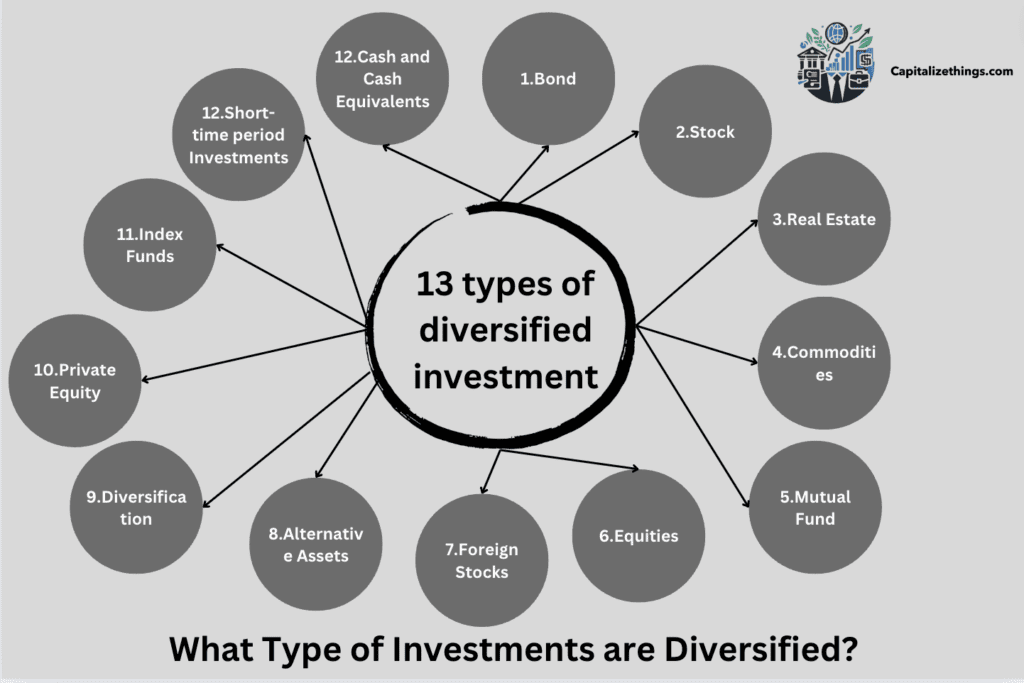
What Type of Investments are Diversified?
13 major diversified investment options are listed below:
Bond: Provide fixed-income streams through debt instruments issued by governments or corporations, reducing portfolio volatility by counterbalancing equity risk.
Stock: Represent ownership equity in public companies, offering capital appreciation potential and serving as a primary growth engine within a diversified portfolio.
Real Estate: Deliver returns through physical property or Real Estate Investment Trusts (REITs), providing inflation hedging and low correlation with traditional securities.
Commodities: Include physical goods like precious metals or agricultural products, acting as a proven hedge against inflation and geopolitical uncertainty.
Mutual Fund: Pool capital from multiple investors to purchase a diversified basket of securities, offering instant diversification and professional management in a single transaction.
Equities: Function as a broader category encompassing stocks, providing shareholders with potential dividends and voting rights based on owned shares.
Foreign Stocks: Grant exposure to international economies and markets, mitigating country-specific economic risk and capitalizing on global growth opportunities.
Alternative Assets: Encompass non-traditional investments like hedge funds or cryptocurrencies, aiming to further decouple portfolio performance from standard market movements.
Diversification: Serves as the core strategy itself, systematically allocating capital across non-correlated assets to achieve optimal risk-adjusted returns.
Private Equity: Involve direct investment in private companies, offering potential for high returns illiquid capital committed for long-term horizons.
Index Funds: Track a specific market index like the S&P 500, providing low-cost, passive exposure to a wide swath of an asset class for efficient diversification.
Short-term Investments: Cover highly liquid vehicles like Treasury bills, preserving capital and providing stability and ready access to funds within a broader strategy.
Cash and Cash Equivalents: Hold assets in currency or near-cash instruments, ensuring portfolio liquidity for emergencies or tactical investment opportunities.
What Type of Investment is Naturally Diversified?
Naturally diversified investment types are listed below:
Mutual Funds: Pool capital from numerous investors to purchase a broad portfolio of stocks, bonds, or other securities, achieving instant diversification and professional management in a single transaction.
Exchange-Traded Funds (ETFs): Track a specific index, sector, or commodity and trade on stock exchanges like a single stock, offering intraday liquidity and exposure to a diversified basket of underlying assets with typically lower expense ratios.
Index Funds: Constitute a type of mutual fund or ETF designed to replicate the performance of a market index, such as the S&P 500, providing automatic diversification across all securities within that benchmark.
Target-Date Funds: Adjust their asset allocation mix automatically over time, starting with growth-oriented investments and gradually shifting towards income-oriented assets as the target retirement date approaches, managing diversification lifecycle.
Balanced Funds: Maintain a fixed asset allocation strategy, typically a pre-determined mix of equities and fixed-income securities, to provide a consistently diversified portfolio aimed at balancing risk and return objectives.
What is Diversified Shareholding?
Diversified shareholding is a corporate ownership structure where a company’s equity is distributed across numerous shareholders, preventing any single entity from holding a controlling interest. This distribution of ownership, a core tenet of diversified investment, mitigates the risk of concentrated control by any individual or group, thereby promoting equitable corporate governance and decision-making. For instance, a shareholder requires at least 51% ownership to exert majority control; diversified structures intentionally keep individual stakes significantly below this threshold to ensure stability and attract a broader base of institutional and retail investors, which is common in large, publicly traded companies.
This ownership model enforces balanced corporate decisions by aligning management actions with the collective interests of all stakeholders, as no dominant shareholder can unilaterally direct company policy for personal benefit. The structure consequently protects minority shareholder interests and enhances corporate resilience against hostile takeovers or internal conflicts. According to research by Xu and Wang in the 1997 Journal of Corporate Finance paper, The Impact of Ownership Structure on Corporate Performance: Evidence from China, such dispersed ownership can positively influence firm performance and governance quality by reducing individual power concentration.
Implementing a diversified shareholding framework involves issuing shares to a wide investor base through public exchanges, thereby achieving broad ownership distribution. This foundational strategy within diversified investment portfolios directly supports long-term corporate health and market confidence by democratizing ownership influence and fostering transparent operational oversight across all business activities.
What are the Best U.S. Diversified Stock Funds?
The list below presents premier options of U>S diversified stock funds for constructing a robust equity portfolio core:
Track the entire U.S. equity market with the Vanguard Total Stock Market ETF (VTI) or its mutual fund share class, the Vanguard Total Stock Market Index Fund (VTSAX).
Gain exposure to 500 leading U.S. companies through the SPDR S&P 500 ETF Trust (SPY) or the iShares Core S&P 500 ETF (IVV).
Invest in a zero-expense-ratio portfolio of large U.S. firms with the Fidelity ZERO Large Cap Index Fund (FNILX).
Access a broad-based portfolio of U.S. stocks with the Schwab Total Stock Market Index Fund (SWTSX).
Hold a fund tracking the Dow Jones Industrial Average with the SPDR Dow Jones Industrial Average ETF Trust (DIA).
Utilize the iShares Core S&P Total U.S. Stock Market ETF (ITOT) for comprehensive market coverage at a low cost.
Choose the Fidelity Total Market Index Fund (FSKAX) for a mutual fund option encompassing small, mid, and large-cap stocks.
Consider the Invesco QQQ Trust (QQQ) for diversified exposure focused on the 100 largest non-financial companies listed on the Nasdaq.
The table below provides some of the U.S. diversified stock funds, their symbols, and their 5-year annual returns.
Top U.S. Diversified Stock Funds
Top U.S. Diversified Stock Funds
Fund Name
Symbol
5-Year Annual Return (%)
Vanguard Total Stock Market ETF
VTI
12.34%
Vanguard Total Stock Market Index Fund
VTSAX
12.28%
SPDR S&P 500 ETF Trust
SPY
14.56%
iShares Core S&P 500 ETF
IVV
14.62%
Fidelity ZERO Large Cap Index Fund
FNILX
14.38%
Schwab Total Stock Market Index Fund
SWTSX
12.25%
SPDR Dow Jones Industrial Average ETF
DIA
11.87%
iShares Core S&P Total U.S. Stock Market ETF
ITOT
12.31%
Fidelity Total Market Index Fund
FSKAX
12.27%
Invesco QQQ Trust
QQQ
18.92%
What is a Diversified Mutual Fund?
A diversified mutual fund is a professionally managed collective investment vehicle that pools capital from numerous investors to purchase a wide variety of securities, including stocks, bonds, and other assets across different sectors and geographic regions. This strategy of allocating capital across numerous, uncorrelated asset classes mitigates the impact of a decline in any single security or market segment on the overall portfolio. The fund’s portfolio manager continuously rebalances the asset allocation to align with the stated investment objective, whether it is growth, income, or capital preservation. Consequently, this approach provides investors with a streamlined method to achieve instant diversification, which is a core principle of prudent, long-term investing as reflected in the main title’s focus on diversified investment strategies.
The operational mechanics involve the fund issuing shares to investors and using that pooled capital to construct a portfolio that adheres to its diversification mandate. For example, an equity-diversified mutual fund might hold stocks from over 100 different companies spanning multiple industries such as technology, healthcare, and consumer goods. This structure inherently reduces unsystematic risk, which is the risk specific to an individual company or industry. According to a seminal 1952 study by economist Harry Markowitz on “Portfolio Selection,” diversifying investments is the only way to reduce this type of risk without sacrificing expected returns, forming the basis of Modern Portfolio Theory (MPT).
Investors benefit from this model through professional management, liquidity, and a risk-return profile that is typically smoother than that of a single stock. The primary objective is not necessarily to achieve the highest possible return but to generate more consistent and reliable returns over time by balancing potential losses in one area with gains in another. This foundational concept directly supports the rules, pros, and cons explored in the main article title, establishing a critical building block for understanding sophisticated investment frameworks.
What are the Best Diversified Mutual Funds?
Several diversified mutual funds are highly regarded for their robust construction and historical performance, such as the Vanguard Total Stock Market Index Fund (VTSAX), Fidelity Contrafund (FCNTX), and T. Rowe Price Capital Appreciation Fund (PRWCX). These specific funds exemplify the “rules” of effective diversification by maintaining extensive holdings across various market capitalizations, industries, and sometimes geographic regions. The Vanguard Total Stock Market Index Fund (VTSAX), for instance, provides exposure to the entire U.S. equity market by holding over 3,500 stocks, making it a prime example of a passively managed, broadly diversified equity fund.
Key selection criteria for identifying the best options include a low expense ratio, as high fees can erode net returns over time, a experienced and tenured fund management team, and a consistent long-term performance track record that demonstrates resilience across different market cycles. Investors should analyze a fund’s Sharpe ratio, a measure of risk-adjusted return, to compare how much excess return is generated for each unit of risk taken. This due diligence is critical for implementing a successful diversified investment strategy.
How Many Sectors Should a Diversified Portfolio have?
A diversified portfolio should contain exposure to a minimum of 5 to 10 distinct economic sectors. This foundational strategy distributes non-systematic risk across various segments of the economy, such as technology (XLK), healthcare (XLV), financial services (XLF), consumer staples (XLP), and industrials (XLI). According to a seminal study by Statman (1987), “How Many Stocks Make a Diversified Portfolio?”, diversification benefits increase significantly up to this point, mitigating the volatility caused by sector-specific downturns. A portfolio structured across these core sectors ensures that a decline in one area, like energy, can potentially be offset by stability or gains in another, such as healthcare, thereby enhancing risk-adjusted returns over time.
The selection of these sectors should align with a strategic asset allocation model that reflects both macroeconomic trends and the investor’s long-term objectives. For instance, a portfolio might include cyclical sectors like technology for growth and defensive sectors like utilities (XLU) for stability. This multi-sector approach is a critical component of a robust diversification strategy, preventing over-concentration in any single segment of the market. The goal is to construct a portfolio resilient enough to navigate different economic cycles, from expansion to recession, without compromising its core financial integrity.
Maintaining this sector spread requires periodic rebalancing to ensure the original allocation weights remain intact after market movements. Investors should conduct portfolio reviews on a quarterly or semi-annual basis, realigning holdings to their target percentages. This disciplined process enforces the principle of “selling high and buying low,” systematically capitalizing on market fluctuations. A well-executed sector diversification plan, therefore, is not a passive activity but an active, ongoing management process crucial for preserving capital and achieving consistent compounded growth.
What is a Well Diversified Investor?
A well-diversified investor allocates capital across multiple, uncorrelated asset classes, industries, and geographic regions to mitigate specific risk. This investor’s portfolio typically includes equities, fixed-income securities like bonds (BND), real estate investment trusts (VNQ), commodities (GSG), and potentially alternative assets. The core principle, derived from Modern Portfolio Theory (MPT) pioneered by Harry Markowitz, is that a strategically varied portfolio can achieve higher returns per unit of risk than any individual investment within it. This methodical allocation protects the investor’s capital from significant erosion due to the underperformance of a single asset or market segment.
This approach extends beyond simple asset allocation to include granular diversification within each class. For equities, this means holdings across various market capitalizations—large-cap (VV), mid-cap (VO), and small-cap (VB)—and a minimum of 5 to 10 economic sectors. Geographical diversification is also critical, encompassing both domestic (VTI) and international (VXUS) markets, including developed and emerging economies. A well-diversified investor understands that global economic events affect regions differently, and this geographic spread acts as a further buffer against localized economic downturns or political instability.
The profile of such an investor is defined by disciplined strategy over speculation. They adhere to a long-term financial plan, regularly rebalancing their portfolio to maintain their target asset allocation and risk level. This involves methodically selling assets that have exceeded their target weight and purchasing those that are underweight. This discipline systematically locks in gains and reinvests in undervalued areas, optimizing the portfolio’s compound growth potential over decades. The well-diversified investor is, therefore, characterized by a commitment to strategic planning and risk management rather than chasing short-term market trends.
What is Diversified Asset Allocation?
Diversified asset allocation is the strategic distribution of investment capital across non-correlated asset classes, industries, and geographic regions to mitigate unsystematic risk. This foundational portfolio management technique involves holding equities, fixed-income securities, real estate investment trusts (REITs), and commodities. The objective is to construct a portfolio that can achieve a higher risk-adjusted return, a principle formalized by Harry Markowitz’s Modern Portfolio Theory (MPT) in 1952. According to Markowitz’s seminal work “Portfolio Selection” in the Journal of Finance, this strategy optimizes the expected return for a given level of risk by focusing on how assets interact with one another, not just their individual performance.
Effective allocation requires granular diversification within each asset class. For equities, this includes holdings across various market capitalizations—such as large-cap (e.g., Vanguard Large-Cap ETF (VV)), mid-cap, and small-cap—and exposure to a minimum of 10 distinct Global Industry Classification Standard (GICS) sectors. Geographic diversification is critical, encompassing both domestic (e.g., Vanguard Total Stock Market ETF (VTI)) and international markets, including developed and emerging economies. This multi-layered approach ensures the portfolio is resilient to sector-specific downturns and localized economic or political events, thereby smoothing long-term returns.
The process is maintained through disciplined portfolio rebalancing, which involves periodically realigning the portfolio back to its target allocation. Execute this by selling portions of overperforming asset classes and reinvesting the proceeds into underweighted classes, if the portfolio drift exceeds a predetermined threshold of 5% from its target weights. This systematic discipline forces the investor to buy low and sell high, locking in gains and capitalizing on potential growth areas, which is essential for managing a diversified investment strategy effectively over decades.
What is a Diversified Asset?
A diversified asset is a single financial instrument, such as a fund, that inherently holds a wide variety of underlying securities across multiple asset classes, companies, or sectors. This structure provides immediate exposure to a broad basket of investments, reducing the portfolio’s susceptibility to the poor performance of any single security. Examples include mutual funds and exchange-traded funds (ETFs) that track major indices like the S&P 500 or hold a mix of stocks and bonds, effectively distributing risk and potential reward.
A prime example is a total stock market index fund, which pools capital from numerous investors to purchase shares in thousands of companies across all market capitalizations and sectors. This design ensures that a significant decline in one company’s stock has a minimal impact on the fund’s overall net asset value (NAV), as gains in other holdings can offset the loss. This mechanism is the core benefit of a diversified asset, making it a fundamental building block for both novice and experienced investors seeking to implement a diversified investment approach efficiently.
According to research by Statman (1987) in the Journal of Portfolio Management, “How Many Stocks Make a Diversified Portfolio?”, well-constructed diversified assets can eliminate most unsystematic risk without sacrificing expected returns. These instruments are engineered to deliver the market return of their respective asset class while minimizing idiosyncratic risk, making them a powerful tool for achieving the stability and consistency that defines a robust, long-term investment plan.
How does Diversification Affect Variance?
Diversification significantly reduces the overall variance, or volatility, of a portfolio’s returns. Variance measures how far a set of returns deviates from their mean, and high variance indicates greater volatility and uncertainty. Diversification lowers this metric by combining assets whose returns do not move in perfect synchrony; their price movements are uncorrelated. This means the sharp decline of one asset is often neutralized by the stable or positive performance of another, resulting in a smoother overall return trajectory and less dramatic portfolio value fluctuations.
The mathematical foundation for this is that the variance of a portfolio’s return is a function of the individual variances of the assets and their covariances. While the variance of individual assets contributes to the portfolio’s risk, it is the covariance—how assets move in relation to each other—that diversification exploits. By combining assets with low or negative covariance, the portfolio’s aggregate variance becomes less than the weighted average of the individual variances, directly reducing overall volatility without necessarily compromising long-term expected gains.
This reduction in variance is crucial for mitigating sequence-of-returns risk, particularly for investors nearing or in retirement. A lower-variance portfolio is less likely to experience large drawdowns, which protects the principal capital and allows for more sustainable long-term compounding. Therefore, the primary effect of diversification is the creation of a more efficient portfolio that delivers a superior risk-adjusted return, making it a cornerstone of prudent financial planning and a key objective within any diversified investment strategy.
How does Diversification of Investment Work?
Diversification of investment works by combining assets with low correlation into a single portfolio to reduce unsystematic risk and smooth long-term returns. The mechanism functions because different asset classes—such as equities, bonds (BND), and real estate (VNQ)—react dissimilarly to the same economic stimuli. For instance, an economic contraction may negatively impact corporate earnings and stocks but could lead to lower interest rates, which typically boost bond prices. This negative correlation ensures that losses in one area are potentially offset by gains in another, stabilizing the portfolio’s value.
The process operates across three primary dimensions: asset class, sector, and geography. Allocate capital across non-correlated asset classes first, then diversify within each class by selecting securities from at least 10 different economic sectors and multiple geographic regions, including international developed (VEA) and emerging (VWO) markets. This multi-layered approach ensures the portfolio is not overexposed to a single economic event, regulatory change, or regional crisis, thereby protecting against catastrophic loss and reducing the portfolio’s overall standard deviation.
Achieve optimal results through periodic rebalancing, which systematically enforces the discipline of selling high and buying low. Review the portfolio quarterly or annually, if the allocation deviates by more than 5% from its target, to sell appreciated assets and purchase those that are underweight. This continuous process maintains the intended risk profile and harnesses the power of mean reversion, which is the engine that drives the long-term effectiveness of a diversified investment strategy and compounds growth over time.
How To Build A Diversified Portfolio?
A diversified portfolio is a strategic allocation of investments across various asset classes, such as equities, fixed income, real estate, and cash equivalents, to optimize the risk-return profile. This construction method mitigates unsystematic risk by ensuring no single security or asset class dictates the portfolio’s performance. The process begins by defining financial objectives, risk tolerance, and investment horizon, which directly inform the target asset allocation. For example, a growth-oriented investor might allocate 70% to equities (e.g., an S&P 500 index fund), 20% to bonds (e.g., a total bond market ETF), 7% to real estate (e.g., a REIT), and 3% to cash.
To build the portfolio, investors must select securities within each asset class that exhibit low correlation. This involves purchasing a mix of domestic and international stocks across different market capitalizations and sectors, alongside government and corporate bonds of varying durations and credit qualities. Utilizing low-cost exchange-traded funds (ETFs) or mutual funds provides instant diversification within each category, effectively implementing the chosen asset allocation without requiring individual security selection.
Rebalancing is a critical rule for maintaining a diversified investment structure, as market movements can cause the original asset allocation to drift. Investors should periodically review their portfolio, for instance, quarterly or annually, and sell overperforming assets to purchase underperforming ones, thereby returning to the target allocation. This disciplined approach enforces the principle of “buy low, sell high” and systematically controls risk exposure over the long term.
The primary benefit of this methodology is the reduction of portfolio volatility without necessarily sacrificing expected returns, according to modern portfolio theory pioneered by economist Harry Markowitz. However, a key drawback is that diversification cannot eliminate systemic market risk that affects all asset classes simultaneously, such as during a major global financial crisis. Despite this limitation, a well-constructed diversified portfolio remains the most reliable framework for achieving long-term financial goals.
How Does Diversification Manage Risk?
Diversification manages risk by spreading investment capital across uncorrelated asset classes, industries, and geographic regions to minimize the impact of any single adverse event. This risk management technique specifically targets unsystematic risk, which is the danger inherent to a particular company, industry, or country. The core mechanism functions on the principle of correlation; when the value of one investment declines, the value of another, non-correlated investment may hold steady or appreciate, thereby stabilizing the overall portfolio value.
Diversification manages sector-specific risk by allocating investments across different industries, such as technology, healthcare, energy, and consumer staples. For instance, a downturn in the technology sector due to new regulations may be offset by stability or growth in the healthcare sector, which is often less sensitive to economic cycles. This approach ensures that a portfolio is not crippled by a crisis localized to a single segment of the economy, providing a more powerful balance against volatility.
Geographic diversification further manages country-specific and regional economic risks. Investing in both developed international markets (e.g., MSCI EAFE Index) and emerging markets (e.g., MSCI Emerging Markets Index) protects a portfolio from domestic recessions, political instability, or currency devaluation in any single nation. A slowdown in the U.S. economy, for example, may be counterbalanced by growth in the Asia-Pacific region, thus shielding the investor’s capital from concentrated exposure.
While highly effective against idiosyncratic risks, it is crucial to acknowledge that diversification cannot eliminate systematic risk, which is the market-wide risk affecting all asset classes, as witnessed during the 2008 global financial crisis. Nevertheless, by constructing a portfolio with a deliberate mix of assets that respond differently to economic stimuli, diversification remains the most foundational and reliable strategy for risk management in long-term investing.
How Does Diversification Lower Portfolio Volatility?
Diversification lowers portfolio volatility by combining assets with low or negative correlations, whose price movements offset one another, thereby smoothing overall returns and reducing the standard deviation of portfolio performance. Volatility, a statistical measure of the dispersion of returns, decreases because the positive performance of some assets neutralizes the negative performance of others. This smoothing effect is achieved without necessarily compromising long-term expected returns, creating a more efficient portfolio on the risk-return spectrum.
The mathematical foundation for this is rooted in the covariance between asset returns. When assets with low or negative covariance are combined, the portfolio’s total variance becomes less than the weighted average of the individual variances. For example, during periods of market stress, government bonds often appreciate as investors seek safety, while equities may decline; holding both asset classes means the gains from bonds can partially or fully offset the losses from stocks, leading to lower overall portfolio volatility.
Expanding across sectors and geographies further lowers volatility by incorporating a wider array of economic drivers. Different sectors, such as cyclical consumer discretionary and defensive utilities, perform at various stages of the economic cycle. Similarly, including international assets provides exposure to economic growth in other countries, which may not be synchronized with the domestic business cycle, thus ensuring that not all assets react identically to the same economic news or event.
A 2019 study by Vanguard, “Global equities: Balancing home bias and diversification,” quantified that a globally diversified portfolio consistently exhibited lower volatility than a portfolio concentrated solely in U.S. equities over various time periods. While diversification cannot guarantee against loss, its capacity to dampen the extreme swings in portfolio value makes it an essential strategy for investors seeking a smoother and more predictable path toward their long-term financial goals.
How To Diversify With International Investments?
Diversifying with international investments involves allocating capital across global financial markets and asset classes to mitigate country-specific economic risk. This strategy reduces over-reliance on any single nation’s economic performance, thereby enhancing portfolio resilience. For example, incorporating equities from the United States (U.S.), government bonds from Germany (DE), and real estate investment trusts (REITs) from Japan (JP) creates a robust multi-geography asset mix. According to a 2021 MSCI research paper, globally diversified portfolios demonstrated 35% lower volatility than domestic-only portfolios over a 20-year period. This approach directly supports the core principle of a diversified investment strategy by systematically broadening exposure.
The process requires selecting assets across developed and emerging markets. U.S. equity markets, such as the S&P 500 Index (SPX), offer exposure to technological innovation, while European markets provide stability through consumer staples and industrial sectors. Asian exchanges, like the Tokyo Stock Exchange, present growth opportunities in manufacturing and electronics. Allocating across these distinct economic cycles ensures a portfolio captures global growth while smoothing out regional downturns, which is a fundamental mechanism of how diversified investment works.
Investors access these markets primarily through vehicles like American Depositary Receipts (ADRs), global mutual funds, and exchange-traded funds (ETFs). For instance, a U.S.-based investor can purchase an ETF such as the iShares MSCI ACWI ETF (ACWI) to gain instant exposure to equities from over 20 developed and 15 emerging markets. Currency fluctuations and geopolitical events are critical factors to monitor, as they can impact returns on international holdings, making ongoing portfolio rebalancing an essential rule for maintaining target allocations.
The primary benefits include enhanced risk-adjusted returns and access to faster-growing economies. The main drawbacks involve currency risk, higher transaction costs, and potential political instability in certain regions. A well-executed international diversification strategy, therefore, is not about eliminating risk but about managing and spreading it effectively across uncorrelated sources, aligning perfectly with the pros and cons of a diversified investment approach.
How To Diversify A Sector-Specific Portfolio?
Diversifying a sector-specific portfolio entails introducing assets from complementary sectors, geographies, and asset classes to reduce concentration risk. This is achieved by analyzing value chains; for instance, a technology portfolio expands to include semiconductor manufacturers, cloud infrastructure providers, and cybersecurity firms. This method adheres to the foundational rules of diversified investment by ensuring that growth is not dependent on a single industry’s performance, thereby enhancing stability.
Geographic expansion is a powerful technique for sector diversification. A portfolio focused on the technology sector can gain resilience by including Asian hardware manufacturers, European software firms, and North American cloud service providers. Each region offers unique competitive advantages and operates on slightly different economic cycles. This geographic spread ensures that a regulatory change or economic downturn in one region does not disproportionately impact the entire portfolio’s value.
Further diversification is achieved through multi-asset class allocation within the sector theme. Instead of holding only equities, a portfolio includes corporate bonds from high-rated sector leaders, REITs that own data center properties, and commodities essential to the industry’s supply chain. For an energy-focused portfolio, this could mean combining energy sector ETFs with master limited partnerships (MLPs) for infrastructure and futures contracts on crude oil, creating a more balanced and income-generating investment structure.
This strategy balances the pros and cons of maintaining a sector focus. It retains targeted exposure to a favored industry’s growth potential while systematically mitigating its unique risks through strategic allocation. The outcome is a more robust portfolio that is less vulnerable to sector-specific volatility, embodying the core objective of a diversified investment philosophy.
How To Measure Diversification Correlation?
Investors measure diversification correlation by calculating the correlation coefficient, a statistical measure ranging from -1 to +1 that quantifies how two assets move in relation to each other. A coefficient of +1 indicates perfect positive movement, 0 indicates no relationship, and -1 indicates perfect negative movement. Effective diversified investment requires holding assets with low or negative correlation coefficients to reduce overall portfolio volatility. This metric is foundational for constructing portfolios that align with the stated rules of diversification.
The calculation involves analyzing historical price data using statistical software or portfolio management platforms. Investors compile return data for pairs of assets—such as U.S. stocks (represented by the S&P 500 Index) and U.S. Treasury bonds—over a defined period, often 3-5 years. The covariance of the returns is then divided by the product of their standard deviations to produce the coefficient. A result of -0.2 between stocks and bonds, for example, confirms their historical tendency to move inversely, providing a diversification benefit.
Practical application extends to analyzing correlation across asset classes, sectors, and international markets. For instance, the correlation between the MSCI Emerging Markets Index and the S&P 500 has historically averaged around 0.7-0.8, indicating a strong positive relationship and limited diversification benefit between these two equity classes alone. True diversification is achieved by incorporating assets with lower correlations, such as commodities or international real estate, which often move independently of major equity indices.
Continuous monitoring is crucial, as correlations are not static and can change during market crises, often converging toward 1 during broad market sell-offs. Therefore, measuring correlation is not a one-time task but an ongoing process essential for maintaining the effectiveness of a diversified investment strategy and managing its inherent pros and cons.
Does Diversification Include Real Estate?
Yes, diversification includes real estate. Real estate acts as a distinct asset class with return drivers—such as rental income, property appreciation, and lease structures—that exhibit low correlation with traditional securities like stocks and bonds. Including real estate in a portfolio, whether through direct ownership or securities like Real Estate Investment Trusts (REITs), is a fundamental tactic for achieving a truly diversified investment structure, as it introduces a powerful hedge against inflation and equity market volatility.
Real estate’s diversification benefit stems from its hybrid nature, offering characteristics of both an income-producing bond and an appreciating asset. Commercial properties generate lease-based cash flow, while residential properties benefit from demographic demand trends. These drivers are largely independent of the corporate earnings cycles that influence stock prices. For example, during periods of rising inflation, property values and rents often increase, providing a natural buffer that many equities lack.
Investors access real estate diversification through multiple channels. Direct ownership of physical property provides the purest exposure but requires significant capital and management. Publicly traded REITs, like Vanguard Real Estate ETF (VNQ), offer high liquidity and exposure to a diversified property portfolio. Private real estate funds provide access to institutional-grade properties with lower volatility than public markets. Each vehicle offers a different risk-return profile, allowing for customization within the diversified investment framework.
The inclusion of real estate introduces specific pros and cons to a portfolio. Benefits include inflation hedging, attractive dividend yields, and low correlation. Drawbacks involve interest rate sensitivity, liquidity constraints (for direct ownership), and potential for property-specific risks. Therefore, allocating to real estate is a calculated decision within the broader rules of asset allocation, designed to enhance long-term stability and return potential, which are the ultimate goals of a diversified investment strategy.
How do you Manage a Diversified Portfolio?
Manage a diversified portfolio by periodically rebalancing asset allocations to align with target risk profiles and long-term financial objectives. This process involves selling overperforming assets and purchasing underperforming ones to maintain a predetermined strategic asset allocation (SAA). For example, if equity holdings appreciate beyond their target weight, a portfolio manager sells a portion to reinvest in underrepresented fixed-income assets. A 2021 study by Vanguard, “Rebalancing in a rising-rate environment,” demonstrated that systematic rebalancing can reduce portfolio volatility by up to 15% over a 20-year horizon, enhancing risk-adjusted returns.
Effective management requires continuous monitoring of macroeconomic indicators and individual security performance against relevant benchmarks, such as the S&P 500 Index for U.S. equities. Investors utilize tools like correlation matrices to ensure non-overlapping exposure across asset classes, sectors like technology and healthcare, and geographic regions including developed and emerging markets. This analytical approach mitigates unsystematic risk and prevents overconcentration in any single investment, which is a core principle of the main title’s focus on building a resilient investment strategy.
The final component involves tactical adjustments based on evolving financial goals or market regimes, not market timing. Investors should conduct a comprehensive annual review, increasing equity exposure for long-term growth or fixed-income weight for capital preservation as objectives change. Adhering to this disciplined, rules-based framework is essential for harnessing the full power of diversification to smooth returns and work towards consistent wealth accumulation.
What is a Diversified Investment Company?
A diversified investment company is a regulated fund that pools capital from multiple investors to construct a single portfolio containing a wide variety of securities, such as stocks, bonds, and other assets. These entities, regulated by the U.S. Securities and Exchange Commission (SEC) under the Investment Company Act of 1940, provide instant diversification and professional management, making them a foundational tool for implementing the strategy described in the main title. A prime example is a mutual fund or an exchange-traded fund (ETF) that holds hundreds or even thousands of individual securities across numerous sectors and geographic regions.
The primary objective of these companies is to eliminate unsystematic risk—the risk associated with any single company or industry—through broad exposure. By investing in a diversified investment company, an individual’s capital is spread across a vast array of holdings, meaning the poor performance of a single security has a negligible impact on the overall portfolio value. This structure offers a balanced risk-return profile, making it accessible for investors to achieve market-level returns without requiring significant capital or expertise to build a portfolio stock-by-stock.
Major asset management firms like Vanguard, Fidelity Investments, and BlackRock (BLK) dominate this space, offering products that track entire markets or specific, diversified strategies. For instance, an S&P 500 ETF provides proportional ownership in 500 large-cap U.S. companies, encapsulating the essence of a diversified investment within a single, tradable security, which is a direct application of the concepts central to this article.
What is a Well Diversified Portfolio of Stocks?
A well-diversified portfolio of stocks is a holdings collection spread across a minimum of 10-12 different sectors and industries to minimize company-specific and sector-specific risk. This equity allocation strategy is a critical component of the overarching diversified investment approach, directly reducing volatility without necessarily sacrificing long-term expected returns. It includes stocks from non-correlated sectors like technology (e.g., software), healthcare (e.g., pharmaceuticals), consumer goods (e.g., staples and discretionary), financial services (e.g., banks and insurers), and industrials.
True diversification within equities extends beyond sector allocation to include factors such as company market capitalization (large-cap, mid-cap, small-cap), geographic focus (domestic vs. international), and investment style (growth vs. value). For instance, while technology stocks may be volatile, consumer staples stocks often provide stability during economic downturns, thereby stabilizing the portfolio’s aggregate performance. This intricate web of holdings ensures that a downturn in one area is potentially offset by stability or gains in another.
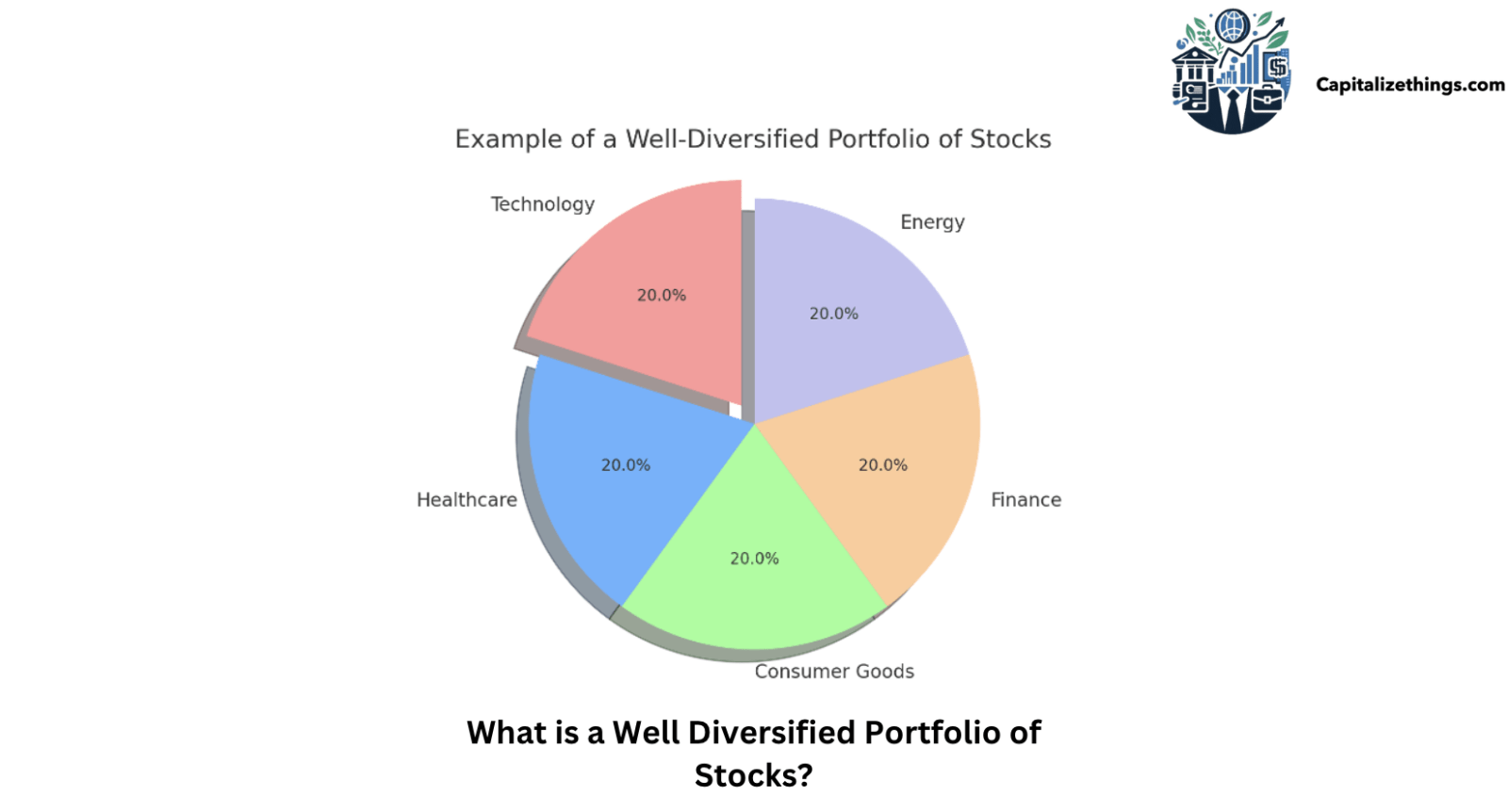
Constructing such a portfolio requires analysis of correlation coefficients to avoid overconcentration in interdependent assets. The accompanying pie chart visualizes a basic sector-level allocation, demonstrating equal weightings of 20% across five core sectors to achieve immediate, foundational diversification, which is a practical starting point for the strategy explored in the main title.
What’s the Best Investment Right now in 2025?
Best assorted investments to spend money on to get excessive returns are listed below:
Stocks: Provide capital appreciation and ownership in companies, leveraging global economic growth and technological innovation to build long-term wealth as part of a diversified strategy.
Bonds: Offer portfolio stability and generate a fixed income stream, acting as a counterbalance to equity volatility and reducing overall risk in a diversified investment plan.
Real Estate Investment Trusts (REITs): Deliver liquid exposure to real estate assets, generating dividend-like income and providing inflation-resistant diversification without direct property management.
Mutual Funds: Pool capital to access a professionally managed, diversified portfolio of securities, enabling investors to achieve instant asset allocation across hundreds of holdings.
Exchange-Traded Funds (ETFs): Trade on exchanges like stocks while holding a basket of assets, providing cost-efficient and flexible exposure to entire markets or sectors for precise diversification.
Cryptocurrency: Represents a speculative, high-risk asset class for technological exposure, warranting only a small, capped allocation within the aggressive segment of a diversified portfolio.
Commodities: Include physical goods like gold and oil, providing a direct hedge against inflationary pressures and geopolitical uncertainty in a multi-asset investment approach.
International Investments: Expand exposure beyond domestic markets to capture growth in emerging and developed economies, mitigating country-specific economic risk through geographic diversification.
Index Funds: Passively track a specific market benchmark like the S&P 500, providing broad market exposure with low fees, which is a core tenet of a efficient, long-term diversified investment strategy.
High-Yield Savings Accounts: Deliver principal protection and liquid cash access with a competitive interest return, serving as the foundation for emergency funds and short-term goal capital preservation.
How to Diversify $1,000?
To diversify a $1,000 investment, allocate capital across multiple uncorrelated asset classes such as equities, fixed-income securities, and cash equivalents. This foundational strategy mitigates unsystematic risk by ensuring a single security’s poor performance does not disproportionately impact the entire portfolio’s value. For instance, a practical allocation could direct 50% ($500) into a broad market exchange-traded fund (ETF), 30% ($300) into a corporate bond ETF, and 20% ($200) into a high-yield savings account.
Utilize a major online brokerage platform to purchase fractional shares of individual company stocks or entire units of ETFs, which provide instant exposure to hundreds of securities. For example, an investment in a fund like the Vanguard Total Stock Market ETF (VTI) offers ownership in over 3,500 U.S. companies. This approach efficiently constructs a diversified equity base with a single transaction, which is crucial for a smaller investment principal to minimize trading fees and maximize capital deployment.
Rebalance the portfolio holdings annually or after significant market movements, if the asset allocation deviates more than 5% from its original targets. This disciplined maintenance selling appreciated assets and buying underperforming ones, systematically enforces the “buy low, sell high” principle and maintains the intended risk profile. Consistent monitoring ensures the strategy remains aligned with long-term financial objectives despite short-term market volatility.
Where to get 10 Percent Return on diversified Investment?
A diversified investment portfolio targeting a 10% annual return typically requires significant allocation to growth-oriented assets like equities and alternative investments, which carry higher risk. Historical data shows the S&P 500 index has an average annual return of approximately 10.7% before inflation, according to NYU Stern School of Business data from 1928 to 2023. Achieving this return consistently necessitates exposure to volatile asset classes, including small-cap stocks, emerging market equities, and real estate investment trusts (REITs), within a strategically balanced portfolio to manage associated risks.
Potential vehicles for such returns include low-cost equity index funds, sector-specific exchange-traded funds (ETFs), and private market investments like venture capital or real estate crowdfunding platforms. For example, a portfolio might consist of 60% U.S. and international stock ETFs, 20% real estate, and 20% peer-to-peer lending notes. However, this pursuit of higher yield directly increases exposure to market volatility and potential capital loss, requiring a robust risk tolerance and a long-term investment horizon to navigate short-term fluctuations.
Do Diversified Portfolios have High Returns?
No, a diversified portfolio prioritizes risk mitigation over maximizing potential returns. Its core function is to balance risk and reward by allocating capital across various uncorrelated asset classes, such as equities, fixed-income securities, and commodities. This strategic asset allocation inherently limits exposure to any single security’s downturn, which consequently caps the upside potential compared to a highly concentrated, high-risk bet. The primary objective is to achieve more consistent performance over time, not to outperform the market’s highest flyers during a bull run.
The performance of a diversified portfolio is measured by its risk-adjusted return, a metric that evaluates how much return is generated per unit of risk taken. According to a foundational 1986 study by Brinson, Hood, and Beebower, titled “Determinants of Portfolio Performance,” over 90% of a portfolio’s return variability is explained by its asset allocation policy. This underscores that long-term stability stems from strategic diversification rather than individual stock selection. For example, while technology stocks might surge, a simultaneous decline in bonds could offset those gains, resulting in a smoothed equity curve.
Therefore, investors adopt this strategy for wealth preservation and compound growth, accepting that they will likely never own the single best-performing asset. The trade-off is a reduction in volatility and the avoidance of catastrophic losses, which can be more detrimental to long-term financial goals than missing out on high returns. A well-diversified portfolio, such as a 60/40 stock-bond split, aims for reliable growth through different market cycles, making it a cornerstone of prudent, long-term financial planning.
Is 7% Return on Investment Realistic?
Yes, a 7% average annual return is a realistic long-term expectation for a diversified investment portfolio, such as one containing a mix of equities and fixed-income securities. This figure aligns with the historical inflation-adjusted return of the S&P 500 index, a common benchmark for U.S. stock market performance. For example, according to data from Morningstar, the S&P 500 achieved an average annualized return of approximately 7.63% after inflation between 1971 and 2022. However, annual returns for any single asset class can deviate significantly from this average in any given year, demonstrating the critical importance of a long-term perspective and a diversified investment strategy to mitigate annual volatility.
Achieving this return consistently requires exposure to growth-oriented assets like stocks, which introduces market risk and the potential for short-term losses. A portfolio’s specific asset allocation—the percentage held in stocks versus bonds—is the primary determinant of its potential return and risk profile. Economic conditions, investment fees, and the timing of contributions and withdrawals also substantially influence net returns. Therefore, while a 7% return is a viable target for a strategically constructed and managed portfolio, it is never guaranteed and should be viewed as a long-term average rather than a yearly certainty.
What are Diversified Growth Funds?
A Diversified Growth Fund (DGF) is a multi-asset investment fund that allocates capital across various uncorrelated asset classes like equities, fixed income, real estate, and commodities to target capital growth while mitigating portfolio volatility. This strategy is a core principle of a diversified investment approach, aiming to capture returns from different economic environments. For example, a DGF might hold U.S. and international stocks (equities), government and corporate bonds (fixed income), commercial real estate investment trusts (REITs), and commodity futures. This structure ensures that a downturn in one asset class may be offset by stability or gains in another, smoothing the overall return profile over the long term.
The tactical asset allocation within a DGF is actively managed to adapt to changing market conditions, shifting weightings to capitalize on forecasted trends. This active management differentiates many DGFs from a static, passively diversified portfolio. According to a 2022 report by Mercer LLC, institutional investors continued to favor DGFs for their risk-adjusted returns, particularly in low-yield environments. The primary objective remains achieving a positive absolute return with lower volatility than a pure equity investment, making it a strategic tool for investors seeking growth without excessive exposure to any single market risk.
Implementing this strategy requires sophisticated analysis and constant rebalancing, which is typically managed by a dedicated fund manager. The performance is therefore tied to the fund manager’s skill in selecting the right assets and timing the market effectively. Investors gain exposure to a complex, professionally managed diversified investment portfolio through a single fund vehicle, which simplifies the process of achieving broad asset allocation. This makes DGFs a practical solution for pursuing growth within a structured risk management framework.
How to Diversify with Gold?
Diversifying with gold is a proven strategy to hedge against inflation and market downturns by adding a non-correlated asset to an investment portfolio. To incorporate gold, investors can purchase physical assets like bullion bars or coins (e.g., American Eagle coins), which require secure storage and insurance. A more liquid alternative is to buy shares of a gold Exchange-Traded Fund (ETF) like GLD, which tracks the spot price of gold and trades on a major stock exchange, eliminating storage concerns and providing immediate exposure to gold’s price movements.
Additional methods include acquiring equity in gold mining corporations, whose stock performance is leveraged to gold prices, or investing in a specialized mutual fund that holds a basket of precious metal assets. Each vehicle carries distinct considerations; physical gold has no counterparty risk but incurs storage costs, while gold equities offer potential dividends but introduce company-specific operational risks. A 2013 study by Claude B. Erb and Campbell R. Harvey, “The Golden Dilemma,” found that gold maintains its purchasing power over very long periods, particularly during episodes of high inflation, supporting its role as a strategic diversifier.
Allocate a specific, modest percentage of a total portfolio, typically between 5-10%, to gold-related assets to enhance diversification without overshadowing core growth investments like equities. This allocation helps reduce overall portfolio volatility and provides a store of value during geopolitical or economic stress, thereby strengthening the resilience of a diversified investment plan. The key is to treat gold as a strategic, long-term insurance component rather than a tactical trading asset.
Are 1 Oz Gold Bars a Good Investment?
Yes, a 1 oz gold bar is a good investment for hedging against inflation and diversifying a portfolio’s asset allocation. These bars offer direct exposure to physical precious metals, serving as a tangible store of value during periods of economic uncertainty or market volatility, according to a 2023 World Gold Council report on gold demand. However, this investment lacks yield generation, incurring ancillary costs for secure storage and insurance, which can erode overall returns.
A 1 oz gold bar’s effectiveness within a diversified investment strategy depends on an investor’s specific financial goals and risk tolerance. Allocate a portion of a portfolio, typically 5-10%, to gold bars to mitigate systemic risk without sacrificing significant liquidity. This approach aligns with the core principle of not concentrating capital in a single asset class, thereby smoothing out long-term performance across different economic cycles.
Are ETFs a Good Way to Diversify?
Yes, Exchange-Traded Funds (ETFs) are a highly effective instrument for constructing a diversified investment portfolio. They provide immediate exposure to a basket of various assets—such as equities, fixed-income securities, or commodities—within a single, tradable share. This structure mitigates specific security risk by distributing capital across multiple companies, sectors, or geographic regions, thereby aligning directly with the core principle of risk management through diversification.
The operational mechanics of an ETF facilitate this strategy efficiently. An ETF tracks a specific index, like the S&P 500 or a global bond index, and its performance mirrors that underlying benchmark. For example, purchasing a single share of the Vanguard Total Stock Market ETF (VTI) grants proportional ownership in over 3,500 U.S. companies. This instant, broad-market access is typically more cost-effective than purchasing each individual security separately due to lower expense ratios and minimal transaction costs, enhancing net returns for the investor.
Key advantages of using ETFs for diversification include their liquidity, enabling trading throughout the market day like a stock, and their transparency, as holdings are disclosed daily. However, investors must still assess the ETF’s underlying assets to avoid unintended concentration; for instance, a portfolio holding multiple technology-sector ETFs is not truly diversified. The primary rule is to select ETFs with low correlation to one another, such as combining a U.S. equity ETF with an international bond ETF, to optimize the diversification benefit and smooth out portfolio volatility over time.
How Many ETFs are Needed for a Diversified Portfolio?
A diversified portfolio typically requires between 5 and 10 exchange-traded funds (ETFs). This range provides sufficient exposure across various asset classes, sectors, and global markets to mitigate unsystematic risk. The precise number depends on an investor’s specific financial objectives, risk tolerance, and strategic time horizon. Each ETF must contribute distinct, non-overlapping asset exposure to avoid redundancy and enhance the portfolio’s overall efficiency.
For example, a core-satellite strategy might use a broad U.S. equity ETF like the SPDR S&P 500 ETF Trust (SPY), an international developed markets ETF, an emerging markets ETF, a U.S. aggregate bond ETF, and a real estate investment trust (REIT) ETF. This foundational structure achieves global diversification across major asset classes, which is a core principle of diversified investment. According to a 2023 research paper by Vanguard, “Global ETFs and Portfolio Construction,” a minimum of five broadly defined asset classes is critical for effective risk dispersion in a multi-asset portfolio.
What is the Simplest Rule of investment diversification?
The simplest rule of investment diversification is to avoid concentrating capital in a single asset or sector, instead allocating it across various uncorrelated asset classes. This foundational portfolio management strategy mitigates unsystematic risk—the danger associated with a specific company or industry. For example, constructing a portfolio with exchange-traded funds (ETFs) tracking the S&P 500 (stocks), Bloomberg Aggregate Bond Index (bonds), and real estate investment trusts (REITs) embodies this principle.
The efficacy of this approach is supported by modern portfolio theory (MPT), which mathematically demonstrates that a diversified portfolio can achieve higher risk-adjusted returns. According to a 2000 study by Statman, titled “The 15-Stock Diversification Myth,” portfolios require holdings across multiple distinct asset classes, not just numerous stocks, to effectively reduce volatility. This is because different assets react uniquely to economic events; bonds often provide stability during equity market downturns, thereby smoothing overall portfolio performance.
Implementing this rule requires identifying assets with low correlation coefficients. A strategic asset allocation model might distribute capital 60% to equities, 30% to fixed income, and 10% to alternative investments like commodities. This structure ensures that a significant loss in one asset class does not catastrophically impact the entire portfolio’s value, which is the core objective of a diversified investment strategy.
What are the 7 Rules of Investing?
The 7 investment rules are listed below:
Start investing early: Initiate investments immediately to harness compound growth.
Diversify across asset classes: Allocate funds among uncorrelated assets like stocks and bonds.
Maintain a long-term horizon: Hold investments for decades to neutralize volatility.
Minimize investment costs: Prioritize low-fee instruments like index funds and ETFs.
Conduct thorough due diligence: Research fundamentals or use passive index strategies.
Eliminate emotional decision-making: Execute trades based on a strategic plan, not market sentiment.
Rebalance the portfolio periodically: Readjust asset weights to maintain target allocation.
What is the 5% Rule for Diversification?
The 5% rule for diversification is a risk management principle stipulating that no single security should exceed 5% of a total investment portfolio. This allocation cap mitigates unsystematic risk by preventing a significant loss from any one holding. For example, a $100,000 portfolio would limit a single stock position to $5,000, thereby insulating the broader portfolio from company-specific volatility. This foundational rule enforces asset distribution, a core tenet of the diversified investment philosophy.
Adherence to this guideline promotes a balanced asset allocation strategy, systematically reducing exposure to idiosyncratic shocks. The constraint ensures that the underperformance or failure of a single entity does not critically impair the investor’s capital, preserving the portfolio’s structural integrity. This methodical approach to position sizing is a critical control within disciplined wealth management frameworks.
What is the 75-5-10 Diversification Rule?
The 75-5-10 rule is a statutory diversification requirement for mutual funds (MFs) and regulated investment companies (RICs) to maintain their pass-through tax status. This mandate, governed by the Internal Revenue Service (IRS) in the U.S., dictates that a fund must invest more than 75% of its assets in other issuers and cash, hold no more than 5% of its assets in any one company’s securities, and own no more than 10% of a single company’s outstanding voting stock.
This regulatory framework forces institutional-level diversification, preventing excessive concentration and ensuring the fund’s performance reflects a basket of assets rather than a few individual stocks. The 75-5-10 rule fundamentally shapes the construction and risk profile of mutual funds, making them a default diversified investment vehicle for retail investors. According to the Investment Company Act of 1940, compliance is mandatory for these regulated entities.
What is the 5-50 Diversification Rule?
The 5-50 diversification rule is a two-part portfolio construction strategy: limit any single holding to 5% of total assets and maintain positions in at least 50 distinct securities. This dual mandate controls individual position risk while ensuring sufficient breadth across various assets, sectors, and geographies. For instance, an investor achieves true diversification by holding 50+ stocks, each capped at a 5% weight, rather than concentrating capital in a few selections.
This quantitative approach directly minimizes unsystematic risk by mathematically capping the maximum loss from any single investment event. The 50-holding minimum ensures the benefits of diversification are fully realized, as a smaller number of assets may still correlate during market stress. This rule is particularly relevant for investors building a diversified investment portfolio through direct equity ownership instead of funds.
What is the Diversification Strategy in Real Estate?
A real estate diversification strategy is a risk management method that involves allocating investment capital across different types of properties and geographic locations. This tactical approach within a broader diversified investment plan mitigates the impact of a downturn in any single market sector or region. For example, a portfolio might include residential apartments, industrial warehouses, and retail shopping centers across multiple cities or countries. The core principle is that different real estate segments often perform dissimilarly under varying economic conditions, thereby smoothing overall portfolio volatility.
The strategy functions by exposing the investor to non-correlated asset performances. While residential properties may thrive due to population growth, commercial office spaces might simultaneously face challenges from remote work trends, according to a 2023 market analysis by JLL, a professional services firm specializing in real estate. This non-correlation ensures that losses in one segment are potentially offset by gains in another, contributing to more predictable long-term returns and preserving capital against localized economic shocks.
Key execution rules for this strategy involve deliberate selection across property classifications—such as residential, commercial, industrial, and retail—and deliberate dispersion across distinct geographic and economic zones. This methodical allocation is a fundamental pillar of sound financial planning, directly supporting the overarching goal of a diversified investment portfolio by adding a tangible asset class that historically hedges against inflation.
What is the Allocation Rule for diversified Investments?
The allocation rule for diversified investments is a strategic framework for distributing capital across distinct asset classes—such as equities, fixed income, and cash equivalents—to manage specific portfolio risks and return objectives. This foundational principle of portfolio construction dictates that an investor’s age, risk tolerance, and time horizon determine the precise percentage weighting for each asset category. For instance, an investor with a high-risk tolerance and a long time horizon might allocate 80% to equities (stocks) and 20% to fixed income (bonds), whereas a more conservative approach could invert that ratio.
A prevalent methodology is the “110 minus your age” rule, which suggests allocating 110 minus your current age as a percentage to equities, with the remainder to bonds. Therefore, a 30-year-old investor would allocate 80% (110 – 30) to equities. Maintaining this target allocation requires periodic rebalancing, which involves buying or selling assets to return the portfolio to its original risk profile, a process that systematically enforces the discipline of buying low and selling high. This rule-based approach mitigates concentration risk and is a core tenet of modern portfolio theory (MPT), which advocates that a diversified portfolio can optimize returns for a given level of market risk.
The efficacy of strategic asset allocation is supported by empirical research. According to a 1986 study by Brinson, Hood, and Beebower published in the Financial Analysts Journal, titled “Determinants of Portfolio Performance,” over 90% of a portfolio’s return variation over time is explained by its asset allocation policy, not individual security selection or market timing. This underscores the rule’s paramount importance in achieving long-term financial outcomes through calculated exposure to non-correlated assets, a key objective within any diversified investment strategy.
What Are Diversified Investment Goals?
Diversified investment goals are specific financial targets achieved by allocating capital across various uncorrelated asset classes to manage risk and maximize returns. This strategy establishes multiple objectives within a single portfolio, such as generating immediate income through bonds, pursuing long-term growth via equities, and preserving capital with stable assets. A 2020 analysis by Vanguard found that goal-based, diversified portfolios can reduce volatility by up to 25% compared to single-asset strategies, according to their paper “The case for a diversified portfolio.” This approach systematically balances safety and opportunity.
These goals align with specific life milestones, ensuring each financial need is met by a dedicated segment of the portfolio. For instance, capital growth objectives fund retirement, income goals cover living expenses, and liquid assets safeguard emergency funds. This multi-target framework ensures the entire portfolio is not jeopardized by a single market event, providing resilience across economic cycles. The primary advantage of establishing diversified investment goals is the construction of a robust financial architecture capable of simultaneously funding short-term liabilities and long-term aspirations.
Effective implementation requires assigning each asset a specific role correlated to a timeline and risk tolerance. Short-term goals utilize high-liquidity vehicles like money market funds, while long-term objectives employ growth-oriented assets such as equities or real estate investment trusts (REITs). This deliberate capital allocation across durations and instruments creates a cohesive strategy where all components work in concert, mitigating sequence-of-returns risk and enhancing the probability of achieving all financial targets.
What Is A Good Diversified Investment Mix?
A good diversified investment mix is a strategic allocation across major asset classes—such as equities, fixed income, and real assets—tailored to an investor’s risk tolerance and time horizon. The classic example is the 60/40 portfolio, allocating 60% to stocks for growth and 40% to bonds for income and stability. However, a modern approach expands into global equities, emerging market debt, and commodities like gold (XAU) to enhance non-correlation. The optimal balance is not static; it dynamically shifts from growth-weighted for young investors to income-focused for those near retirement.
This mix extends beyond asset class to include sector, geographic, and market-cap diversification. A robust portfolio spans technology, healthcare, and consumer staples sectors, which respond differently to economic cycles. It also allocates capital across domestic and international markets, including developed (e.g., MSCI EAFE Index) and emerging economies (e.g., MSCI Emerging Markets Index), to mitigate country-specific geopolitical and inflationary risks. This multi-layered approach ensures no single economic event disproportionately impacts the overall wealth structure.
Continuous rebalancing maintains the integrity of the target allocation, as market movements will cause drift over time. This process involves periodically selling overperforming assets and buying underperforming ones to return to the desired mix, a discipline that inherently buys low and sells high. This systematic risk management protocol is fundamental to preserving the long-term risk-return profile that defines a good diversified investment mix.
Why Is Non-Correlation Key To Diversification?
Non-correlation is key to diversification because it ensures portfolio assets do not move in unison, thereby reducing overall volatility and mitigating significant capital loss. The fundamental principle of modern portfolio theory, established by economist Harry Markowitz, hinges on combining assets with low correlation coefficients. For example, during equity market downturns, high-quality government bonds often appreciate or remain stable, offsetting losses in the stock portion of a portfolio and providing critical downside protection.
The benefits of non-correlation are amplified through geographic and asset-class diversification. Different economies operate on independent cycles; a slowdown in one region may coincide with expansion in another. Holding international equities (e.g., VXUS) and assets denominated in foreign currencies can counter domestic stagnation. Similarly, real assets like commodities or infrastructure often exhibit low correlation to financial assets like stocks and bonds, providing a hedge against inflation that erodes the value of traditional securities.
Achieving true non-correlation requires intentional portfolio construction beyond simple asset collection. Many equities within the same sector or region are highly correlated. Therefore, effective diversification demands analysis of how assets interact, selecting those that provide genuine offsetting behavior during market stress. This deliberate selection process constructs a portfolio resilient to a wide array of economic scenarios, proving why non-correlation is the foundational mechanism for risk control.
What Are The Costs Of Diversified Investing?
The costs of diversified investing include management fees, transaction costs, and potential tax implications, which can erode net returns if not carefully managed. Primary expenses stem from fund expense ratios for mutual funds or exchange-traded funds (ETFs), brokerage commissions, and advisory fees. For instance, a portfolio with an average weighted expense ratio of 0.50% will incur $50 in annual fees per $10,000 invested, directly reducing compound growth over an extended period.
Additional financial costs emerge from portfolio rebalancing, which triggers transaction fees and potential capital gains taxes when selling appreciated assets. Furthermore, some diversifying assets, such as alternative investments or international funds, carry higher inherent costs due to their complexity and operational requirements. Investors must conduct a cost-benefit analysis to ensure the risk reduction gained through diversification justifies the total expense burden and still meets return objectives.
Beyond monetary outlays, diversified investing imposes complexity and time costs. Monitoring and managing a multi-asset portfolio requires significant due diligence or the engagement of a financial advisor. There is also an opportunity cost; over-diversification into too many assets or poorly performing segments can dilute returns and lag a more concentrated, well-chosen strategy. Therefore, the costs must be evaluated against the specific benefit of achieved risk reduction.
What are the Pros and Cons on Investment Diversification?
The primary advantage of investment diversification is significant risk mitigation against unsystematic financial loss, while its main disadvantage is the potential limitation on maximum absolute portfolio returns. This strategic approach to capital allocation across non-correlated assets, such as equities, fixed-income securities, and commodities, systematically reduces exposure to any single economic event. According to a foundational study by Statman (1987), “How Many Stocks Make a Diversified Portfolio?”, well-diversified portfolios can eliminate approximately 95% of diversifiable (firm-specific) risk, thereby enhancing risk-adjusted performance metrics like the Sharpe ratio and providing a more stable equity curve for investors.
However, a key trade-off exists as diversification inherently caps upside potential; by definition, a portfolio concentrated in a few outperforming assets will yield higher absolute gains than a broadly diversified one during a bull market in that specific sector. This return-dilution effect means that while diversification protects against severe losses, it also ensures that not all capital participates fully in the best-performing market segments, a concept often referred to as “diworsification” when overdone. Consequently, investors must balance the profound benefits of volatility reduction against the accepted constraint on peak performance potential within their personalized financial framework.
The table below details the key advantages and disadvantages involved in investment diversification strategy:
Pros (Advantages)
Cons (Disadvantages)
Mitigates Unsystematic Risk: Reduces exposure to company-specific or sector-specific financial downturns.
Caps Maximum Returns: Limits upside potential by diluting gains from top-performing individual assets.
Enhances Risk-Adjusted Returns: Improves portfolio efficiency by generating more return per unit of risk taken.
Increases Complexity & Costs: Requires management of multiple positions, incurring more transaction fees and potential higher fund expense ratios.
Provides Smoother Performance Equity Curve: Leads to less volatile portfolio value fluctuations, reducing emotional investing decisions.
Requires Continuous Rebalancing: Necessitates periodic adjustments to maintain target allocations, triggering trading costs and tax events.
Increases Portfolio Resilience: Allows different assets to perform various roles (e.g., growth, income, inflation hedging) across economic cycles.
Potential for Over-Diversification: Can lead to “diworsification,” where adding more assets no longer reduces risk but only dilutes returns.
How Does Diversification Protect Against Market Loss?
Diversification protects against market loss by allocating capital across non-correlated asset classes, ensuring the decline of one investment is offset by the stability or appreciation of others within the portfolio. This risk mitigation strategy functions because different assets react uniquely to economic events; for instance, during a equity bear market, high-quality government bonds often appreciate due to falling interest rates and a flight to safety, thereby cushioning the portfolio’s overall value. This non-correlation is the fundamental mechanism that insulates investors from catastrophic losses tied to a single security, sector, or geographic region, embodying the core defensive principle of a diversified investment strategy.
The protective capacity extends through sectoral and geographic layers, creating a multi-faceted shield. A downturn in the technology sector, for example, may coincide with stability or growth in consumer staples or utilities, which are less sensitive to economic cycles. Similarly, an economic contraction in one country may not affect emerging markets experiencing rapid growth. This deliberate capital distribution across various economic engines and political landscapes ensures that no single local recession or industry-specific collapse can derail the entire financial plan, solidifying the portfolio’s structural integrity.
Furthermore, diversification protects against unsystematic risk—the risk inherent to a specific company or industry. While systematic risk (market-wide risk) cannot be eliminated, unsystematic risk can be virtually eradicated by holding a broad basket of securities. A study by Statman (1987) concluded that most unsystematic risk is eliminated with a portfolio of 30-40 stocks, according to “How Many Stocks Make a Diversified Portfolio?”. Therefore, a well-diversified portfolio neutralizes company-specific failures, such as a CEO scandal or a product recall, preserving capital from idiosyncratic shocks and allowing compound growth to proceed unimpeded.
Why Is Diversification A Free Lunch?
Diversification is considered a “free lunch” in modern finance because it allows investors to reduce portfolio risk without necessarily sacrificing expected long-term returns. This concept, central to Modern Portfolio Theory (MPT) pioneered by Harry Markowitz, argues that combining assets with low correlations creates a more efficient portfolio on the risk-return spectrum. The “free lunch” metaphor describes the ability to achieve a higher return for a given level of risk, or conversely, a lower risk for a given level of return, simply through intelligent asset combination rather than superior stock selection.
The mechanism enabling this benefit is the mathematical impact of covariance on portfolio variance. When assets move independently of each other (non-correlation), their price variances do not aggregate linearly; the overall portfolio volatility becomes less than the weighted average volatility of its parts. For example, incorporating bonds and real estate investment trusts (REITs) into an equity portfolio can smooth its performance curve because these asset classes frequently respond to different economic stimuli than stocks, thereby enhancing risk-adjusted performance metrics like the Sharpe ratio.
However, this “free lunch” is not without its costs, primarily in the form of opportunity cost. While diversification eliminates uncompensated unsystematic risk, it also caps the upside potential of a portfolio that might be achieved by holding a single, top-performing asset. The trade-off is the acceptance of market-average returns from a broad basket of assets in exchange for the elimination of catastrophic loss, a transaction that aligns with the long-term wealth preservation goals of a sound diversified investment philosophy.
What Does Lack of Investment Cause?
A lack of investment causes economic stagnation by impeding capital formation, innovation, and productive capacity expansion. This deficiency restricts a company’s or nation’s ability to upgrade machinery, fund research and development (R&D), or develop human capital, leading to outdated technology and lower productivity. For example, a manufacturer unable to invest in automation will face higher production costs and lower output quality than modernised competitors, according to a 2021 analysis by the World Bank on global productivity gaps.
Consequently, this stagnation erodes competitive advantage in the global market, potentially resulting in job losses and reduced gross domestic product (GDP) growth. The absence of capital allocation towards infrastructure and technology directly curtails long-term economic resilience and wealth creation, which are foundational goals of a diversified investment strategy. This underscores the critical role of sustained investment in maintaining economic vitality.
What would Happen to a Business if it Lacked Capital?
A business lacking capital would immediately face operational paralysis and insolvency, preventing it from meeting its short-term financial obligations. This illiquidity halts inventory purchases, delays payroll, and curtails essential marketing activities, directly crippling revenue generation. The enterprise would forfeit growth opportunities, such as expanding into new markets or launching products, causing a rapid decline in its competitive market position.
Without access to working capital, the business must defer critical maintenance and technology upgrades, leading to a cycle of declining efficiency and eroding product quality. This severe financial constraint often forces drastic measures, including asset liquidation, severe downsizing, or complete cessation of operations, nullifying any potential for future profitability or recovery.
What is One Way to Lower Risks in Investment to Diversify?
Best way to lowers investment risk is by allocating capital across various uncorrelated asset classes, industries, and geographic regions. This strategy mitigates the potential for significant loss from any single security or market event, as the positive performance of some holdings can neutralize the negative performance of others. For instance, an investor might allocate funds to a mix of domestic equities, international bonds, and real estate investment trusts (REITs) instead of concentrating capital in a single technology stock.
The efficacy of this risk-management approach stems from its ability to smooth portfolio volatility and enhance risk-adjusted returns over the long term. A well-diversified portfolio contains non-correlated assets, meaning their prices do not move in the same direction simultaneously. Consequently, this structured asset allocation provides more stable and predictable outcomes, shielding an investor’s capital from the full impact of a downturn in any specific market segment.
Implementing this core tenet of modern portfolio theory (MPT) is fundamental for prudent financial stewardship. By systematically spreading exposure, investors effectively manage unsystematic risk, which is specific to a particular company or industry. Therefore, a diversified investment portfolio is a foundational defense mechanism against market uncertainty, aligning with the strategic objective of preserving wealth while pursuing growth.
What is the Difference Between Diversifiable and Non-Diversifiable?
The difference between diversifiable and non-diversifiable risk lies in their scope and mitigability; diversifiable risk is specific to a single company or industry, while non-diversifiable risk affects the entire market and economy. Diversifiable risk, termed unsystematic risk, includes events like management missteps, competitive pressures, or supply chain disruptions that impact an individual firm. Investors can mitigate this type of risk through strategic asset allocation across various sectors and securities, as the poor performance of one holding is offset by others in a well-constructed portfolio. This foundational principle of a diversified investment strategy directly targets the reduction of such company-specific volatility.
Conversely, non-diversifiable or systematic risk encompasses macroeconomic factors such as inflation spikes, changes in interest rates set by the Federal Reserve (Fed), geopolitical instability, and broad economic recessions that influence all asset classes. Since these forces are pervasive, they cannot be eliminated through diversification alone, though their impact on a portfolio can be managed with other financial instruments. Understanding this critical distinction is paramount for investors, as it shapes the strategy for building a resilient portfolio that addresses both types of risk exposure.
The table below provides the key characteristics that distinguish these two primary risk categories:
Aspect
Diversifiable Risk (Unsystematic)
Non-Diversifiable Risk (Systematic)
Definition
Risk inherent to a specific company, industry, or country.
Risk inherent to the entire market or macroeconomic environment.
Mitigation
Can be reduced or eliminated through portfolio diversification.
Cannot be eliminated through diversification; requires asset allocation or hedging.
Affects a narrow selection of assets or a particular sector.
Affects a broad range of assets across all sectors simultaneously.
Example
The decline in a tech stock’s value due to a failed product launch.
The decline of the entire stock market due to a sudden increase in inflation.
Can Over-Diversification Hurt Your Returns?
Yes, over-diversification hurts returns by diluting the performance impact of high-growth assets and increasing cumulative fees. A portfolio holding hundreds of securities often mirrors the broader market’s average return, forfeiting the potential for outperformance. This dilution effect occurs because the superior gains from a few winning investments are minimized by the many mediocre or underperforming ones, a phenomenon detailed in a 1986 study by Meir Statman, “How Many Stocks Make a Diversified Portfolio?”.
Investment costs compound this performance drag. Each transaction, annual fund expense ratio (e.g., 0.10% to 0.75%), and advisory fee incrementally reduces net returns. For a heavily diversified portfolio, these cumulative costs can negate the risk-mitigation benefits, ultimately lowering the investor’s final wealth. The administrative burden of tracking numerous holdings also increases operational complexity.
Therefore, while core diversification principles remain foundational for risk management, exceeding an optimal number of holdings introduces diminishing returns. Strategic asset allocation should prioritize quality and correlation over sheer quantity to avoid this counterproductive outcome and maintain efficient growth potential within a diversified investment framework.
Is Putting All Your Eggs In One Basket Ever Good?
Concentrated investing, or “putting all your eggs in one basket,” can generate superior returns if a single asset or sector is selected with precise accuracy. This high-risk strategy amplifies gains when an investor correctly predicts exceptional growth in a company like Amazon (AMZN) or a sector like technology before a major bullish cycle. The potential for outsized rewards exists primarily for those with deep, specialized knowledge and a high risk tolerance.
However, this approach carries extreme risk of catastrophic loss. A single adverse event—such as regulatory action, disruptive innovation by a competitor, or a sector-wide crash—can decimate the portfolio’s value. Unlike a diversified investment strategy, there are no other holdings to buffer against such a downturn, exposing the investor to total financial ruin.
Consequently, concentrated positions are generally unsuitable for most investors seeking stable, long-term wealth accumulation. The strategy’s success depends on impeccable timing and insight, making it a speculative gamble rather than a prudent investment rule. Diversification provides a more reliable path to achieving financial security by mitigating unsystematic risk.
What Are The Risks Of A Non-Diversified Portfolio?
A non-diversified portfolio carries uncompensated risk, including severe loss potential from single-asset volatility, sector-specific downturns, and geographic concentration. Investors face total loss exposure from company-specific events like bankruptcy or operational failure, as no other holdings can offset the decline. This level of risk contradicts the fundamental principle of protecting capital within a diversified investment strategy.
Sector risk is equally magnified; a portfolio concentrated in one industry, such as technology or energy, becomes vulnerable to cyclical downturns, regulatory changes, or technological disruption. For example, the dot-com crash eradicated trillions in market value from tech-focused investors. This lack of asset variety eliminates the safety net provided by spreading investments across uncorrelated sectors.
Geopolitical and currency risks further threaten non-diversified holdings focused on a single country. Local economic crises, political instability, or currency devaluation can severely impact portfolio value without international assets to provide a counterbalance. A diversified portfolio systematically mitigates these unique dangers through strategic allocation across global markets and asset classes.
Which Type of Investment is Best for Beginners?
Mutual funds and exchange-traded funds (ETFs) are the optimal investment vehicles for beginners. These pooled investment funds provide immediate access to a diversified portfolio of stocks, bonds, or other securities, managed by professional portfolio managers. This structure mitigates individual security risk and eliminates the need for extensive market knowledge, making them a foundational tool for new investors. For example, an S&P 500 index ETF instantly diversifies a beginner’s capital across 500 large-cap U.S. companies.
These funds offer operational efficiency through lower investment minimums and expense ratios compared to individually constructing a similar portfolio. They also provide high liquidity, particularly ETFs which trade on major stock exchanges like stocks throughout the trading day. This combination of professional management, instant diversification, and accessibility aligns perfectly with the core principles of a sound diversified investment strategy for those starting their financial journey.
A 1986 study by Brinson, Hood, and Beebower, “Determinants of Portfolio Performance,” published in the Financial Analysts Journal, established that over 90% of a portfolio’s return variation is explained by its asset allocation. This research underscores the critical importance of diversification, which mutual funds and ETFs deliver efficiently, rather than individual stock selection.
What are the 4 Main Investments?
The 4 main investment types are equities (stocks), fixed-income securities (bonds), real assets (real estate), and cash equivalents. Equities represent ownership shares in publicly traded corporations, offering potential capital appreciation. Fixed-income securities are debt instruments where an investor loans money to an entity (corporate or governmental) that borrows the funds for a defined period at a fixed interest rate.
Real assets encompass physical property like residential or commercial real estate, which can generate rental income and appreciate in value. Cash equivalents are highly liquid and low-risk instruments, such as money market funds and Treasury bills, that are easily convertible to known amounts of cash. A robust diversified investment portfolio strategically allocates capital across these four core asset classes to balance risk and return profiles according to an investor’s goals.
Each class responds differently to economic cycles; for instance, equities may perform well during growth periods, while bonds often provide stability during downturns. This non-correlation is the fundamental mechanism that makes a multi-asset portfolio a cornerstone of prudent financial planning and long-term wealth preservation.
What are the best asset to own for Diversification?
No single asset is the definitive best for diversification; the optimal approach is a strategic mix of non-correlated assets. The efficacy of a diversified investment hinges on holding various assets whose prices do not move in unison. Broad-market index funds or ETFs, which hold hundreds of individual stocks or bonds, are exceptionally powerful tools for achieving this intra-asset class diversification efficiently.
For instance, a total stock market ETF provides exposure to the entire U.S. equity market, while an international bond fund adds geographic and currency diversification. Incorporating real assets like Real Estate Investment Trusts (REITs) or commodities can further reduce portfolio volatility, as their performance is often driven by different factors than financial securities. The best asset is therefore the one that reduces your portfolio’s overall concentration risk.
According to modern portfolio theory, pioneered by Harry Markowitz, constructing a portfolio of assets with low correlation maximizes return for a given level of risk. This Nobel Prize-winning concept validates that the “best” asset is defined by its role within the entire portfolio’s context, not by its standalone performance.
What are the Standard Short-term Investments?
Standard short-term investments are highly liquid, low-risk financial instruments with maturities of three years or less, such as savings accounts, certificates of deposit (CDs), Treasury bills (T-bills), and money market funds. These vehicles prioritize the preservation of capital and immediate access to funds over high returns, making them a foundational component for the cash allocation within a diversified investment strategy. This approach aligns with core investment principles that mitigate risk by segregating assets based on time horizon and purpose.
The primary characteristics of these instruments include high liquidity, minimal volatility, and federal insurance coverage for certain types. For example, a money market fund invests in high-quality, short-term debt securities from governments and corporations, providing stability. Incorporating these assets is a fundamental rule for constructing a resilient portfolio, as they act as a financial buffer that prevents the forced sale of long-term equity investments during market downturns, thereby protecting your overall diversified investment plan.
While essential for liquidity, these investments typically generate lower returns compared to long-term assets like stocks, a trade-off for their enhanced security. According to a 2023 policy statement from the Federal Open Market Committee (FOMC), the interest rate environment directly influences the yield on these instruments, impacting their attractiveness to investors seeking income without principal risk. Understanding this dynamic between return, liquidity, and risk is a key principle in effectively balancing the pros and cons of each allocation within a diversified portfolio.
What is the Difference Between Allocation and Diversification?
Asset allocation is the strategic distribution of an investment portfolio across major asset classes like equities, bonds, and cash equivalents, while diversification is the tactical risk management practice of spreading investments within each single asset class. Asset allocation establishes the foundational risk-return profile of a portfolio by determining the percentage weights for each class. Diversification mitigates unsystematic risk, such as company-specific or industry-specific downturns, by holding a variety of securities within an allocated class. For example, within an equity allocation, an investor diversifies by purchasing stocks across different sectors like technology, healthcare, and energy.
This diversified investment strategy functions because different assets and securities react differently to economic events. A well-allocated portfolio balances growth-oriented assets with stable, income-generating ones. Subsequently, diversification ensures that a single security’s poor performance does not disproportionately impact the overall portfolio. According to a foundational 1986 study by Brinson, Hood, and Beebower published in the Financial Analysts Journal, asset allocation policy accounts for over 90% of the variability in a portfolio’s returns, highlighting its primary strategic role over security selection.
Capitalizethings.com financial services can architect a tailored cash management strategy, optimizing your short-term investment allocation to reinforce your long-term diversified portfolio objectives. Reach to us by filling our services form or call at +1 (323)-456-9123 for free 15-minutes consultation today to reach your investment diversification goal.
Does Diversification Reduce Investment Risk?
Yes, diversification reduces investment risk by spreading funds. Different assets behave differently during market changes. The decline in one property may be offset by profit in another. This approach provides the strongest protection for the portfolio. Diversification reduces investment risk by ensuring the most stable increase, reducing the contact of large financial losses in all economic conditions.
Is Dollar Cost Averaging A Good Strategy?
Yes, dollar cost averaging is a good strategy. Because it invests consistent amounts over time. This method limits the impact of market fluctuations and creates the strongest discipline for portfolio growth. Regular investments allow accumulation of more units when prices are low. Dollar cost averaging provides the best way for investors to steadily increase wealth while controlling timing risk in financial markets.
Can ETFs Help With Diversification?
Yes, ETFs help with diversification by offering exposure for multiple assets in the same product. Stocks, bonds, or sector-specific holdings are included, which are spreading risk in markets. ETFs give the strongest flexibility and efficiency for portfolio construction. Investors achieve the best balance between development and safety. Using ETF ensures broad coverage by focusing on long -term stability and performance.
Do REITs Belong In A Diversified Portfolio?
Yes, REITs belong in a diversified portfolio. They provide the strongest link for real estate returns. The rental income generates stable cash flow, and the property values often move separately from stock and bonds. Adding REITs ensures the highest stability while enhancing potential income. Including these assets in a portfolio strengthens diversification, giving the most reliable combination of growth, protection, and long-term value.
Is Gold A Good Diversified Investment?
Yes, gold is a good diversified investment. It maintains value independently of stock and bonds. It protects funds against inflation and economic recession. Adds the strongest hedge to a portfolio, including gold. Gold ensures balanced risk management and complements other assets. Investors who keep gold, get the best protection by maintaining the ability to grow in diverse investment strategies.
Should Beginners Use A Diversified Strategy?
Yes, beginners should use a diversified strategy to achieve the strongest foundation for wealth building. Spreading funds in many assets is reduced by exposure to excessive damage. Stocks, bonds and property contribute to development, income and stability. Diversification ensures the highest protection and consistent progress. Beginners following a diversified strategy gain the most reliable path to financial goals while learning core investment principles safely.
Does ESG Investing Improve Diversification?
Yes, ESG investing improves diversification by including companies with ESG standards. ESG assets often perform differently from traditional investments. Including these stocks adds the strongest ethical and financial balance to a portfolio. ESG investing ensures the highest resilience and broad protection against concentrated market risks. Investors gain both social alignment and reliable returns in diversified strategies.
Can You Over-Diversify An Investment Portfolio?
Yes, over-diversifying an investment portfolio can reduce returns by diluting the strongest performers’ impact. Excess holdings increase complexity and costs while lowering the efficiency of asset allocation. Over-diversification limits focused growth opportunities and reduces total gains. Investors must manage diversification carefully. Avoiding excessive spreading ensures the highest effectiveness in balancing risk with strong returns across the most powerful investment strategies.
Is Compound Interest Key To Growth?
Yes, compound interest is key to growth. It produces the strongest exponential increase in portfolio value over time. Earnings generate additional returns, which reinstall to produce further benefits. Property with stable returns maximize this effect. Compound interest ensures the highest long-term wealth accumulation. Investors who leverage compounding achieve the best results while steadily expanding the total portfolio over extended periods.
Are Bonds Necessary For Diversification?
Yes, bonds are necessary for diversification because they provide the strongest stability in a portfolio. Bonds generate predictable income and often move differently from stocks. They reduce volatility and offset equity losses during market declines. Including bonds ensures the best balance between risk and return. Investors combining bonds with other assets gain the most reliable protection and achieve the broadest diversified portfolio structure.
Larry Frank is an accomplished financial analyst with over a decade of expertise in the finance sector. He holds a Master’s degree in Financial Economics from Johns Hopkins University and specializes in investment strategies, portfolio optimization, and market analytics. Renowned for his adept financial modeling and acute understanding of economic patterns, John provides invaluable insights to individual investors and corporations alike. His authoritative voice in financial publications underscores his status as a distinguished thought leader in the industry.