The Dividend Growth Rate (DGR) is the annualized percentage increase in a company’s dividend payout, serving as a direct measure of its financial prosperity and commitment to returning capital to shareholders. This metric is a critical input for valuation models like the Dividend Discount Model (DDM), linking corporate profitability and management strategy directly to shareholder returns and intrinsic value calculation.
The Two-Stage Dividend Growth Model provides a fundamental equity valuation framework for pricing stocks with distinct high-growth and stable-growth phases, offering a realistic approach for firms in transitional industries. This model discounts projected future dividend payouts to their present value, capturing a company’s shift from supernormal to normal growth and making it an indispensable tool for assessing long-term financial potential and building a resilient portfolio.
What is the Dividend Growth Rate (DGR)?
The Dividend Growth Rate (DGR) is the annualized percentage rate at which a company increases its dividend payout to shareholders. This metric measures the compound annual growth of dividend distributions, reflecting a firm’s commitment to returning capital and its financial prosperity. A consistently positive DGR signals robust earnings growth and stable cash flow generation, which are fundamental for shareholder value creation in financial services.
The DGR is a critical input for valuation models like the Dividend Discount Model (DDM), which calculates a stock’s intrinsic value based on the net present value of its future dividends. According to research by Eldomiaty, Atia, and Abdallah (2014) in “How Do Managers Manage Dividends Growth Rates?”, management strategies for sustaining DGR often focus on core profitability drivers, including revenue expansion and cost of goods sold (COGS) optimization, rather than minor cash flow adjustments.
What Is The Two-Stage Dividend Growth Model?
The Two-Stage Dividend Growth Model is a fundamental equity valuation method for pricing stocks with distinct high-growth and stable-growth phases. This Dividend Growth Rate (DGR) forecasting technique initially applies a premium growth percentage for a finite period, typically five to ten years, before transitioning to a lower, perpetual growth rate into perpetuity. It provides a more realistic valuation framework for firms experiencing rapid expansion that is unsustainable long-term, such as those in emerging technology or biotech sectors, according to Damodaran’s 2012 work on valuation models.
This analytical model discounts projected future dividend payouts back to their present value using a required rate of return, creating a net present value (NPV) for the income stream. The first stage captures the company’s aggressive reinvestment and market penetration strategy, where retained earnings fuel the elevated DGR. The model then seamlessly integrates into a Gordon Growth Model for the terminal value, reflecting the company’s maturation into a stable, industry-average growth profile, which mitigates the risk of overvaluation inherent in single-stage models.
Key inputs include the initial high-growth DGR, the stable-growth DGR, the duration of the high-growth period, and the investor’s discount rate. Sensitivity analysis on these variables is crucial; for instance, extending the high-growth phase by two years can significantly alter the intrinsic value calculation. This model is particularly valuable for fundamental analysts assessing companies in transitional industries, as it accurately captures the shift from supernormal to normal growth, a critical aspect of long-term financial planning.
The primary advantage of this two-phase approach is its ability to model corporate life cycles with greater accuracy than constant-growth assumptions. It acknowledges that competitive advantages and high profitability margins eventually attract competition, leading to a natural deceleration in growth and, consequently, the Dividend Growth Rate. This makes it an indispensable tool for investors focused on identifying growth-at-a-reasonable-price (GARP) opportunities and building a resilient dividend growth portfolio.
What Does Dividend Growth Rate Measure?
The Dividend Growth Rate (DGR) measures the annualized percentage increase in dividend distributions paid by a corporation to its shareholders. This financial metric directly quantifies the compounding growth of an investor’s income stream from a particular stock over time. It serves as a tangible indicator of a company’s commitment to returning capital and its ability to consistently generate increasing amounts of cash flow, which is a hallmark of financial vitality.
This rate effectively measures the pace and sustainability of a firm’s shareholder reward policy and capital allocation strategy. A steadily rising DGR reflects management’s confidence in future earnings visibility and its priority to distribute a portion of growing profits back to owners. It demonstrates a disciplined balance between reinvesting capital for future expansion and providing immediate, growing returns to equity participants, a key factor tracked by income-focused investors.
Furthermore, the DGR acts as a barometer for corporate financial health and expansion strength. It typically rises when a company’s net earnings and free cash flow (FCF) increase at a faster pace than its operational costs and capital expenditures. Conversely, a stagnating or declining DGR can signal underlying profitability challenges or a shift in strategy towards debt reduction or aggressive acquisition spending, providing critical insights for fundamental analysis.
Analysts often calculate the DGR using historical averages or the sustainable growth rate formula, which links it to the return on equity (ROE) and the earnings retention ratio. This measurement is vital for applying discounted cash flow (DCF) models, like the Dividend Discount Model (DDM), to estimate a stock’s fair value. A strong, predictable DGR is a powerful differentiator, separating financially resilient firms from their weaker competitors within the same sector.
Why Is Dividend Growth Rate Important For Investors?
The Dividend Growth Rate (DGR) is critically important for investors because it directly impacts total return, signals financial health, and provides protection against inflation. A rising DGR enhances an investment’s yield on cost (YOC) over time, dramatically increasing the passive income generated from an initial investment without additional capital outlay. This compounding effect is a central tenet of long-term wealth creation for dividend growth strategies, according to a foundational principle often cited by investor John Bogle.
This metric provides a transparent signal of a company’s operational success and management’s shareholder-friendly policies. A consistent history of increasing dividends often correlates with strong corporate governance, predictable cash flows, and a sustainable competitive advantage. Investors prioritize the DGR as a quality filter because companies cannot fake long-term dividend growth without genuine earnings power and a solid balance sheet, making it a reliable measure for fundamental analysis.
Furthermore, dividend growth serves as a critical hedge against inflationary pressures. Companies that can regularly raise their payouts typically possess pricing power, allowing them to pass increased costs to consumers and maintain profit margins. This ensures an investor’s real purchasing power from dividend income is preserved and grows over decades, a key advantage over fixed-income securities in various economic climates.
For valuation purposes, the DGR is an indispensable input for all dividend discount models (DDM), which are core to intrinsic value calculation. A higher expected DGR, all else being equal, results in a higher net present value for future income streams and a higher calculated fair value for the stock. Therefore, accurately estimating and monitoring the DGR is paramount for making informed buy-or-sell decisions and constructing a portfolio designed for long-term income growth and capital appreciation.
How Does Payout Ratio Affect Dividend Growth?
The payout ratio directly dictates a company’s capacity for future dividend growth by determining the proportion of earnings retained for reinvestment. A lower payout ratio, typically below 60%, signals strong potential for higher future Dividend Growth Rate (DGR) as more capital is allocated to fund expansion and profitability. Conversely, a high payout ratio, often above 80%, severely limits growth potential and threatens dividend sustainability by leaving minimal earnings for internal investment. This metric is a primary indicator of management’s strategic balance between rewarding shareholders and securing long-term corporate health.
This dynamic operates through the fundamental principle of earnings allocation. A ratio favoring high immediate payouts reduces retained earnings, which are the essential capital required for research, development, and market expansion that drive future earnings increases. Therefore, a stable and moderate ratio demonstrates a disciplined approach to capital allocation, supporting consistent dividend growth. According to a 2023 report by the Hartford Funds, companies initiating and growing dividends have historically achieved higher long-term returns with lower volatility, a feat made possible by prudent payout management.
The payout ratio’s impact becomes critically evident during economic downturns or recessions. Companies with a sustainably managed ratio possess the financial resilience to maintain or even grow dividends during market contractions, thereby signaling operational strength to investors. A sudden spike in the ratio during weak economic periods often acts as a red flag, indicating underlying earnings distress and a potential risk to the dividend itself. This makes the payout ratio an indispensable tool for evaluating the durability of an income stream.
Ultimately, the payout ratio affects dividend growth by defining a company’s reinvestment capacity. A sustainable ratio creates a virtuous cycle: retained earnings fuel growth, leading to higher future earnings, which in turn support further dividend increases. This intrinsic link between a company’s financial health and its distribution policy makes the payout ratio the most direct and powerful factor shaping long-term Dividend Growth Rate (DGR) prospects and shareholder total return.
What Is A Sustainable Dividend Growth Rate?
A sustainable dividend growth rate is the maximum annual percentage increase a company can maintain in its dividend per share without requiring external financing or jeopardizing its financial health. This rate is intrinsically linked to the firm’s long-term earnings growth, which is fueled by its profit retention and return on equity (ROE). It represents a balance where shareholder distributions are supported by genuine operational success rather than debt or corporate financial engineering.
This metric is fundamentally calculated using the sustainable growth rate formula (g = ROE * retention ratio), which compounds a firm’s profitability with its reinvestment policy. A company achieving a 15% ROE that retains 40% of its earnings, for example, implies a sustainable dividend growth rate of 6%. This demonstrates management’s efficiency in allocating capital to generate shareholder value, ensuring that dividend expansions are backed by tangible economic progress and not merely aspirational projections.
A sustainable rate prevents the overdistribution of profits, which is a common pitfall that can starve a business of the capital necessary for innovation and competitive adaptation. It protects investors from the volatility of unstable income streams that are prone to cuts or freezes during economic stress. By focusing on sustainability, firms signal a commitment to predictable and reliable dividend growth, which is a cornerstone of long-term equity valuation models and income investing strategies.
Evaluating a sustainable Dividend Growth Rate (DGR) requires analysis beyond a single formula, incorporating free cash flow trends, debt levels, and industry cyclicality. However, it remains the strongest measure of a company’s capacity to compound shareholder income reliably over decades. It connects corporate profitability directly to dividend policy, ensuring that growth is not just promised but is financially executable.
How Does Recession Impact Dividend Growth?
Recession typically negatively impacts dividend growth by pressuring corporate earnings and cash flows, leading to widespread dividend cuts or eliminations. During an economic contraction, decreased consumer demand and tighter credit conditions compress profit margins, forcing management teams to prioritize cash preservation. This often results in the reduction or suspension of dividend payments to maintain liquidity, fund essential operations, and service existing debt obligations, directly impairing the Dividend Growth Rate (DGR).
The impact is highly divergent across sectors, illustrating the critical nature of industry selection. Cyclical industries, such as consumer discretionary or industrials, experience severe earnings volatility and are most likely to cut dividends significantly. In contrast, defensive sectors like consumer staples, utilities, and healthcare often demonstrate resilience due to the inelastic demand for their essential products and services, allowing them to maintain or even continue a modest dividend growth trajectory.
Furthermore, a recession forces a rigorous stress test on a company’s dividend sustainability, often exposed by an unsustainably high pre-recession payout ratio. Firms that entered the downturn with a conservative payout ratio and a strong balance sheet are far more likely to sustain their payments. This period separates companies with transient dividend policies from those with genuine commitment to shareholder returns, ultimately lowering overall investor expectations for near-term income growth across the market.
The recession’s legacy on dividend growth extends beyond the immediate cuts; it instills a culture of conservatism in corporate payout policies that can last for years. Companies that successfully navigated the downturn without reducing dividends earn significant investor trust, while those that cut face a long road to reinstating their reputation and achieving a higher Dividend Growth Rate (DGR) in the subsequent recovery phase.
Capitalizethings.com risk management strategies focus on identifying recession-resilient companies with strong balance sheets and sustainable payout ratios to protect your portfolio’s income during economic downturns. Reach out to us today for free 15-min consultation.
How Are Dividend Growth Rates Compared By Industry?
Dividend Growth Rates (DGR) are compared by industry using sector-specific benchmarks, median growth figures, and analysis of underlying profit cycle volatility. This comparative analysis reveals that capital-intensive, mature industries like utilities and consumer staples typically offer lower but more stable growth, while technology or financial sectors may exhibit higher but more variable growth rates. The comparison hinges on the inherent capacity of different business models to generate and reliably grow free cash flow over time.
The process involves aggregating historical data to establish industry averages and medians, providing a reference point to gauge any single company’s performance. For instance, a 4% DGR might be exceptional for a regulated utility but considered mediocre for a thriving software company. Analysts further compare rates by reviewing fundamental drivers such as average return on equity (ROE), capital expenditure requirements, and the typical payout ratio norms within a sector, which dictate the potential for reinvestment and expansion.
This industry-level comparison is crucial for investors to set realistic expectations and build a diversified income portfolio. It highlights sectors with competitive advantages that foster reliable growth, such as regulated markets or brands with pricing power. Evaluating Dividend Growth Rates (DGR) by industry also identifies sectors most vulnerable to economic cycles, enabling investors to assess the resilience and sustainability of payouts during different phases of the economy, from expansion to contraction.
Ultimately, the goal is to rank sectors and identify firms that consistently outperform their industry’s average Dividend Growth Rate (DGR). This indicates superior management execution, a durable competitive moat, and a shareholder-friendly capital allocation policy. Such cross-industry comparison is a fundamental step in selecting equities for an income-focused portfolio that aims for both stability and growth.
Is Dividend Growth Rate A Valuation Tool?
Yes, the Dividend Growth Rate (DGR) is a fundamental component of several established valuation models, most notably the Gordon Growth Model (GGM). In the GGM, the DGR is a critical input used to calculate the intrinsic value of a stock by discounting the sum of all future dividend payments back to their present value. The formula is expressed as V = D1 / (r – g), where ‘g’ represents the perpetual dividend growth rate, directly determining the final valuation output.
The Dividend Growth Rate (DGR) functions as a valuation tool because it encapsulates the market’s expectation of a company’s long-term profitability and management’s commitment to returning capital to shareholders. A higher, yet sustainable, growth rate justifies a higher valuation multiple, as it promises greater future cash flows to the investor. This intrinsic link between dividend expansion and corporate value creation makes the DGR a reliable proxy for gauging a firm’s financial health and growth prospects within income-based appraisal methodologies.
However, its efficacy as a standalone valuation tool is limited to companies with a stable and predictable history of dividend payments, typically mature, profitable firms. It is less applicable to non-dividend-paying growth stocks or companies with erratic payout patterns. When used appropriately, the Dividend Growth Rate (DGR) significantly improves the precision of long-term valuation models by anchoring them in tangible, distributed cash flows rather than speculative earnings projections.
The accuracy of any valuation using the DGR hinges on the reasonableness of the growth assumption. An overly optimistic DGR will inflate the calculated value, while a pessimistic one will undervalue the company. Therefore, it must be cross-referenced with fundamental factors like return on equity (ROE) and earnings growth to ensure the projected rate is sustainable and aligned with the company’s actual financial capacity.
Is The Dividend Growth Model Accurate?
Yes, the Dividend Growth Model (DGM) is accurate for valuing mature companies with a predictable and stable dividend growth rate (DGR). Its precision depends heavily on the quality of its inputs, specifically the estimated DGR and the required rate of return. For instance, the model provides a reliable intrinsic value calculation for a blue-chip consumer staples firm with a 50-year history of consistent dividend increases. Accuracy diminishes, however, for growth-oriented tech firms that reinvest all profits instead of distributing dividends, as their DGR is effectively zero or highly volatile.
The model’s valuation output remains most accurate within sectors characterized by consistent cash flows and transparent long-term dividend policies, such as utilities or established consumer goods corporations. A 2021 study by the National Bureau of Economic Research (NBER) titled “Payout Policy and The Dividend Discount Model” found that the DGM’s predictive power for stock prices increases significantly for firms with low earnings volatility. The model’s structural simplicity requires a constant perpetual growth assumption, which often fails to capture real-world economic cycles and corporate shifts in strategy.
Key factors that enhance the DGM’s accuracy include a dividend history exceeding ten years, a payout ratio aligned with sustainable earnings, and a growth rate that does not exceed the long-term nominal Gross Domestic Product (GDP) growth of the economy. Investors achieve superior results by applying the model to evaluate companies where the dividend growth rate reflects fundamental earnings power rather than temporary financial engineering. Disciplined application with conservative DGR estimates is therefore critical for reliable valuation outputs.
Does Dividend Growth Signal Financial Health?
Yes, a sustained and rising dividend growth rate frequently signals strong corporate financial health and disciplined capital allocation. A company’s commitment to increasing its dividend per share demonstrates management’s confidence in future earnings visibility and cash flow stability. For example, a firm that consistently grows its dividend at 5% annually signals its operational efficiency and robust balance sheet strength to the market, directly impacting its cost of equity capital.
This signal gains credibility when the dividend growth is supported by expanding profit margins, high free cash flow conversion, and a manageable payout ratio, typically below 75% for most industries. A rising dividend, funded organically by earnings and not by debt, indicates a sustainable shareholder return policy. According to a report by Hartford Funds, companies in the S&P 500 Index that initiated or grew dividends achieved superior earnings growth and lower volatility from 1973 to 2022, underscoring the correlation between dividend growth and financial resilience.
Furthermore, a strategic dividend policy acts as a signaling mechanism to investors, conveying transparency and a long-term orientation that aligns executive priorities with shareholder interests. Firms that prioritize a predictable dividend growth rate often maintain stronger corporate governance and a sharper focus on profitable capital expenditures, which reinforces their financial stability and creditworthiness. This makes the dividend growth rate a practical metric for assessing corporate endurance.
How Does Dividend Growth Build Long-Term Wealth?
Dividend growth builds long-term wealth primarily through the powerful mechanism of compounding reinvested income and rising cash flow streams. An investor who reinvests dividends to purchase additional shares accelerates portfolio growth, as each subsequent dividend payment is calculated on a larger number of shares. For instance, a $10,000 investment in a stock with a 3% yield but a 7% dividend growth rate can generate exponentially higher income over a 25-year period than a static high-yield investment.
This strategy provides a dual return engine: a steadily increasing income stream that often outpaces inflation and potential capital appreciation as the market values the growing payouts. Companies with a high dividend growth rate are typically high-quality businesses whose share prices tend to be more stable during market downturns, thereby preserving capital. The consistent compounding effect transforms a modest initial yield into a significant wealth-building tool, effectively creating a self-funding asset that requires no additional capital injection from the investor.
Wealth accumulation is further enhanced because a rising dividend directly increases an investor’s annual percentage yield on their original cost basis. An investor who bought a stock at $100 with a $3 dividend has a 3% yield; if the dividend grows to $6, their yield on cost becomes 6%. This growing income stream provides inflation-protected cash flow, which is crucial for retirement planning, allowing investors to fund living expenses without selling principal assets, thus securing financial independence.
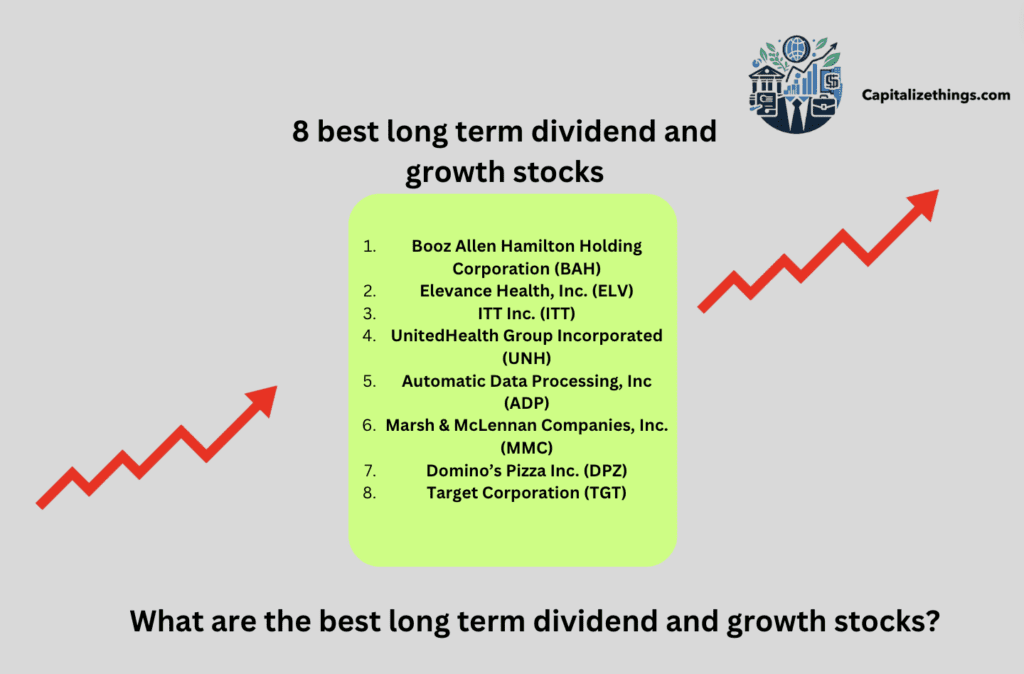
What are the best long term dividend and growth stocks?
8 best long term dividend and growth stocks are the following:
Booz Allen Hamilton Holding Corporation (BAH): Provides strategic consulting and analytics services to the U.S. government, ensuring stable cash flows and a defensible market position that supports its dividend growth trajectory.
Elevance Health, Inc. (ELV): Operates a leading health benefits platform, leveraging demographic tailwinds and pricing power to generate the earnings necessary for consistent long-term dividend increases.
ITT Inc. (ITT): Manufactures highly engineered critical components, utilizing its niche market leadership to produce strong margins and the free cash flow essential for funding its shareholder return program.
UnitedHealth Group Incorporated (UNH): Dominates the managed healthcare sector, using its integrated care model to drive earnings growth that reliably fuels annual dividend growth rate expansions.
Automatic Data Processing, Inc. (ADP): Runs a flagship payroll processing business, benefiting from recurring revenue and high switching costs that underpin its exceptional dividend consistency and growth.
Marsh & McLennan Companies, Inc. (MMC): Offers global professional services in risk and insurance, capitalizing on its advisory role to deliver predictable profits that facilitate a rising dividend.
Domino’s Pizza Inc. (DPZ): Expands its global franchise network, using a asset-light model to generate strong returns on invested capital and fund its commitment to returning cash to shareholders.
Target Corporation (TGT): Maintains a strong omnichannel retail presence, adapting to consumer trends to protect profitability and secure the dividend growth rate for its income-focused investors.
Can Dividend Growth Beat Inflation?
Yes, a rising dividend growth rate (DGR) can beat inflation when the annual percentage increase in payouts exceeds the inflation rate. This dynamic preserves the purchasing power of investor income. For instance, a 7% DGR outpaces a 3% inflation rate, generating a 4% real income growth. According to a 2023 report by Hartford Funds, dividends contributed approximately 33% of the S&P 500’s total return since 1960, demonstrating their critical role in wealth preservation during inflationary periods. A sustained DGR acts as a direct hedge against the erosive effects of rising consumer prices.
Corporate profitability is the primary engine for this outperformance. Firms with wide economic moats and pricing power, such as those in the consumer staples or energy sectors, often pass increased costs to consumers, protecting their profit margins. This allows them to generate the consistent cash flows necessary to fund a robust DGR. Consequently, a portfolio emphasizing a strong DGR provides a growing, inflation-adjusted income stream that fixed-income investments cannot guarantee during price surges.
Investors achieve long-term financial security by selecting companies with a proven history of elevating their DGR above the average inflation benchmark. This strategy transforms equity income from a static return into an actively appreciating asset. The compounding effect of reinvesting these growing dividends further accelerates the inflation-beating potential of the total portfolio, building a durable foundation for retirement planning that adapts to economic changes.
Why Is Dividend Growth Good For Passive Income?
Dividend growth is superior for passive income because it provides an escalating, predictable cash flow that compounds wealth without requiring capital liquidation. Unlike fixed annuities or bond coupons, a rising dividend growth rate (DGR) automatically increases the income yield on an investor’s original cost basis annually. This creates a natural income inflation hedge, making it a cornerstone strategy for long-term financial independence and retirement planning, directly aligning with the core principles of sustainable passive income generation.
The reliability of this income stream stems from corporate financial discipline. Companies that prioritize a consistent DGR typically possess mature business models, strong free cash flow, and shareholder-friendly management. This operational stability ensures the passive income is not only recurring but also likely to grow. For example, reinvesting dividends from a stock with a 5% DGR effectively purchases more shares each year, which in turn generate their own growing dividends, harnessing the power of compounding within a passive framework.
This self-reinforcing cycle minimizes the need for active portfolio management and timing the market. Investors can rely on the mechanistic growth of their income through corporate profit expansion rather than speculative trading. Therefore, a strategic focus on a robust DGR transforms a portfolio from a static income source into a dynamic, self-expanding asset that efficiently funds ongoing expenses and legacies.
Does Dividend Growth Show Management Confidence?
Yes, a committed dividend growth rate (DGR) directly signals management confidence in the company’s future earnings potential and financial stability. A board of directors authorizes a dividend increase only upon a firm conviction that future cash flows can sustain the elevated payout level. This action serves as a tangible, non-verbal communication of operational strength and a positive forward-looking earnings trajectory, making it a highly valued signal for market participants assessing corporate leadership credibility.
This confidence is quantified through financial metrics. A rising DGR, especially when supported by a stable or expanding profit margin and a manageable payout ratio, indicates a robust balance sheet. Management would not commit to returning more capital to shareholders unless it was confident in its ability to fund ongoing operations and strategic investments simultaneously. For instance, a company raising its DGR during economic uncertainty demonstrates a belief in its resilient business model and competitive advantages.
Consequently, a track record of dividend growth is a key indicator of prudent and confident corporate governance. It aligns management’s priorities with shareholder interests, fostering trust. Investors often interpret a growing DGR as a more reliable indicator of corporate health than qualitative statements, as it involves a direct financial commitment.
What Is The Constant Dividend Growth Model?
The constant dividend growth model (CDGM), or Gordon Growth Model, is a stock valuation method that calculates the intrinsic value of a share by discounting all future dividends that grow at a constant rate indefinitely. The formula is Stock Value = Next Year’s Dividend / (Required Rate of Return – Dividend Growth Rate). This model is a foundational tool in equity analysis for estimating the present worth of an infinite stream of steadily growing income cash flows, directly applying the concept of a perpetual dividend growth rate (DGR).
The CDGM requires three inputs: the expected dividend for the next period (D1), the investor’s required rate of return (k), and the constant perpetual dividend growth rate (g). Its application is most appropriate for mature, stable companies in non-cyclical industries with predictable earnings and a history of steady dividend increases, such as many utility or consumer defensive firms. The model’s critical assumption is that the dividend growth rate must be less than the required rate of return; otherwise, the value approaches infinity.
A significant limitation of the model is its sensitivity to the growth rate assumption. A small change in the estimated perpetual DGR can cause a large swing in the calculated stock value. Furthermore, the assumption of a constant growth rate forever is often unrealistic, as companies face different growth phases throughout their life cycle. Therefore, while useful for stable firms, the CDGM is less effective for high-growth or volatile companies.
How To Estimate Future Dividend Growth?
Investors estimate future dividend growth by analyzing a company’s sustainable growth rate, which is the product of its return on equity (ROE) and its earnings retention ratio (1 – payout ratio). This formula, Sustainable Growth Rate = ROE × Retention Ratio, provides a quantitative ceiling for a company’s ability to grow its dividends without external financing. A high ROE combined with a prudent retention ratio indicates significant capacity for future dividend growth rate (DGR) expansion, anchoring the estimation in factual financial capacity.
Historical analysis provides a crucial baseline for this forecast. Examining the 5-year and 10-year historical DGR trends reveals management’s commitment to shareholder returns and the company’s consistency through economic cycles. However, past performance is not a perfect predictor. This historical data must be tempered with forward-looking analysis of earnings projections, industry trends, and the company’s capital allocation strategy. A sudden deviation from a long-term trend warrants deeper investigation into the underlying business fundamentals.
Analysts also scrutinize guidance from management and the stated dividend policy. A firm targeting a specific payout ratio range offers a clear framework for estimating how dividends will grow in line with earnings. For example, if a company aims for a 50% payout ratio and earnings are projected to grow at 8% annually, the implied future DGR is also 8%. Combining this top-down guidance with bottom-up financial ratio analysis yields the most robust estimate.
How To Value A Stock Using DGR?
Value a stock using the dividend growth rate (DGR) by applying the Gordon Growth Model, which discounts all future dividends growing at a constant rate. The core formula is P0 = D1 / (r – g), where P0 is the stock’s intrinsic value, D1 is the expected dividend next year, r is the required rate of return, and g is the perpetual dividend growth rate. This method is a cornerstone of dividend discount modeling (DDM) and is particularly effective for appraising mature, dividend-paying equities with stable and predictable expansion metrics.
The process begins by estimating the three critical inputs. First, determine D1 by multiplying the current annual dividend by (1 + g). Second, establish the required rate of return (r), often derived using the Capital Asset Pricing Model (CAPM), which accounts for the risk-free rate, the stock’s beta, and the market risk premium. Finally, and most critically, estimate a sustainable perpetual DGR (g), which must be less than the required return (r) and is typically aligned with the long-term growth rate of the economy or the company’s industry.
Execute a sensitivity analysis after obtaining a result, as the model’s output is highly sensitive to the growth assumption. For instance, a stock might be calculated as fairly valued with a 4% DGR but significantly overvalued if the DGR is 3.5%. Therefore, using a range of realistic growth rates provides a more practical valuation band than a single point estimate. This model is best suited for stable blue-chip companies, not for firms with erratic or non-existent dividends.
How Does ROE Affect Dividend Growth?
A high return on equity (ROE) directly enables stronger dividend growth by generating more profits from existing shareholder capital, providing more capital to distribute. ROE measures a firm’s efficiency at generating profits from its net assets. According to a foundational principle by DuPont analysis, a higher ROE, driven by either superior profit margins, efficient asset use, or financial leverage, expands the firm’s sustainable growth rate, which is the primary engine for future dividend growth rate (DGR) increases without jeopardizing financial stability.
The relationship is governed by the sustainable growth formula: g = ROE * b, where *g* is the sustainable growth rate and *b* is the retention ratio (the portion of earnings not paid out as dividends). A company with a 15% ROE that retains 40% of its earnings (pays out 60%) has a sustainable growth rate of 6%. This 6% represents the potential growth rate for both its earnings and its dividends over the long term, creating a direct, mathematical link between profitability and payout expansion.
Conversely, a low or declining ROE constrains dividend growth. If ROE falls, management must choose between maintaining the current DGR by increasing the payout ratio—which is unsustainable—or reducing dividend growth to conserve capital. Therefore, investors analyzing a company’s DGR potential must prioritize consistent and high-quality ROE figures, as this metric is a powerful indicator of the company’s capacity to fund its growth and its shareholder rewards simultaneously.
How Does Payout Ratio Impact DGR?
The payout ratio, which is the percentage of earnings paid as dividends, inversely impacts the potential dividend growth rate (DGR); a lower ratio typically allows for higher future growth, while a higher ratio constrains it. This ratio is a critical gauge of a company’s dividend sustainability and its capacity to finance future expansion internally. A balanced payout ratio, often between 35% and 55% for mature firms, allows a company to reward shareholders immediately while retaining sufficient earnings to fund the profit growth that drives future DGR increases.
A excessively high payout ratio (e.g., over 80%) signals a potential dividend trap. It leaves minimal earnings for reinvestment into research, development, or capital expenditures, stifling future earnings growth. Consequently, a high ratio often leads to stagnant or unsustainably high DGR, increasing the risk of a future dividend cut. In contrast, a very low payout ratio may indicate a company is reinvesting heavily for growth, which can support a higher DGR later, but it also might suggest a lack of mature, distributable cash flows.
The optimal payout ratio is industry-specific. Utilities and real estate investment trusts (REITs) traditionally maintain higher ratios due to their stable cash flows and high depreciation charges. In contrast, technology or healthcare firms often retain most earnings to fuel rapid innovation, resulting in a lower current payout but potentially higher future DGR. Analyzing the trend of the payout ratio alongside earnings growth provides a complete picture of DGR sustainability.
Are dividend yield and dividend growth different from each other?
Yes, dividend yield and dividend growth rate (DGR) are distinct metrics measuring different aspects of a company’s dividend policy. Dividend yield is a snapshot metric calculated as Annual Dividend / Current Stock Price, representing the immediate income return. Dividend growth is a forward-looking measure of the annualized percentage rate at which the dollar amount of the dividend increases over time, reflecting the company’s commitment to enhancing shareholder returns.
A high yield alone does not indicate a quality investment; it can result from a falling stock price due to underlying business problems. This yield may be unsustainable. Conversely, a lower-yielding stock with a high DGR represents a strategy of compounding wealth over time. The dividend itself may start small, but a high DGR means the income stream grows rapidly, often leading to a much higher yield on the original cost basis within a few years. For example, a stock with a 2% starting yield and a 10% DGR will double its effective yield to 4% on the initial investment in approximately 7.2 years.
Investors must choose based on their financial goals: current income requires a focus on yield, while long-term wealth and income growth necessitate a focus on a robust DGR. The most powerful strategy often combines both—a reasonable starting yield with a strong, sustainable DGR—providing immediate income that grows significantly over the holding period, protecting against inflation and compounding returns.
What is the relation between Dividend Growth Rate and Security Pricing?
The Dividend Growth Rate (DGR) is a primary determinant of a stock’s intrinsic value in dividend-based valuation models. These models, like the Gordon Growth Model, calculate security pricing by discounting future dividend streams, where the DGR is the key variable projecting the growth of those cash flows. A higher DGR directly results in a higher calculated intrinsic value, assuming a constant discount rate.
The DGR’s accuracy is therefore critical for a realistic valuation, as an overestimated growth rate can lead to significant asset overpricing. This intrinsic value provides a benchmark for investors to compare against the current market price, identifying potential undervalued or overvalued securities for portfolio allocation.
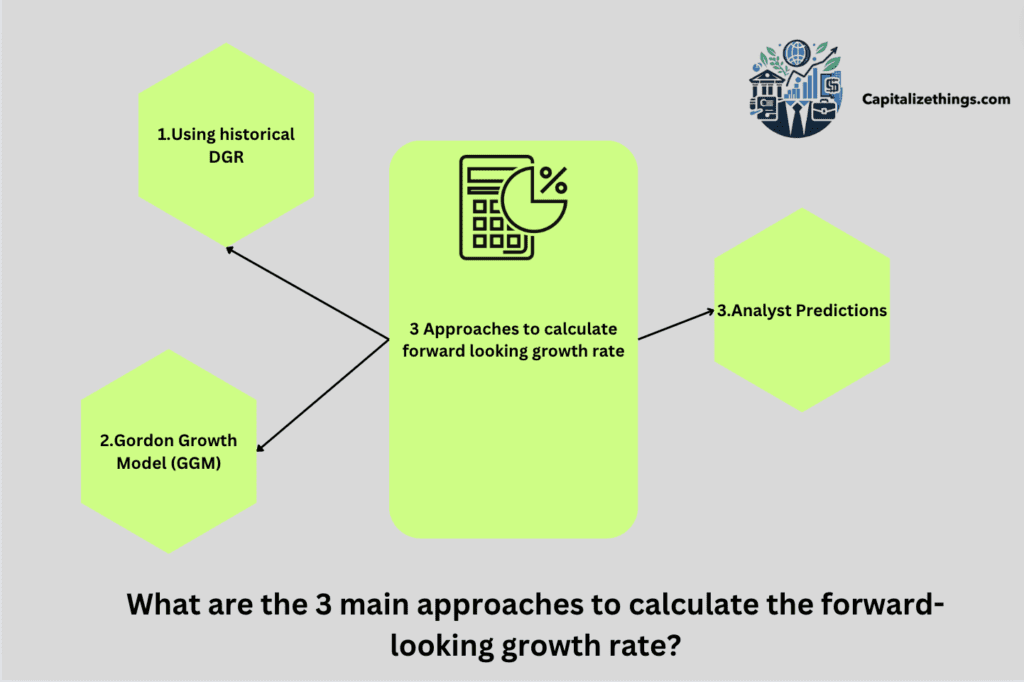
What are the 3 main approaches to calculate the forward-looking growth rate?
The 3 main approaches to calculate the forward-looking growth rate listed below:
Historical DGR: Extrapolates the company’s proven average annual dividend growth trajectory into the future.
Gordon Growth Model (GGM): Calculates the implied growth rate based on the company’s current retained earnings and return on equity (ROE).
Analyst Predictions: Incorporates consensus estimates from market experts on future earnings and dividend per share (DPS) increases.
What is the GD stock dividend growth rate?
The General Dynamics Corporation (GD) stock dividend growth rate (DGR) is the annualized percentage increase in dividend per share (DPS) distributions paid to its common equity shareholders. This metric quantifies the compound annual growth rate of a company’s cash dividend payments over a specified period, reflecting its commitment to returning capital and its financial prosperity.
The calculation of the dividend growth rate for GD, or any security, relies on historical dividend data. Analysts typically employ the compounded annual growth rate (CAGR) formula, using dividends paid over a multi-year horizon, such as five or ten years, to smooth out short-term volatility and identify a sustainable long-term trend. Key factors directly influencing this rate include the company’s free cash flow (FCF) generation, net income stability, debt-to-equity ratio, and capital allocation strategy prioritizing shareholder returns.
For instance, a company like General Dynamics, a major aerospace and defense contractor, must balance substantial research and development (R&D) expenditures with its shareholder distributions. A consistent or accelerating DGR often signals strong future earnings per share (EPS) projections and a robust balance sheet, making it a critical variable for dividend discount models (DDM) used in equity valuation. Consequently, a stable dividend growth rate reduces perceived investment risk and can lower a company’s cost of equity capital.
What is a reasonable 5 year dividend growth rate?
A reasonable 5-year dividend growth rate (DGR) is typically between 5% and 10% annually for a mature company in a stable industry. This specific percentage range indicates robust financial health and a management team confident in its future earnings potential and cash flow sustainability. For instance, a large-cap consumer staples corporation might target a 7% DGR, balancing reliable shareholder returns with strategic capital reinvestment needs. However, this figure is not absolute and varies significantly based on sector profitability, corporate size, and macroeconomic conditions.
Smaller, rapidly expanding firms or those in high-growth sectors like technology may target a higher DGR, sometimes exceeding 15% for a five-year period, to attract investors seeking aggressive income expansion. Conversely, well-established utility or telecommunications companies might exhibit a lower, more conservative DGR, often between 2% and 4%, prioritizing predictable dividend stability over high growth. The sustainability of the payout ratio, which measures dividends as a percentage of earnings, is a more critical metric than the raw growth figure alone.
Evaluating a company’s 5-year dividend growth rate requires analyzing its consistency against free cash flow trends and net income growth. A reasonable DGR is one that the company’s operational earnings and financial structure can support without escalating debt or cutting essential capital expenditures. According to a 2022 report from the Hartford Funds, companies in the S&P 500 that initiated or grew their dividends achieved an average annualized return of 10.24% from 1973 to 2021, outperforming non-dividend payers.
How Is CAGR Used In Dividend Growth?
The Compound Annual Growth Rate (CAGR) calculates a smoothed annualized growth rate of dividend payments over a specified multi-year period. Investors utilize CAGR to objectively compare the long-term dividend growth performance of different equities, eliminating the distortion caused by yearly volatility. The formula for dividend CAGR is: [(Ending Dividend per Share / Beginning Dividend per Share) ^ (1 / Number of Years)] – 1. This metric provides a single, clear percentage figure that represents the mean annual progression of dividend distributions.
CAGR is essential for identifying companies with a strong and consistent history of rewarding shareholders, as it highlights the powerful effect of compounding on dividend income. A stock exhibiting a high 10-year dividend CAGR demonstrates a management commitment to reliably returning capital to owners. This metric serves as a key stress test for corporate dividend policy, revealing the underlying strength of its earnings and cash flow generation capabilities beyond short-term market fluctuations.
For income-focused portfolios, the dividend growth rate calculated via CAGR is a primary determinant of future yield on cost, which measures the effective return based on the original investment price. A steadily increasing CAGR signifies successful corporate reinvestment and profitable expansion, directly fueling future dividend increases. This makes it a cornerstone metric for constructing a durable passive income stream that outpaces inflation over time.
What does 5% CAGR mean?
A 5% Compound Annual Growth Rate (CAGR) means an investment’s value grew at a constant annualized rate of 5% over a specified period, smoothing out interim volatility. This metric calculates the mean annual growth trajectory of an asset, like an equity mutual fund or a company’s revenue, assuming all profits are reinvested at the end of each compounding period. For example, a $1,00,000 portfolio achieving a 5% CAGR would grow to approximately $1,27,628 over five years, according to the universal CAGR formula.
The CAGR provides a standardized analytical tool for comparing the performance of disparate investments, such as stocks versus bonds, over identical timeframes. It eliminates the distortion caused by volatile yearly returns, offering a clear view of long-term wealth accretion potential. Investors utilize this figure to assess the efficacy of a financial strategy or to project future portfolio values based on historical growth rates.
Is 100% CAGR good?
Yes, a 100% CAGR is exceptionally high and typically unsustainable for established companies, though it may be achievable for early-stage startups. For large-cap corporations in mature sectors, a sustainable sales CAGR often ranges from 5% to 12%. A 100% figure usually indicates a company is scaling rapidly from a very small base, a scenario common in venture capital portfolios but carrying significant risk of future volatility or decline.
Evaluating whether a specific CAGR is “good” requires context, including the company’s life cycle, industry benchmarks, and the underlying financial metrics measured. For instance, a 100% CAGR in user growth is more plausible than a 100% CAGR in net profit for a new market entrant. Sustained triple-digit expansion is rare and often precedes market saturation or increased competitive pressures.
What is the 70 growth rate?
The Rule of 70 estimates the number of years required for an investment to double in value, given a constant annual growth rate, by dividing 70 by that rate. For a Dividend Growth Rate (DGR) of 5%, an investor’s dividend income would double in approximately 14 years (70 / 5 = 14). This principle applies to any compounding growth figure, including population growth or inflation, providing a quick mental calculation for doubling time.
This rule demonstrates the powerful effects of exponential compounding central to long-term financial planning. A higher growth rate drastically reduces the doubling time; a 7% DGR would double income in about 10 years. The formula is a simplified version of the more precise logarithmic calculation, offering an approximate result that is accurate for growth rates below approximately 20%.
Is dividend growth good?
Yes, a consistently rising dividend payment is a strong positive indicator of a company’s financial health and management’s confidence in future earnings. According to a 2019 report from Ned Davis Research, S&P 500 dividend growers and initiators outperformed non-dividend payers with significantly less volatility from 1973 to 2018. This growth signals robust cash flow, profitability, and a shareholder-friendly capital allocation policy.
Sustained dividend growth can provide investors with an increasing income stream that helps offset inflation, enhancing total return through compounding. Companies with a long history of raising dividends, often called Dividend Aristocrats or Kings, demonstrate operational resilience during economic cycles. This commitment often attracts a dedicated investor base, which can provide relative price stability.
What is the dividend growth rate of S&P Global?
The dividend growth rate (DGR) for S&P Global (SPGI) is 12.80%. This metric quantifies the annualized percentage increase in the company’s dividend distribution to shareholders over a specific period. A DGR of this magnitude indicates a robust corporate commitment to returning capital and reflects strong underlying free cash flow generation, a key consideration for dividend growth investors evaluating the S&P 500 index components.
Understanding this DGR requires analysis of the firm’s payout ratio and earnings consistency, as sustainable growth hinges on profitability exceeding distribution increases. The calculation of this rate often utilizes a compounded annual growth rate (CAGR) formula over a multi-year horizon to smooth annual volatility and provide a clearer picture of the long-term trajectory, which is central to any dividend growth strategy.
This specific growth rate positions S&P Global favorably within the financial data services sector, often surpassing broader market averages. Investors utilize this figure within valuation models, such as the Dividend Discount Model (DDM), to estimate the intrinsic value of SPGI stock by forecasting future dividend streams and discounting them to their present value.
What is the Dividend of P&G NSE?
The annual dividend for Procter & Gamble (P&G) is $4.026 per share, which equates to a dividend yield of 2.39% based on its current share price. This distribution is declared by the parent company, The Procter & Gamble Company (NYSE: PG), and is paid to holders of its equity shares, including those traded on the National Stock Exchange of India (NSE) via the international depository receipt route. The company’s price-to-earnings (P/E) ratio is 28.13.
The calculation of the dividend yield involves dividing the annual dividend per share by the current market price per share. A yield of 2.39%, coupled with a history of consistent dividend growth, signifies a focus on delivering reliable shareholder income rather than high-yield speculation. This payout strategy is a critical component for understanding the total return potential of a consumer staples equity investment.
For investors focused on the dividend growth rate, P&G’s long-term record of increasing its annual payout is a key analytical factor. This consistent growth, often measured on a per-share basis, demonstrates management’s confidence in the company’s stable earnings model and strong cash flow generation, which supports future dividend sustainability.
Does the dividend growth rate affect stock price?
Yes, the dividend growth rate (DGR) directly affects a company’s stock price through established financial valuation models. According to the Gordon Growth Model, a core dividend discount model (DDM), the intrinsic value of a stock is calculated by dividing the expected next annual dividend by the difference between the required rate of return and the dividend growth rate. Therefore, a higher DGR, all else being equal, leads to a higher calculated intrinsic value.
The market’s anticipation of a changing DGR causes immediate price adjustments. For example, an announcement of an increased growth rate often signals strong future earnings potential and managerial confidence, leading to upward price momentum. Conversely, a dividend cut or a lowered growth trajectory frequently triggers a sell-off, as it implies financial distress or reduced future cash flow returns to shareholders.
This relationship underscores why the dividend growth rate is a pivotal metric for equity analysis, inextricably linking corporate profitability, strategic capital allocation, and market valuation. A sustainable and growing dividend stream, therefore, is not merely an income feature but a primary driver of capital appreciation over extended periods.
What is the Formula for Dividend Growth Rate (DGR)?
The foundational equation for single-year growth is DGR = (Current Year Dividend / Previous Year Dividend) – 1 The Dividend Growth Rate (DGR) formula calculates the annualized percentage rate of growth a company’s dividend per share undergoes over a specified period. . This formula expresses the change as a percentage, indicating either an increase or decrease in shareholder distributions from one fiscal year to the next.
To calculate a multi-year DGR, such as a 3-year rate, you must compile the annual dividend per share data for the past four years. The calculation involves determining the individual year-over-year growth rate for each period within that timeframe and then computing the average of those annual rates. This methodology smooths out short-term volatility, providing a more stable measure of a company’s long-term dividend expansion trajectory and its commitment to returning capital to shareholders.
The key entities in this calculation are the annual dividends, which represent the sum of all quarterly distributions paid within a fiscal year. For example, a company paying $0.25 per share each quarter would have an annual dividend of $1.00 per share. Utilizing annual figures is critical for accurate DGR analysis, as it standardizes the data across companies with varying distribution frequencies.
What is the geometric average dividend growth rate?
The geometric average dividend growth rate (DGR) is the compound annual growth rate of dividends per share paid by a corporation over a specific multi-period timeframe. This metric calculates a smoothed annualized rate, mitigating the volatility of periodic fluctuations to provide a more accurate long-term perspective on a company’s dividend distribution trajectory.
The formula for calculating the geometric average DGR is [D<sub>N</sub> / D<sub>0</sub>]<sup>1/N</sup> – 1, where D<sub>0</sub> represents the initial dividend per share, D<sub>N</sub> is the final dividend per share, and N equals the total number of compounding periods between them. For example, a company increasing its dividend from $1.00 (D<sub>0</sub>) to $1.50 (D<sub>5</sub>) over five years (N=5) would have a geometric average DGR of [$1.50 / $1.00]<sup>1/5</sup> – 1 = 0.0845 or 8.45%, according to the foundational principles of time value of money (TVM) in corporate finance.
How To Calculate Average Dividend Growth Rate?
The average dividend growth rate (DGR) is calculated by summing the individual annual percentage growth rates and dividing by the number of periods. This arithmetic mean provides a clear measure of the central tendency of a company’s dividend increases over a defined timeframe, smoothing out short-term volatility to reveal the underlying trend in shareholder remuneration. For instance, calculating the average DGR is a fundamental step in the dividend discount model (DDM) for equity valuation.
The formula for the average dividend growth rate is: Average DGR = (G1 + G2 + … + Gn) / n, where G represents the annual growth rate percentage and n is the total number of years. This calculation delivers a single metric that facilitates the comparison of long-term dividend policies across different companies within a portfolio, such as between a stable utility and a growing technology firm. The result offers a quantifiable insight into corporate profit distribution strategies. Use capitalizethings.com advance free DGR calculator for you calculations:
Advanced Dividend Growth Rate Calculator
Historical DGR
Future Dividend
How To Calculate Historical Dividend Growth?
To calculate historical DGR, obtain the initial and most recent DPS figures and the number of compounding periods between them. The formula to compute this metric is: Historical Dividend Growth Rate = (Recent DPS / Old DPS)^(1 / n) - 1, where 'n' represents the number of years. The historical dividend growth rate (DGR) quantifies the annualized percentage increase in dividend per share (DPS) paid by a corporation over a specific period. This calculation provides a clear, compounded annual growth perspective on shareholder remuneration trends, directly reflecting a company's progressive capital allocation policy.
For example, a company paying a dividend of $1.00 per share (DPS) five years ago and $1.50 DPS today has a historical DGR of 8.45% over that period, according to the compound annual growth rate (CAGR) formula. This mathematical approach is essential for fundamental analysis, transforming raw dividend data into a standardized metric for evaluating long-term income generation stability and corporate financial health within an investment portfolio.
The resulting figure is a critical input for equity valuation models, such as the Dividend Discount Model (DDM). A consistent historical DGR signals strong cash flow generation and a management commitment to returning capital to shareholders, making it a cornerstone for income-focused investment strategies and retirement planning.
How To Find Dividend Growth Rate Easily?
Investors can find the dividend growth rate easily by utilizing the compound annual growth rate (CAGR) formula with publicly available dividend per share (DPS) data. The most straightforward method involves sourcing historical DPS figures from a company's financial statements or reputable financial data platforms, then applying the formula: (Current DPS / Starting DPS)^(1 / Number of Years) - 1. This efficient calculation yields the annualized growth percentage, enabling a quick comparison of income growth across different equities and sectors without complex software.
For instance, review a company's last ten years of dividend payments, identify the starting and ending values, and compute the result. Many financial websites automatically calculate and display this metric, streamlining the initial screening process for potential investments. According to a 2023 publication by the CFA Institute, this method remains the most widely accepted for its simplicity and accuracy in measuring consistent dividend appreciation.
This accessible metric empowers investors to quickly screen for companies with a proven track record of increasing shareholder distributions. A steadily rising DGR often correlates with strong underlying profitability and effective capital management, making it a valuable heuristic for constructing a durable income portfolio.
How to calculate the company's dividend growth rate?
Calculate a company's dividend growth rate (DGR) by applying the formula [(Ending Dividend / Beginning Dividend)^(1 / Number of Periods)] - 1 to its historical dividend per share (DPS) payments. This calculation measures the annualized percentage increase in a firm's dividend distributions to shareholders over a specified timeframe, typically 3 or 5 years, to assess its financial stability and commitment to returning capital. For instance, a corporation that raised its DPS from $2.00 to $2.50 over a five-year span demonstrates a specific, calculable growth trajectory that is critical for equity analysis.
The precision of the DGR calculation depends on selecting a consistent period length and using accurate DPS figures from the company's cash flow statements or investor relations materials. Analysts often use a compounded annual growth rate (CAGR) methodology for this computation, as it smooths the growth rate over multiple periods and provides a single annualized figure. This metric is a cornerstone of dividend discount models (DDM), which value stocks based on the net present value of future dividend streams.
A stable or increasing DGR signals strong corporate financial health and consistent earnings power, making the security attractive to income-focused investors. Conversely, a volatile or declining rate may indicate underlying operational challenges or a shift in capital allocation strategy away from shareholder returns. Therefore, understanding this calculation is fundamental for making informed long-term investment decisions in dividend-paying equities.
What is the Dividend growth rate formula for Excel?
The formula for calculating the Dividend Growth Rate in Excel:
[(Ending Dividend per Share / Beginning Dividend per Share) ^ (1 / Number of Years) – 1]
How To Calculate Dividend Growth Rate In Excel?
The Dividend Growth Rate (DGR) is calculated in Excel using the formula for Compound Annual Growth Rate (CAGR), which provides the mean annual growth rate of dividends over a specified period. Investors input historical dividend per share (DPS) figures into adjacent cells, for example, a starting value in cell B2 and an ending value in cell B6 after four growth periods. The standard formula =(B6/B2)^(1/4)-1 computes the annualized DGR, where '4' represents the number of growth periods between the two dividend payments.
This Excel-based calculation automates the analysis of a company's dividend consistency and growth trajectory, directly supporting the evaluation of long-term income compounding. The tool efficiently processes raw dividend data into a precise DGR figure, eliminating manual calculation errors and providing a clear metric for comparing different income-generating assets within a financial services portfolio.
What is the formula for Dividend growth rate from ROE?
The projected Dividend Growth Rate (DGR) derived from Return on Equity (ROE) is calculated by multiplying ROE by the retention rate (RR), which is one minus the dividend payout ratio (DPR). This sustainable growth rate (SGR) formula, SGR = ROE × (1 - DPR), estimates the maximum growth rate a company can achieve without changing its capital structure or seeking additional external financing. A higher ROE or a higher retention of earnings, therefore, indicates a greater potential for future dividend increases, forming a core premise of the dividend discount model (DDM).
This intrinsic calculation links profitability, measured by ROE, directly to shareholder returns through the DGR. For instance, a firm with a 15% ROE and a 40% dividend payout ratio has a 60% retention rate, projecting a sustainable DGR of 9% (0.15 × 0.60). This establishes a fundamental nexus between corporate profitability and the capacity for dividend expansion, a critical relationship for equity research.
What is the Investment appraisal dividend growth rate formula?
The investment appraisal dividend growth rate formula is the Gordon Growth Model (GGM), defined as P = D / (k - g). This fundamental equity valuation method calculates the intrinsic value (P) of a stock based on its expected future dividend series, which is projected to grow at a constant rate (g) indefinitely. The variables are the next period's expected dividend (D), the required rate of return or cost of equity capital (k), and the perpetual Dividend Growth Rate (DGR). This DGR-centric model is a cornerstone of dividend discount model (DDM) analysis for long-term investment appraisal.
The accuracy of this valuation is highly sensitive to the DGR assumption, as a miscalculation can significantly misprice an asset. For instance, a DGR that exceeds the cost of capital (k) renders the model invalid, producing a negative stock value, which underscores the critical need for a conservative and justified DGR estimate. Therefore, financial analysts often use a company's historical DGR, sustainable growth rate, or industry benchmarks to inform this vital input.
What is the constant dividend growth formula assumes?
The constant dividend growth formula, the Gordon Growth Model, assumes dividends will increase at a fixed annual rate (g) perpetually. This model, P₀ = Div₁ / (r - g), requires a stable Dividend Growth Rate (DGR) that is less than the required rate of return (r). It presumes the evaluated company possesses a mature, stable business model with predictable earnings and a consistent policy of distributing dividends, making the DGR a critical and constant variable for accurate valuation.
The formula further assumes that the cost of equity (r) remains constant and that the firm reinvests earnings at a return equal to its cost of capital. These conditions are most applicable to established, blue-chip companies within non-cyclical sectors rather than high-growth firms that reinvest all profits. According to a 2021 review in the Journal of Financial Economics, this model remains a standard tool for valuing utilities and consumer staples sectors where payout policies are highly consistent.
What is the zero dividend growth formula?
The zero dividend growth formula is P = D / r, where P is the stock price, D is the fixed annual dividend per share, and r is the required rate of return. This model calculates the intrinsic value of equities, such as preferred stock, by treating their fixed dividend stream as a perpetuity. The formula provides a fundamental valuation baseline within Dividend Growth Rate (DGR) analysis for securities with no anticipated dividend appreciation.
The calculated stock price is highly sensitive to changes in the required rate of return, which is driven by the perceived risk of the underlying company. For example, a preferred stock with a fixed annual dividend of $4.00 and a required return of 8% would have an intrinsic value of $50.00 ($4.00 / 0.08). This exemplifies the direct application of the formula in financial security pricing.
What is the Two-stage growth model formula?
The two-stage dividend growth model (DGM) formula calculates a stock's intrinsic value by discounting future dividends that grow at a high initial rate before transitioning to a stable, perpetual growth rate. This model divides the valuation into two distinct phases to accommodate companies experiencing a period of high growth followed by a more sustainable, long-term rate. The formula is:
where ‘Σ’ represents the sum of discounted dividends from year 1 to year n. The first segment of the equation values the initial high-growth phase by summing the present value of each individual dividend during that period. The second segment calculates the terminal value at the end of the high-growth phase using the Gordon Growth Model, which is then discounted back to its present value.
This Dividend Growth Rate (DGR) valuation method is particularly effective for evaluating firms in a transitional growth phase, such as emerging tech companies that are scaling rapidly. The key variables include the initial high-growth rate (g₁), the stable perpetual growth rate (g₂), which must be lower than the discount rate (r), and the length of the high-growth period (n).
What is the Variable growth model formula?
The variable-growth dividend discount model (DDM) formula, or the multi-stage model, extends the two-stage concept by allowing for multiple distinct phases of dividend growth rate (DGR) transitions. It provides a framework for valuing companies expected to pass through several growth stages, such as an initial high growth phase, a transitional deceleration phase, and a final mature stable growth phase. The general formula involves calculating the present value of dividends for each unique growth period.
The formula for a dividend payment in any year t during a specific growth phase is: Dₜ = D₀ × (1 + g)ᵗ, where g is the specific growth rate for that phase. A three-stage model, for example, would be constructed as: Value = (PV of Phase 1 dividends) + (PV of Phase 2 dividends) + (PV of Phase 3 terminal value). Each phase uses its own growth rate, and the terminal value is typically calculated once the firm reaches its perpetual stable growth state.
This sophisticated DGR calculation offers maximum flexibility for financial modeling of complex business life cycles, making it ideal for analyzing firms undergoing structural shifts or market maturation. The model's accuracy is highly dependent on the analyst's ability to correctly forecast the duration and magnitude of each growth phase, which requires deep fundamental analysis. However, its complexity also introduces more assumptions and potential points of error compared to simpler models.
What is the difference between dividend yield and dividend growth model?
The dividend yield measures the annual dividend income relative to the current stock price, while the dividend growth model, specifically the Dividend Discount Model (DDM), is a valuation method that calculates a stock's intrinsic value based on projected future dividend payments.
The dividend yield provides a snapshot of current income return, expressed as a percentage, such as a 4% yield on a $100 stock paying $4 annually. Conversely, the DDM incorporates the Dividend Growth Rate (DGR) to estimate the present value of all future dividends, making it a forward-looking tool for assessing long-term investment potential based on payout sustainability and growth trajectory.
The risk profiles differ significantly; a high dividend yield can sometimes signal financial distress or an unsustainable payout ratio, potentially leading to dividend cuts. In contrast, a focus on a robust DGR often indicates a company with a low payout ratio, strong free cash flow, and a resilient balance sheet, allowing it to consistently increase shareholder payments even during economic stress. This fundamental distinction separates short-term income strategies from long-term wealth compounding, directly linking to the principles of understanding and calculating sustainable dividend growth.
What is the difference between the dividend discount model and the dividend growth rate?
The Dividend Discount Model (DDM) is an intrinsic valuation formula, whereas the Dividend Growth Rate (DGR) is a critical input variable used within that model to forecast future dividend distributions. The DDM calculates a stock's fair value by summing the discounted present value of all future dividends it is expected to pay, fundamentally answering "what is the stock worth today based on future income?" The DGR, expressed as an annual percentage increase, is the estimated rate at which those future dividends will grow, making its accurate estimation vital for the model's precision.
The DGR provides the growth engine for projections in various DDM iterations, such as the Gordon Growth Model, which requires a constant perpetual growth rate. An inaccurate DGR estimate, whether too optimistic or pessimistic, will directly distort the DDM's output and lead to a mispriced valuation. Therefore, understanding the DGR is a prerequisite for applying the dividend discount model effectively, as it connects a company's fundamental financial performance to its long-term valuation through dividend policy.
What is better for investing: dividend stocks or growth stocks?
No single option is universally better; the optimal choice depends entirely on an investor's individual financial goals, risk tolerance, and time horizon. Dividend stocks, specifically those with a high and sustainable Dividend Growth Rate (DGR), provide immediate income and typically belong to established, profitable companies in mature industries, making them suitable for capital preservation and income needs in retirement. Growth stocks reinvest all earnings back into the business to fuel rapid expansion, offering higher potential capital appreciation but typically no income, suited for investors with a longer time horizon and higher risk tolerance.
A blended portfolio often captures the benefits of both strategies; dividend-growth stocks offer a growing income stream that compounds over time while providing exposure to appreciated share price, and growth stocks offer aggressive capital appreciation potential. According to a 2021 study by Hartford Funds, dividend growers and initiators have generated significantly higher returns with lower volatility than non-dividend payers since 1973, highlighting how a focus on DGR can contribute to total return and risk mitigation.
How To Calculate A Negative Dividend Growth Rate?
To calculate a negative Dividend Growth Rate (DGR), apply the standard DGR formula using a recent dividend per share (DPS) that is lower than the prior period's DPS, which will yield a negative percentage result. The formula is: [(DPS₂ - DPS₁) / DPS₁] * 100, where DPS₁ is the earlier, higher dividend and DPS₂ is the later, lower dividend. For example, if a company's dividend falls from $1.10 per share to $1.00 per share, the calculation is [($1.00 - $1.10) / $1.10] * 100 = -9.09%.
A negative DGR serves as a critical financial health indicator, signaling severe underlying issues such as declining earnings, contracting profit margins, or a strained cash flow situation that forces management to reduce shareholder distributions. This calculation provides a clear, quantitative measure of dividend sustainability and corporate distress, moving beyond simple observation to a factual metric that can trigger portfolio review actions. It is an essential component of a comprehensive understanding of dividend policy and its implications for stock valuation.
What Does A Declining Dividend Growth Rate Indicate?
A declining Dividend Growth Rate (DGR) indicates a company's diminishing capacity to increase shareholder payouts, often stemming from slowing earnings growth, rising competitive pressures, or deteriorating cash flow generation. This trend signals that management anticipates weaker future financial performance and is prioritizing capital preservation over generous shareholder returns. It serves as a leading indicator for analysts, suggesting that the company's mature phase may be accelerating or that it faces significant operational headwinds that could impact its overall valuation.
Furthermore, a consistently declining DGR can precipitate a sector-wide re-rating, as income-focused investors begin to reallocate capital towards companies with stronger and more predictable growth trajectories. For instance, a study by Ned Davis Research found that companies that cut or eliminated dividends underperformed the market significantly in the following years, underscoring how a declining DGR often precedes more severe corporate actions. This trend directly impacts valuation models like the Dividend Discount Model (DDM), which heavily rely on a stable and predictable long-term growth rate.
How Does A Dividend Suspension Affect Stock Valuation?
A dividend suspension affects stock valuation by immediately eliminating the income component of total return, often triggering a sharp decline in share price as income-focused investors sell their holdings. This action severely disrupts valuation models predicated on future income streams, such as the Dividend Discount Model (DDM), rendering them temporarily useless and forcing a complete reassessment of the stock's worth based on asset values or speculative future earnings. The suspension acts as a powerful signal of acute financial distress, shattering market confidence in the company's near-term stability and capital allocation priorities.
The suspension's impact extends beyond the immediate sell-off, often leading to a prolonged period of undervaluation as the stock is re-categorized from an income investment to a speculative turnaround story. According to a 2020 analysis by S&P Global, companies that suspended dividends during the COVID-19 crisis underperformed their peers who maintained payouts by an average of 15% over the subsequent quarter. This event confirms the critical importance of the Dividend Growth Rate (DGR) as a barometer of financial health, as its decline often foreshadows such a drastic action.
How To Value A Stock With No Dividend Growth?
To value a stock with no dividend growth, apply the Zero-Growth Dividend Discount Model (DDM), which prices the security as a perpetuity of fixed dividend payments. This model calculates the intrinsic value by dividing the annual dividend by the required rate of return, providing a clear valuation metric for mature, non-expanding companies. The formula delivers the strongest measure for stable income equities within a financial services portfolio.
The specific formula is P = D / r, where P represents the stock's intrinsic value, D is the constant annual dividend, and r is the investor's required rate of return or discount rate. For example, a stock paying a perpetual annual dividend of $5.00 (USD) to an investor requiring a 10% (0.10) return has an intrinsic value of $50.00 ($5.00 / 0.10). This calculation provides precise equity valuation for income-focused assets without appreciation potential.
Our financial advisory services provide expert Dividend Growth Rate (DGR) analysis and intrinsic value modeling to optimize your income investing strategy. Reach out to us via services form or call at +1 (323)-456-9123 for free 15-minutes consultation.
Is a Low or Negative DGR Always a Bad Sign?
A low or negative dividend growth rate signals change in the payout pattern. A company may hold cash for expansion, debt payments, or research. A low or negative dividend growth rate may not show weakness if profits are reinvested in valuable projects. The best firms sometimes lower dividends to fund future growth.
What is the downside to dividend stocks?
Dividends are risky and vulnerable to macroeconomic and corporate factors. Another drawback is that dividend-paying stocks are rarely high-growth leaders.
Are dividend stocks the best to invest in as a beginner?
Yes! Dividend stocks are the best to invest in as a beginner. Dividend stocks are fine for beginner investors but should be mixed with mutual funds, bonds, and ETFs. Consult with a financial advisor to prepare a portfolio that meets your goals.
Is it better to take dividends or reinvest?
Yes! It is better to take dividends or reinvest. If a company thrives and your investment portfolio which is also diversified is in profit, reinvesting dividends is better than taking cash. When a firm struggles or your portfolio gets unbalanced, removing the cash and investing it elsewhere can make more sense.
What is the dividend growth rate valuation?
Company stock is valued using the dividend growth model, don’t consider market conditions. The model ignores intangible factors like brand and reputation. Instead, stockholders' dividends are highlighted.
Is A High DGR A Sign Of Financial Health?
Yes, a high dividend growth rate is a strong sign of financial health. It shows that a company can raise payouts from higher earnings. A strong firm can reward investors while keeping growth. The best companies with high dividend growth rate balance cash flow and capital use. Investors see high dividend growth rate as a mark of strength.
Is DGR Used In The Dividend Discount Model?
Yes, dividend growth rate is used in the dividend discount model. The formula is Value = D1 / (r – g). Here D1 is the next dividend, r is cost of equity, and g is dividend growth rate. The model depends on dividend growth rate to give the best fair value estimate.
Can DGR Help Beat Inflation For Investors?
Yes, dividend growth rate helps beat inflation for investors. When a company grows dividends faster than inflation, the real value of payouts rises. The best firms protect investor income through strong dividend growth rate. Investors see higher growth as a shield against reduced purchasing power. Dividend growth rate ensures cash returns keep pace with rising costs.
Is A Stable DGR Good For Risk-Averse Investors?
Yes, a stable dividend growth rate is good for risk averse investors. Stability gives steady income and lower risk of payout cuts. The best companies with stable dividend growth rates provide trust and safety. Investors seeking long-term income value stability more than speed. Dividend growth rate with stability gives clear cash flow over time.
Is The 2025 DGR Formula Different For REITs?
No, the 2025 dividend growth rate formula is not different for REITs. The formula stays DGR = (D1 / D0)^(1/n) – 1. REITs have payout rules but still use dividend growth rate in the same way. The best use is to compare growth over years. REITs with higher dividend growth rate show stronger rental profits.
Is Canada's Average DGR Rising In 2025?
Yes, Canada’s average dividend growth rate is rising in 2025. Strong banks, energy firms, and utilities are driving higher payouts. The best performers raise dividends from strong profits and steady cash flow. Canada’s dividend growth rate reflects the health of key sectors. Investors benefit from this rise through growing income and trust in Canadian firms.
Is Reinvestment Risk Higher With A High DGR?
Yes, reinvestment risk is higher with a high dividend growth rate. A fast-growing payout may not always last. Investors may need to reinvest if cuts occur. The best way to measure this risk is to compare dividend growth rate with earnings growth. A gap signals strain. High dividend growth rate must be reviewed with care.
Does DGR Affect A Company's Cost Of Equity?
Yes, dividend growth rate affects a company’s cost of equity. In the Gordon model, cost of equity equals (D1 / P0) + g. Here g is the dividend growth rate. The best firms with higher growth can lower cost of equity if the stock price supports it. Dividend growth rate directly changes the fair cost of equity estimate.
Is DGR A Key Principle Of Long-Term Investing?
Yes, DGR is a key principle of long-term investing. Growing dividends show lasting earnings strength. Investors who hold for years see the best returns from steady growth. A strong dividend growth rate builds wealth and income together. Long-term investors favor firms with consistent dividend growth rate as a foundation of their strategy.
Is Calculating DGR Necessary For Stock Valuation?
Yes, calculating dividend growth rate is necessary for stock valuation. It forms the base of dividend discount model and long-term cash flow forecasts. The formula DGR = (D1 / D0)^(1/n) – 1 makes growth clear. The best valuations compare dividend growth rate with profit trends. Investors cannot measure value without knowing dividend growth rate.
Larry Frank is an accomplished financial analyst with over a decade of expertise in the finance sector. He holds a Master’s degree in Financial Economics from Johns Hopkins University and specializes in investment strategies, portfolio optimization, and market analytics. Renowned for his adept financial modeling and acute understanding of economic patterns, John provides invaluable insights to individual investors and corporations alike. His authoritative voice in financial publications underscores his status as a distinguished thought leader in the industry.